
The Best Strength Training Exercises for Real Life
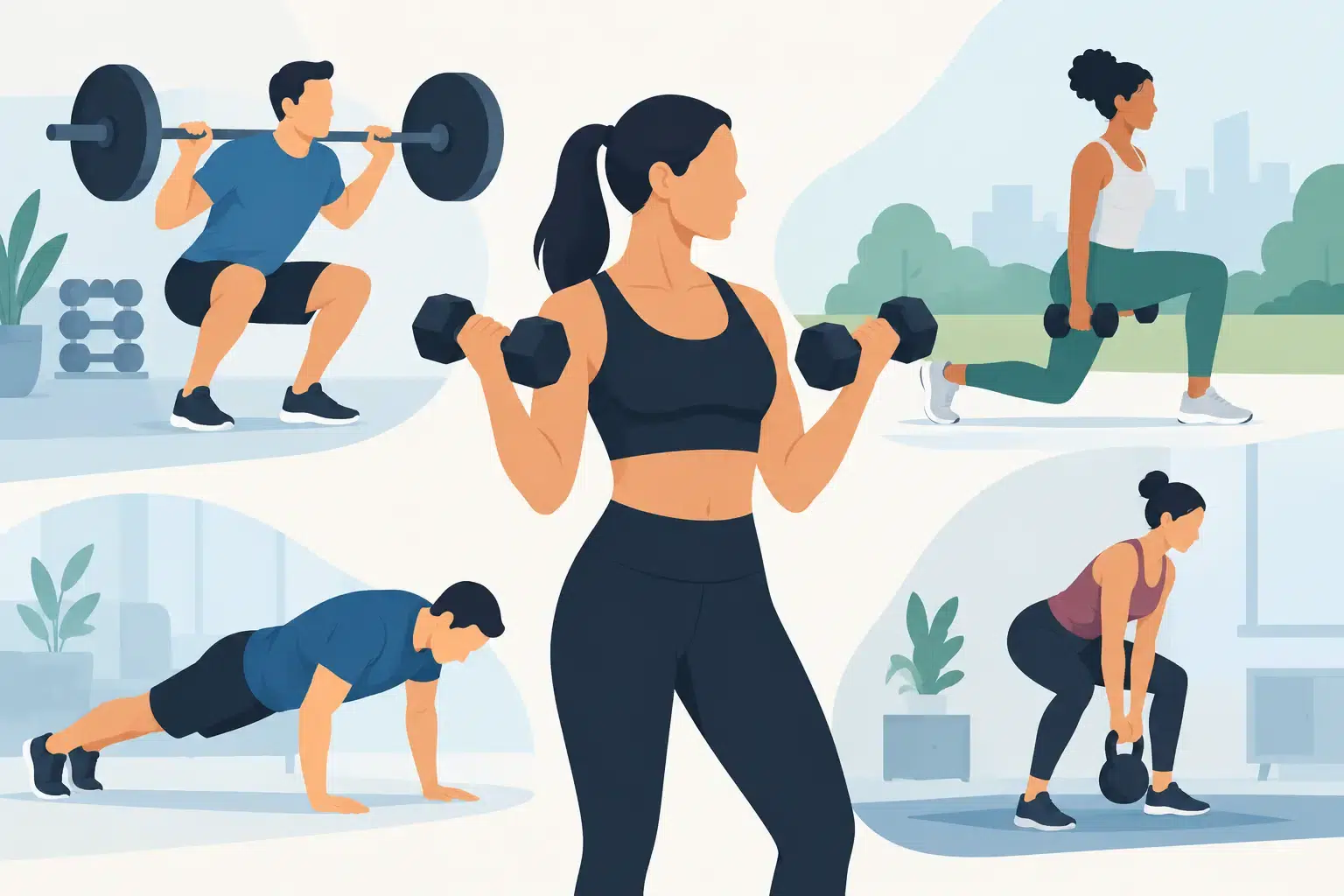
A squat that irritates your knee, a deadlift that leaves your back tight for three days, or a press that pinches your shoulder is not a badge of commitment. It is useful feedback. The best strength training exercises are not simply the most popular lifts in the gym. They are the movements that challenge your body appropriately, build capacity for what you want to do, and can be progressed without repeatedly provoking pain.
For active adults and athletes, strength training should make daily life, recreation, and sport feel more capable. It should help you carry a cooler, play a full round of golf, run with better control, return to the tennis court, or build confidence after an injury. That requires more than copying a workout from social media. It requires choosing the right movement pattern, load, range of motion, and starting point for your body.
What Makes an Exercise Worth Keeping?
A useful strength exercise gives you a clear way to improve. You should be able to add a little weight, perform more high-quality repetitions, use a greater controlled range of motion, or move with better stability over time. If there is no measurable path forward, it is difficult to know whether you are truly getting stronger.
The exercise must also match your current movement capacity. A barbell back squat may be an excellent choice for one person and a poor first option for another person with limited ankle mobility, a painful hip, or a recent lower-body injury. The goal is not to avoid challenging movements. The goal is to earn them through sound mechanics and progressive loading.
Finally, the best choice is one you can perform consistently. A technically demanding lift is only valuable if you have the mobility, coaching, equipment, and recovery resources to perform it well. A simpler variation done consistently will outperform a perfect program that you cannot sustain.
The Best Strength Training Exercises Build Key Patterns
Rather than chasing an endless list of exercises, build your training around fundamental patterns. These patterns cover the strength demands most people need for daily function, injury resilience, and athletic performance.
Squat: Sit, Stand, and Produce Force Through Your Legs
Squatting develops strength in the quadriceps, glutes, and trunk while training the ability to lower and rise with control. Goblet squats are often an effective starting point because the front-loaded position can make it easier to maintain an upright torso and control depth. Bodyweight squats, box squats, split squats, and barbell squats can all have a place depending on your goals.
Depth should be individualized. Squatting deeper is not automatically better if your pelvis tucks under, your heels rise, or pain increases. Use the deepest range you can control comfortably, then work to improve mobility and strength from there.
Hinge: Build Strong Hips and a Resilient Back
The hinge pattern emphasizes the glutes and hamstrings while teaching you to manage load through the hips instead of repeatedly bending through the low back. Romanian deadlifts, kettlebell deadlifts, trap-bar deadlifts, and hip thrusts are all strong options.
A good hinge does not mean keeping the spine rigid at all costs. It means controlling the relationship between your rib cage, pelvis, and hips while creating tension through the lower body. For someone rebuilding after back pain, an elevated kettlebell deadlift may be a more appropriate first step than pulling a barbell from the floor.
Single-Leg Training: Improve Control Where Life Demands It
Walking, climbing stairs, running, changing direction, and stepping off a curb all require you to control your body on one leg. Split squats, reverse lunges, step-ups, and single-leg Romanian deadlifts expose side-to-side differences that a bilateral exercise can hide.
Single-leg work is not just for athletes. It can improve balance, hip control, and confidence for adults returning to activity after an injury. Start with support when needed. Holding onto a rack or wall is not cheating if it allows you to load the legs more effectively and move with better control.
Horizontal Push and Pull: Train the Upper Body Without Ignoring the Shoulder
Push-ups, dumbbell bench presses, and machine chest presses train horizontal pushing. Rows, cable rows, and chest-supported dumbbell rows train horizontal pulling. These movements should be trained together, not because every workout needs exact symmetry, but because the shoulder benefits from a well-rounded program that develops the chest, upper back, arms, and trunk.
If pressing causes shoulder discomfort, changing grip, angle, range of motion, or load can make a major difference. An incline push-up or neutral-grip dumbbell press may allow productive training while you address the movement or tissue limitations contributing to symptoms.
Vertical Push and Pull: Build Overhead Capacity Gradually
Overhead pressing and pulling matter for athletes, workers, swimmers, tennis players, and anyone who wants to maintain capable shoulders. Dumbbell overhead presses, landmine presses, pulldowns, and assisted pull-ups are practical options.
Not everyone needs to press a heavy barbell directly overhead. If shoulder mobility, thoracic motion, or trunk control is limited, a landmine press provides an angled path that is often more tolerable. The right variation lets you train strength without forcing a painful position.
Carries: Turn Strength Into Whole-Body Control
Loaded carries are among the most practical exercises available. Farmer carries, suitcase carries, and front-rack carries build grip strength, trunk stability, shoulder control, and gait mechanics while teaching your body to resist unwanted movement.
Carries are especially valuable because they look like real life. You are moving under load, controlling your posture, and coordinating your entire body. A suitcase carry, with weight held on one side, can be an excellent way to challenge lateral trunk control without excessive spinal motion.
How to Choose the Right Starting Variation
Your exercise selection should be guided by your goal, your movement assessment, and your symptom response. A runner may need more single-leg strength and calf capacity. A golfer may benefit from hip strength, rotational control, and the ability to generate force without irritating the low back. A person returning from pelvic health concerns may need a more deliberate approach to breathing, pressure management, and load progression.
Use these questions to guide your choices:
- Can you perform the movement with control through a useful range of motion?
- Does it produce pain during the exercise or a meaningful symptom flare afterward?
- Can you maintain breathing and trunk control as the load increases?
- Does the exercise support a specific activity, sport, or functional goal?
- Is there a clear way to progress it over the next several weeks?
Pain is not always a simple stop signal, but it should never be ignored. Mild discomfort that remains stable and resolves quickly may be manageable in some cases. Sharp pain, increasing pain, numbness, weakness, joint instability, or symptoms that worsen for days after training warrant a more careful evaluation.
Progression Is What Turns Exercise Into Training
The exercise itself is only the starting point. Strength improves when the challenge gradually exceeds what your body is used to, while recovery remains adequate. You can progress by adding load, repetitions, sets, range of motion, time under tension, or complexity. Change one variable at a time so you can clearly see how your body responds.
For many active adults, two to three full-body strength sessions per week is enough to create meaningful results. Begin with sets that leave a few quality repetitions in reserve rather than pushing every set to failure. This creates room to practice technique, recover well, and train consistently.
Quality matters more than exhaustion. If your form falls apart on the final repetitions, the load may be too heavy for the goal of that session. Train hard, but make each repetition look like the one before it.
When an Assessment Makes the Difference
Recurring pain, uneven strength, repeated injuries, or a plateau after rehab are signs that a generic exercise list may not be enough. The movement that hurts is not always the true source of the problem. A painful knee may be influenced by hip control, ankle mobility, training volume, or how you load the foot. A stiff shoulder may be affected by thoracic motion, rib position, or poor control under fatigue.
At Back In Motion, the goal is to identify those limiting factors and build a progression that connects rehabilitation to real strength and performance. That may mean modifying an exercise temporarily, improving mobility where it is actually needed, and then reintroducing load with a clear plan.
The right exercise should leave you feeling more capable, not more uncertain. Build around the patterns you need, choose variations that respect your current capacity, and give yourself enough time to progress. Stronger movement is earned one well-executed repetition at a time.
About the Author: Dr. Scott Gray




 Call (239) 788-0838