
3 Reasons Why Squatting Hurts Your Knees
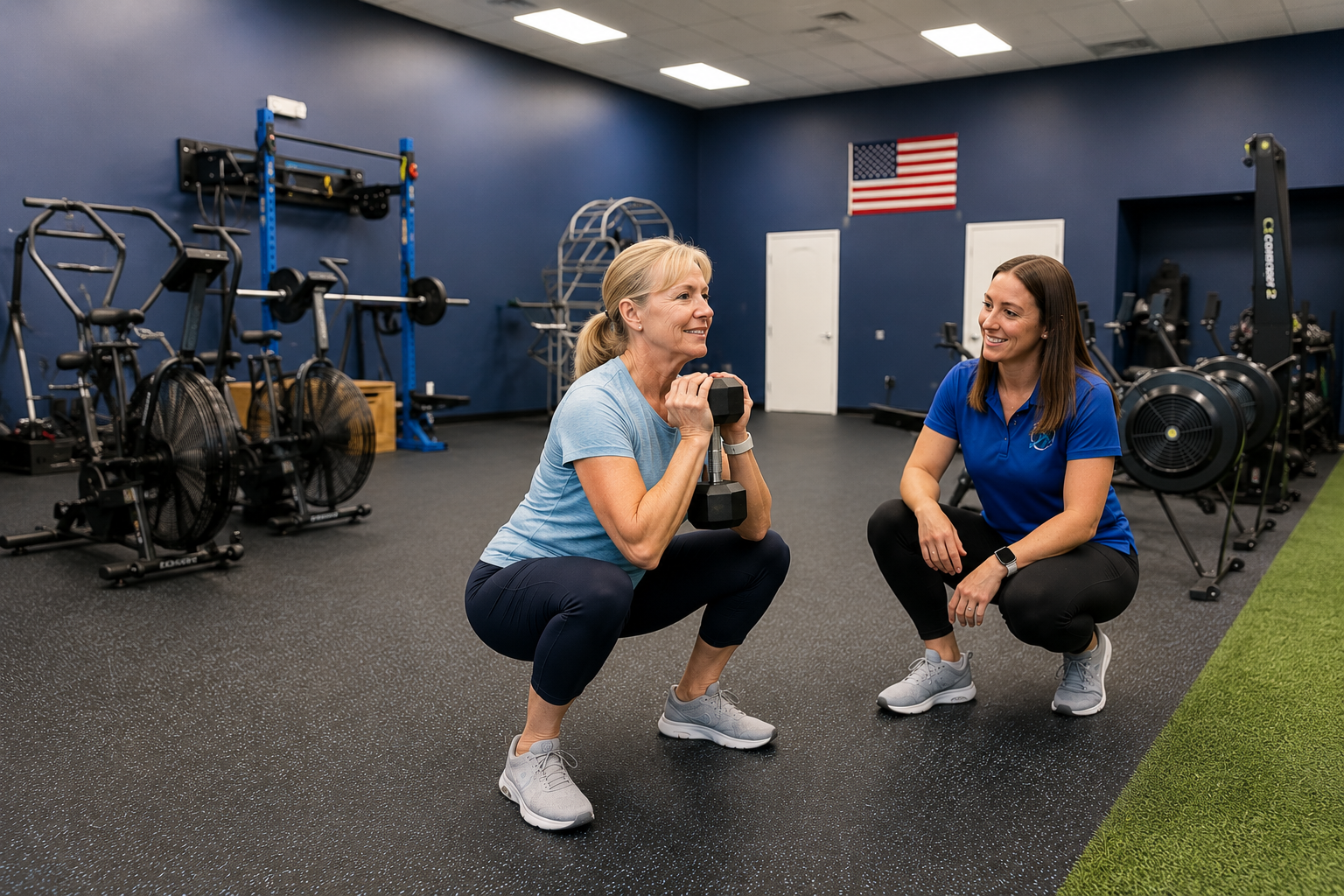
Few things are more frustrating than feeling strong and motivated to exercise, only to have knee pain show up every time you squat.
Whether you’re trying to stay active, improve your fitness, or simply keep up with your daily activities, knee pain during squats can make you feel like you’re constantly taking a step backward.
The good news? Knee pain during squatting doesn’t automatically mean your knees are damaged. In many cases, the source of the problem lies elsewhere.
Here are three common reasons squatting hurts your knees—and what you can do about it.
1. Your Hips Aren’t Doing Their Job
Your knees are caught between two major joints: your hips and your ankles. When the hips lack strength or control, the knees often absorb forces they weren’t designed to handle alone.
This is especially common when the muscles around the hips and glutes aren’t effectively stabilizing the body during movement.
Signs this may be your issue:
- Your knees collapse inward during squats
- You struggle to maintain balance
- You feel weakness in your hips or glutes
The solution isn’t necessarily to stop squatting. Often, improving hip strength and movement control can significantly reduce stress on the knees.
2. Your Ankles Don’t Move Well
Many people are surprised to learn that ankle mobility plays a major role in squat mechanics.
When your ankles can’t bend and move properly, your body has to compensate somewhere else. Frequently, that compensation occurs at the knees.
Limited ankle mobility can cause:
- Excessive pressure through the knees
- Difficulty reaching proper squat depth
- Poor movement mechanics
If you’ve spent years sitting at a desk, wearing stiff footwear, or recovering from previous ankle injuries, restricted mobility may be contributing to your knee discomfort.
3. You’ve Lost Capacity, Not Capability
This is one of the most overlooked reasons for knee pain.
Many people assume that pain means their knees are “bad.” In reality, the issue is often that the tissues haven’t been exposed to the demands being placed on them.
Think about it this way: if you haven’t squatted regularly for months or years, jumping back into deep squats, heavy weights, or high-volume workouts can overwhelm tissues that simply aren’t prepared for that load.
Your body may still be capable of squatting—it just needs time to rebuild tolerance and strength.
This is why gradual progression is so important.
The Bottom Line
If squatting hurts your knees, don’t automatically assume you need to stop squatting forever.
Pain is often a signal that something needs attention, not a sign that movement itself is the problem.
The key is identifying what’s driving the discomfort and creating a plan to address it. For some people, that’s improving hip strength. For others, it’s restoring ankle mobility. And for many, it’s gradually rebuilding their capacity to handle load.
The goal isn’t to avoid movement.
The goal is to move with confidence again.
If you’ve been modifying workouts, skipping exercises, or avoiding activities because of knee pain, a movement assessment can help uncover what’s really limiting you and provide a clear path forward.
About the Author: Dr. Scott Gray




 Call (239) 788-0838