
Best Exercises for Stiff Ankles That Actually Help
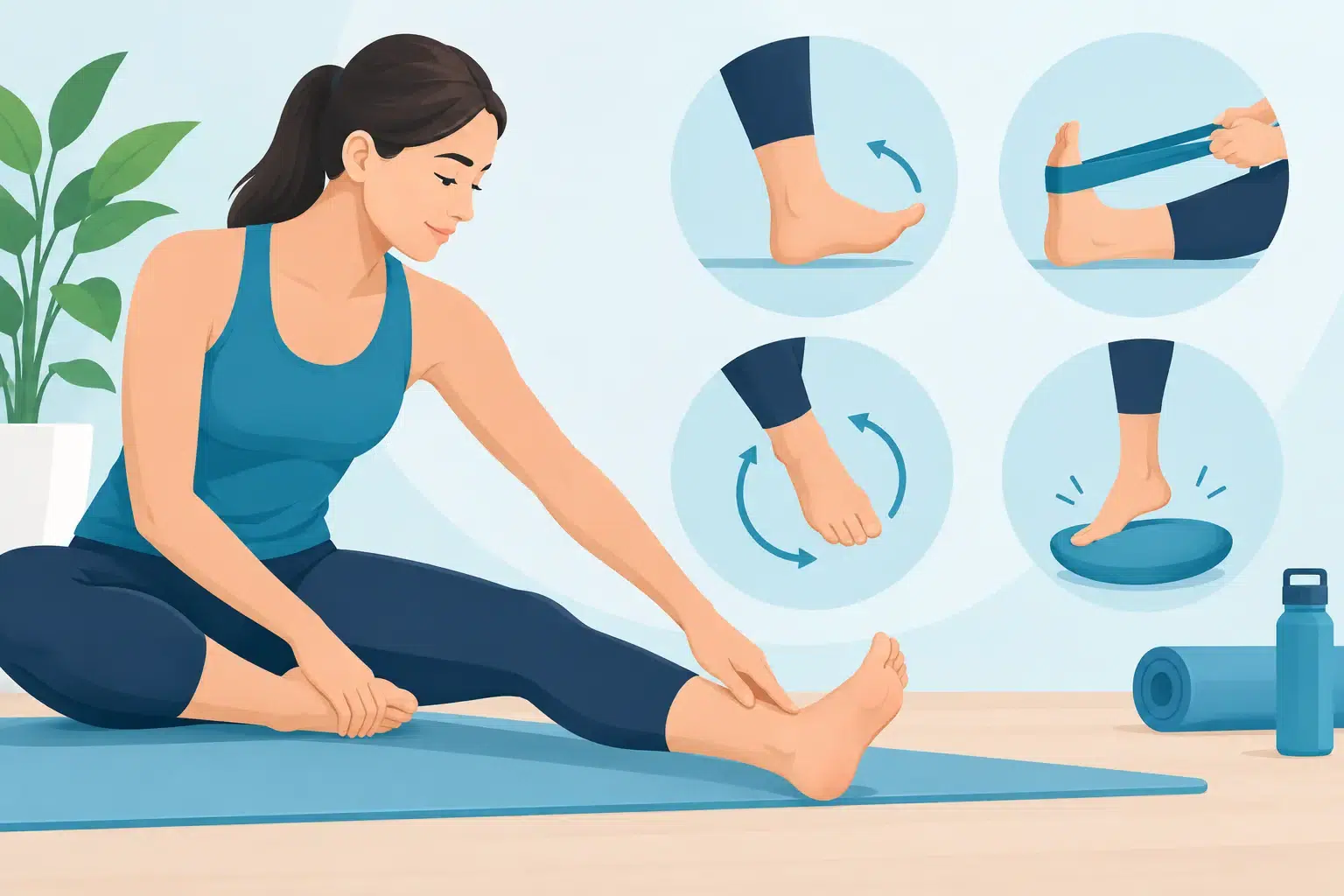
A stiff ankle can show up long before it becomes an obvious injury. Your heels rise early in a squat. One knee caves in when you run or land. Your stride feels shorter on a walk, or your Achilles and plantar fascia keep getting irritated after activity. For active adults and athletes, the best exercises for stiff ankles are not just stretches. They restore the motion you need, then teach you to control and use it under load.
The ankle is not a simple hinge. Limited movement at the foot, ankle joint, calf, or even the hip can change how force travels through your body. That is why repeatedly stretching a tight calf may bring temporary relief without changing the movement pattern that keeps the problem going.
A productive plan starts by identifying what is actually stiff, what is weak, and which positions trigger symptoms. Then it progresses from mobility to strength, balance, and sport-specific movement.
Why ankle stiffness changes the way you move
Most people describe ankle stiffness when they lack dorsiflexion, the ability to bring the knee forward over the toes while the heel stays down. You need this motion to descend stairs, squat, absorb a landing, walk uphill, and change direction.
When dorsiflexion is limited, the body finds another option. The foot may collapse inward, the heel may lift, the knee may drift in, or the low back may round during a squat. None of these compensations are automatically harmful, but they can overload tissues when they become your default strategy.
Stiffness can come from a previous ankle sprain, a period in a walking boot, calf tightness, joint irritation, swelling, foot mechanics, or training that outpaced recovery. If one ankle is noticeably different from the other, or symptoms began after an injury, guessing is rarely the fastest route forward.
Best exercises for stiff ankles: a progression that works
Use these exercises in a pain-aware range. A mild stretch or muscular effort is expected. Sharp pain, catching, instability, or swelling that worsens after exercise is not. Start with the first two movements daily, then add the strength work two to three days per week.
1. Knee-to-wall ankle mobilization
This is one of the clearest ways to train dorsiflexion while keeping the heel grounded. Face a wall in a split stance with the affected foot in front. Place your big toe a few inches from the wall, then drive the front knee toward the wall without allowing the heel to lift or the arch to collapse.
Tap the wall lightly, return to the start, and repeat for two to three sets of 10 to 15 controlled repetitions. If you cannot reach the wall, move closer. If you can reach it easily without the heel rising, move the foot back slightly.
Keep the knee traveling in line with the second and third toes. Do not force the knee far inward just to create more range. The goal is usable ankle motion, not a number on a tape measure.
2. Bent-knee calf stretch
The straight-knee calf stretch gets most of the attention, but the bent-knee version matters just as much. Bending the knee places more emphasis on the soleus, a deeper calf muscle that works hard during walking, running, and deceleration.
Stand facing a wall with one foot behind you. Keep the back heel down, bend both knees, and gently shift your body forward until you feel a stretch low in the calf or near the Achilles. Hold for 30 to 45 seconds and complete two to three rounds per side.
This should feel like a sustained stretch, not an aggressive pull at the Achilles. If the tendon itself is painful, reduce the depth and prioritize a professional assessment before loading it heavily.
3. Supported loaded ankle rocks
Mobility lasts when your body learns to own it. Place the front foot on a low step, weight plate, or folded towel so the heel can stay grounded while the knee moves forward. Hold onto a rack, countertop, or wall for balance. Slowly shift your weight over the front foot, pause for two seconds near your end range, then return.
Perform two or three sets of eight to 12 repetitions. This variation adds body weight to the pattern without turning it into a high-intensity exercise. It is especially useful before squats, lunges, golf, tennis, or a running session.
If the front of the ankle feels pinched rather than stretched, do not push through it. Pinching can reflect joint irritation, bony restriction, or a movement strategy that needs more individualized attention.
4. Slow eccentric calf raises
An ankle that moves well but cannot control force will often become stiff again after activity. Calf raises build the strength and tendon capacity needed to use your new range.
Stand on the edge of a step with both feet. Rise up with both feet, shift more weight to the affected side, and lower slowly for three to four seconds. Use the other foot to help you return to the top. Complete three sets of six to 10 repetitions.
Start on flat ground if a step is too demanding. As strength improves, progress toward single-leg raises with a full, controlled range. Do not rush this exercise. The slow lowering phase is where much of the benefit occurs.
5. Tibialis raises against a wall
The muscles along the front of the shin help control the foot as it contacts the ground. Building them can improve your ability to clear the foot, control deceleration, and balance the work done by the calves.
Lean your back against a wall with your feet about 8 to 12 inches forward. Keep your heels on the floor and lift your toes as high as possible, then lower them slowly. Aim for two to three sets of 12 to 20 repetitions.
You should feel the front of your shins working. If your feet cramp, reduce the range, slow down, and build gradually.
6. Single-leg balance with a reach
An ankle sprain does more than limit mobility. It can disrupt the ankle’s ability to sense position and react quickly. That is why balance training belongs in a complete ankle program.
Stand on one foot with a soft bend in the knee. Reach the opposite foot forward, slightly to the side, and behind you without letting the standing arch collapse or the knee drift inward. Complete two sets of five to eight reaches in each direction.
This does not need to look dramatic. Quality matters more than how far you can reach. Once it becomes easy, perform it barefoot on a firm surface, add a light weight, or use it as part of your warm-up before sport.
How to fit ankle mobility into your training
For many active people, five to 10 focused minutes is enough to create progress when the right exercises are selected and performed consistently. Use knee-to-wall mobilizations and loaded ankle rocks before lower-body training. Use calf strength and balance work after training or on alternate days.
Do not turn every workout into a mobility session. If you spend 20 minutes stretching but still avoid squatting, stepping down, running, or loading the ankle, the new range may not transfer to the activities you care about. The strongest approach is to restore motion, load it progressively, and practice the movement that previously felt restricted.
For example, a runner may pair ankle mobilization with calf raises and a gradual return to hills. A golfer may need ankle range plus hip rotation and lead-leg stability. A lifter who cannot reach squat depth may need ankle work, but may also need adjustments to stance, hip control, or squat setup.
When stiff ankles need more than exercises
Exercises are highly effective when stiffness is largely related to mobility, strength, and movement control. They are not a substitute for an assessment when symptoms suggest a more significant issue.
Get evaluated if you have persistent swelling, repeated giving way, numbness, a visible change in ankle shape, severe loss of motion after an injury, or pain that does not improve with sensible load management. The same applies if ankle stiffness is driving recurring knee, hip, Achilles, or plantar fascia symptoms.
At Back In Motion Physical Therapy & Performance, the goal is not to hand you a generic ankle sheet and hope it works. A detailed assessment can identify whether the restriction is coming from the joint, calf, foot, old injury, or a compensation farther up the chain. From there, treatment can progress from pain relief and mobility to the strength, power, and confidence your sport or daily life demands.
Your ankle does not need endless stretching. It needs the right amount of motion, the strength to control that motion, and a plan that connects both to the way you actually move. Start with precision, stay consistent, and let your progress show up where it matters most: in the squat, on the trail, on the court, and in everyday life.
About the Author: Dr. Scott Gray




 Call (239) 788-0838