
A Guide to Movement-Based Rehab That Lasts
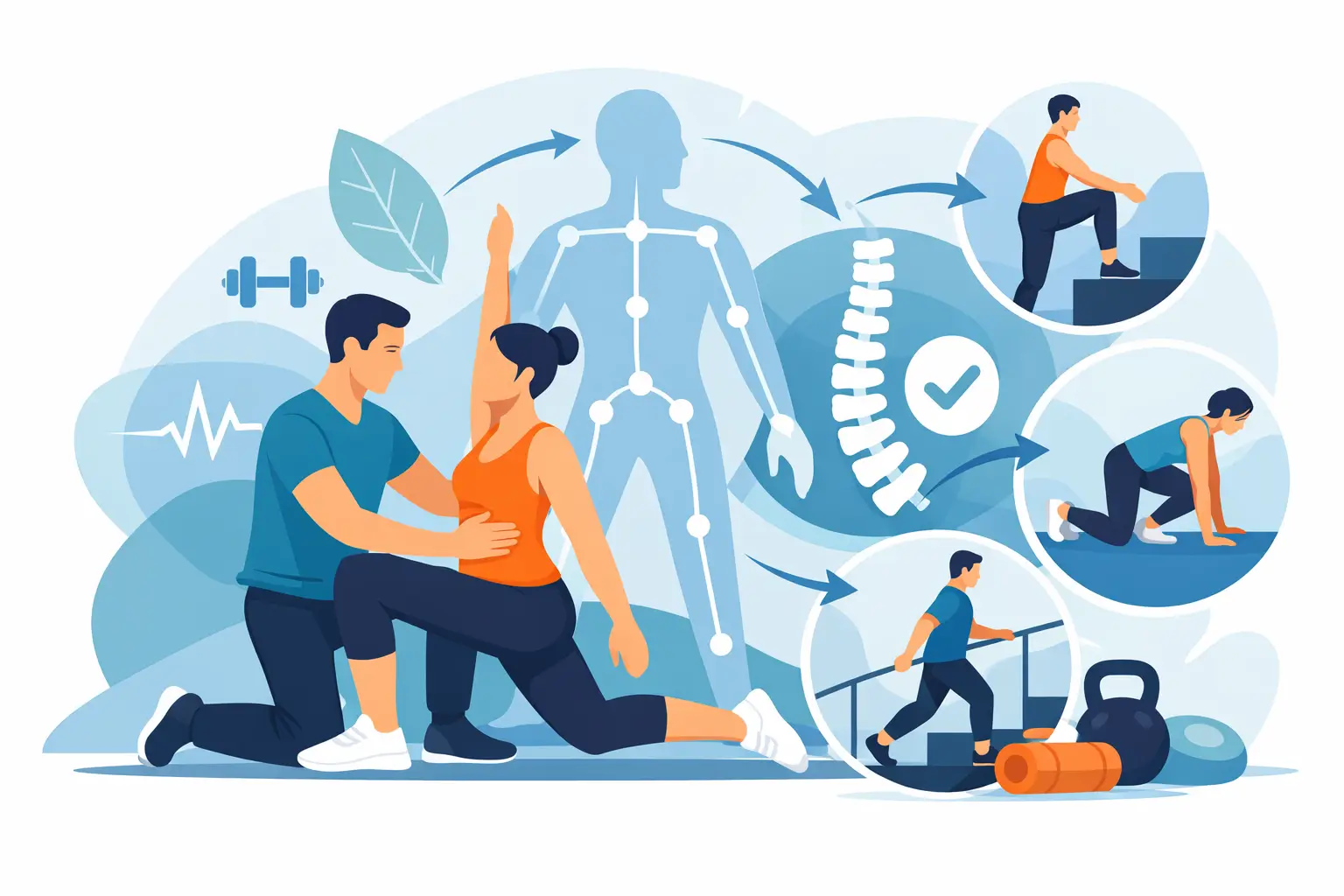
Your back may feel fine walking through the grocery store, then tighten the moment you pick up a golf bag. Your knee may tolerate a casual walk but complain after three miles of running. Those details are not random. They are clues about how your body responds to load, position, speed, and fatigue.
This guide to movement based rehab explains why effective recovery requires more than treating the area that hurts. It is a process of identifying the movement problem, restoring the capacity your body needs, and progressively returning you to the activities that matter – whether that is lifting, tennis, running, golf, playing with your kids, or training without hesitation.
What Movement-Based Rehab Actually Means
Movement-based rehabilitation uses purposeful movement as both an assessment tool and a treatment tool. Instead of relying on passive care alone, your physical therapist looks at how you squat, hinge, walk, reach, rotate, balance, breathe, and perform the specific tasks that bring on your symptoms.
Pain matters, but it is not the entire diagnosis. A painful shoulder may involve limited upper-back motion, poor shoulder-blade control, an overloaded training schedule, or a technique issue when pressing overhead. Knee pain may be influenced by hip strength, ankle mobility, running volume, or the way you absorb force when changing direction. The goal is not to chase every possible imperfection. It is to identify the limitations that are meaningful for you.
Movement-based rehab also recognizes that feeling better and being prepared are different outcomes. Symptoms may improve before your tissues and movement patterns can handle a full tennis match, a heavy deadlift, or a long run. A complete plan closes that gap with progressive strength, coordination, and sport- or activity-specific loading.
Why Passive Treatment Alone Often Falls Short
Hands-on treatment, dry needling, soft-tissue work, and other symptom-relief strategies can have a place in care. They may reduce pain enough for you to move more comfortably or make an exercise easier to perform. But they do not automatically teach your body how to tolerate the task that caused the problem.
If your low back hurts every time you lift a cooler, temporary relief is useful, but it is not the finish line. You still need to rebuild the ability to hinge, brace, carry, and manage load. If your pelvic symptoms are aggravated by exercise, the answer may not be to stop exercising indefinitely. The right approach may include breathing mechanics, pelvic floor coordination, trunk control, and a gradual return to strength training based on your symptoms and goals.
Passive care can be part of a plan. It becomes a limitation when it replaces the plan.
The First Step: A Precise Movement Assessment
A strong rehab plan begins with more than asking where it hurts. Your provider should learn when symptoms started, what makes them worse or better, your training history, prior injuries, daily demands, and the exact goal you want to return to.
Then comes the movement assessment. Depending on your needs, this may include walking and running mechanics, squat and hinge patterns, single-leg control, joint mobility, strength testing, balance, breathing, and task-specific tests. A golfer may need rotational assessment and hip mobility. A runner may need gait analysis, calf capacity testing, and a review of training volume. Someone recovering from a shoulder injury may need to be assessed through pressing, pulling, carrying, and overhead reach.
The best assessment is not a performance contest. You do not need to impress anyone. You need a clear baseline: what you can do now, what triggers symptoms, what your body avoids, and what capacity must improve to get you back to your life.
Find the Driver, Not Just the Symptom
The area of pain is not always the source of the problem. That does not mean every injury has one hidden cause or that posture is solely to blame. Human movement is more complex than that. It does mean recurring pain deserves a closer look at the full system.
At Back In Motion, this root-cause approach is central to The Gray Method™. The process connects dysfunction, correction, and progression rather than treating pain as an isolated event. For an active adult who has tried rest, generic stretches, or short-term treatment without lasting change, that structure can remove a great deal of uncertainty.
How Movement-Based Rehab Progresses
Rehab should change as your body changes. Early care may focus on reducing irritability, restoring comfortable range of motion, and finding movements you can perform without a symptom flare. That is not the time to force a deep squat or return to full-speed sprints simply because you miss training.
As symptoms settle, the work becomes more demanding. You may build strength through controlled ranges, improve single-leg stability, practice rotation, or increase endurance in the muscles that support your movement. The exercises should connect to the demands ahead. A runner needs more than a pain-free leg raise. They need enough calf, hip, and trunk capacity to repeatedly accept force with every stride.
Later-stage rehab introduces the realities of your goal: speed, power, reaction, heavier loads, repeated efforts, and fatigue. A tennis player may progress from basic lateral control to quick changes of direction and rotational power. A lifter may move from supported patterns to loaded squats, deadlifts, and carries. The exercise selection varies, but the principle stays the same: earn the next level of demand.
Progress Is Measured, Not Guessed
A plan should give you concrete ways to see improvement. Pain ratings can be helpful, but they are only one measure. Your therapist may also track range of motion, strength, repetitions, load tolerance, running distance, jump quality, balance, or your confidence with a previously painful task.
This matters because recovery is rarely perfectly linear. A busy work week, poor sleep, an extra round of golf, or a sudden jump in training can create a temporary flare. A flare does not always mean you are back at square one. It may mean the current dose exceeded your capacity. Measured progress helps you adjust intelligently instead of quitting activity or pushing through a problem blindly.
What You Should Expect From Your Program
A movement-based plan should be individualized, specific, and realistic enough to follow. You should understand what each exercise is intended to improve and how it relates to your goal. If you are given an extensive list of exercises but no explanation, no progression, and no reassessment, the program may be missing the structure that produces lasting results.
Your home program should also fit your real life. A high school athlete may have practices, games, and school demands. A Fort Myers professional may be balancing work, family, and limited training time. More exercises are not automatically better. The right dose performed consistently is more valuable than a complicated program that never leaves the paper.
Communication is equally important. Tell your provider what you are actually doing between visits, what movements feel threatening, and what goals matter most. A plan for returning to a 5K should look different from a plan for getting through eight hours on your feet at work, even if both people report the same type of knee pain.
Common Mistakes That Delay Recovery
The most common mistake is resting until pain disappears, then returning immediately to the same workload that caused the issue. Rest can calm symptoms, but it does not necessarily rebuild tolerance. The opposite mistake is treating pain as something to defeat by pushing harder. Some discomfort during rehab can be acceptable, but sharp pain, worsening symptoms, loss of function, or symptoms that linger significantly after activity are signs the plan may need adjustment.
Another problem is following generic social-media exercises without an assessment. Mobility drills and strengthening exercises are not inherently bad, but the right exercise at the wrong time, dosage, or technique can waste valuable weeks. Your body does not need a random collection of “best” exercises. It needs a sequence that matches your current capacity.
Finally, do not stop at pain relief if your goal is an active life. If you want to play pickleball, train in the gym, run races, or compete, rehab needs to prepare you for those demands. Returning to activity is not the same as returning ready.
Movement Is the Bridge Back to Confidence
The purpose of movement-based rehab is not to make you dependent on treatment. It is to give you a clearer understanding of your body, a stronger foundation, and a practical path forward when life or training challenges you again.
The next useful step is simple: identify the movement you have been avoiding, then get an assessment that explains why it is difficult and what it will take to rebuild it. Pain may have changed your routine, but a precise progression can help you move with confidence again.
About the Author: Dr. Scott Gray




 Call (239) 788-0838