
Your Guide to Corrective Exercise Training
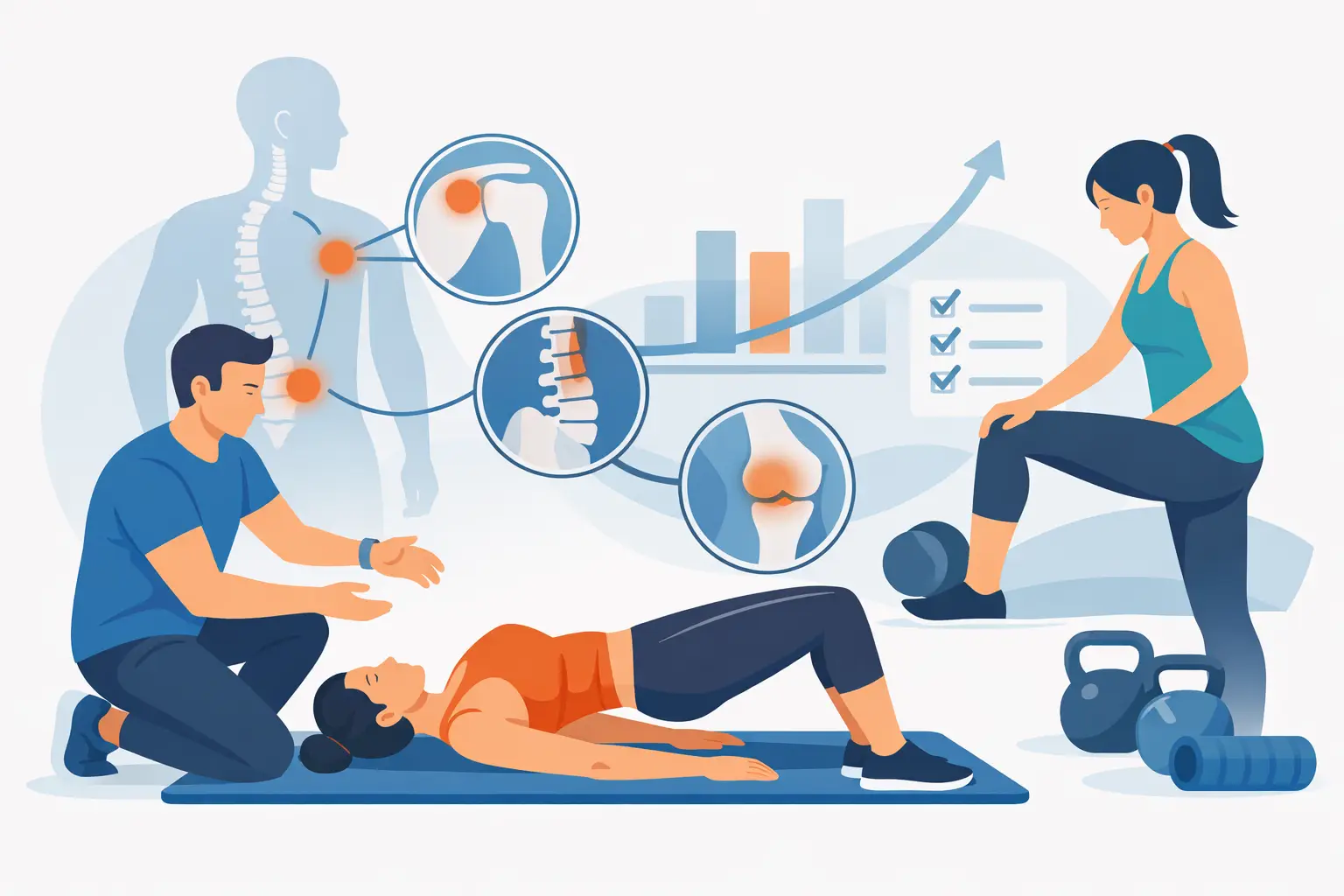
A squat that pinches in the front of your hip, a shoulder that aches after tennis, or low back tightness that returns every time you train is not always a sign that you need to stop moving. It is often a sign that your body needs a more precise plan. This guide to corrective exercise training explains how targeted movement work can identify limiting factors, improve control, and build a stronger return to the activities you enjoy.
Corrective exercise is not a collection of random stretches, foam rolling, or balance drills pulled from social media. When done well, it is a structured process: assess how you move, identify what is driving the problem, address the limitation, and progressively load the body so the improvement holds up in real life.
What corrective exercise training actually does
Corrective exercise training uses specific mobility, stability, motor-control, and strength exercises to improve the way a person moves. The goal is not to chase perfect posture or make every side of the body look identical. The goal is to improve the movement options and capacity you need for your sport, job, training, and daily life.
For example, a runner with recurring knee pain may have limited ankle motion, poor single-leg control, a training-volume problem, or a combination of all three. A golfer with low back pain may be rotating through the lumbar spine because the hips or upper back are not contributing enough. The painful area matters, but it is not automatically the source of the problem.
That distinction changes the plan. Rather than repeatedly treating symptoms, a quality corrective exercise program looks upstream and asks why the body is compensating in the first place.
Who benefits from corrective exercise training?
Active adults and athletes are often the best candidates because they have a clear goal: return to lifting, running, golf, tennis, pickleball, work, or simply moving through the day without guarding every step. Corrective exercise can also help people who have finished traditional physical therapy but do not yet feel ready to return to full training.
It is especially useful when you are dealing with recurring aches, stiffness that changes your form, weakness after an injury, poor balance, or a plateau that persists despite working hard. It can also be valuable after pregnancy, during pelvic health rehabilitation, or when rebuilding confidence with lifting and impact activities.
There are limits. New traumatic injuries, rapidly worsening pain, unexplained numbness or weakness, fever, loss of bowel or bladder control, or significant swelling need medical evaluation first. Corrective exercise is not a replacement for a diagnosis when one is necessary. It is the active bridge between identifying a problem and returning to capable movement.
The assessment comes before the exercise
The most common mistake in corrective training is starting with an exercise instead of an assessment. A hip mobility drill may help one person and irritate another. A deep squat progression may be appropriate for a lifter but unnecessary for a golfer whose primary limitation shows up during rotation.
An effective assessment begins with your history. When did symptoms start? What activities provoke them? What have you already tried? What does your weekly training load look like? These answers matter because pain and movement limitations are shaped by more than one tight muscle.
Next comes movement testing. Depending on your goals, this may include walking, squatting, hinging, stepping, reaching, rotating, single-leg control, overhead movement, running mechanics, or sport-specific patterns. The clinician or coach is looking for how you create motion, where you avoid motion, and whether you can control the positions required by your activity.
At Back In Motion, this assessment-to-progression approach is central to The Gray Method™. The purpose is not to label your body as broken. It is to create a clear starting point and a plan that is specific enough to produce measurable change.
The four parts of a corrective exercise program
A well-designed program usually includes four connected elements. The order can change based on your presentation, but skipping directly to harder exercises often leaves the underlying limitation in place.
1. Restore the motion you need
Mobility work targets joints and tissues that are limiting useful movement. This might include ankle dorsiflexion for squatting, thoracic rotation for an overhead athlete, hip extension for running, or rib and pelvic movement for breathing and trunk control.
Mobility is not about forcing more range at all costs. Some people already have plenty of motion but lack control at the end range. Others need to improve range before loading a pattern. The right dose depends on what the assessment finds.
2. Build control in that range
Once a movement is available, the next question is whether you can own it. Motor-control exercises help teach the nervous system to coordinate a new strategy without relying on the old compensation.
This may look simple at first: controlled hip hinges, supported single-leg work, dead bug variations, scapular control drills, or slow step-downs. Simple does not mean easy. The goal is precision, appropriate effort, and repetition without pain or loss of position.
3. Add meaningful strength
Corrective exercise that never progresses beyond light bands and floor drills has limited value for someone who wants to lift, sprint, carry a child, or play a full match. Strength is what makes improved movement durable.
The progression might move from a supported split squat to a loaded split squat, from a basic row to heavier pulling, or from controlled landing drills to hopping and cutting. The exercise selection matters, but dosage matters just as much. Load, volume, tempo, range of motion, and recovery all need to match your current capacity.
4. Return to the demands that matter
The final phase is specific. A runner needs tolerance for repeated impact. A tennis player needs acceleration, deceleration, rotation, and overhead control. A recreational lifter needs confidence under load. Someone returning after pelvic health symptoms may need a graded approach to breathing, pressure management, impact, and strength.
This is where corrective exercise becomes performance training. You do not earn a return to activity because an exercise looks clean in the clinic. You earn it by demonstrating that your body can handle the actual demands of your life.
How to know if your program is working
Progress should be more than “it felt good after the session.” Short-term relief can be useful, but it is not the only marker. Look for changes that matter: less pain during a specific activity, improved range of motion, better balance, increased load tolerance, reduced next-day soreness, or a return to an activity you previously avoided.
Track one or two relevant measures from the start. If knee pain appears after 10 minutes of running, the goal may be to gradually increase pain-free running tolerance. If a shoulder limits your serve, track range, strength, and your response to practice volume. Clear measures keep the plan honest.
Pain does not always need to be zero before you move forward, but it should be understood and monitored. Mild, temporary symptoms that settle quickly may be acceptable in some rehabilitation plans. Sharp pain, escalating symptoms, altered mechanics, or soreness that lingers and worsens are signs to adjust the dose.
Common mistakes that slow recovery
One mistake is treating every limitation as tightness. More stretching is not always better, especially when the real issue is instability, poor load management, or a lack of strength. Another is changing too many variables at once. If you add new drills, increase lifting volume, start running, and play three rounds of golf in the same week, it becomes hard to tell what your body is responding to.
Consistency also matters more than novelty. A focused program performed correctly for several weeks usually outperforms a constantly changing routine. As your capacity improves, however, the program should evolve. The point is not to do corrective drills forever. The point is to need fewer restrictions and tolerate more of what you want to do.
A smarter way to return to training
Corrective exercise training works best when it is integrated into your larger training plan rather than treated as a separate chore. Early on, that may mean a short daily mobility and control routine plus modified strength work. Later, the corrective elements become part of your warm-up, movement preparation, and strength programming while the focus shifts toward performance.
The right plan should give you answers, not more uncertainty. You should know what is being addressed, why each exercise is included, what progress looks like, and when you can expect the next progression. That clarity turns rehabilitation from a passive waiting period into purposeful training.
Your body is not asking for a generic fix. It is asking for the right challenge at the right time. Start with a precise assessment, build capacity one layer at a time, and let stronger movement carry you back to the activities that make you feel like yourself.
About the Author: Dr. Scott Gray




 Call (239) 223-0484
