
How to Train With Back Pain Safely
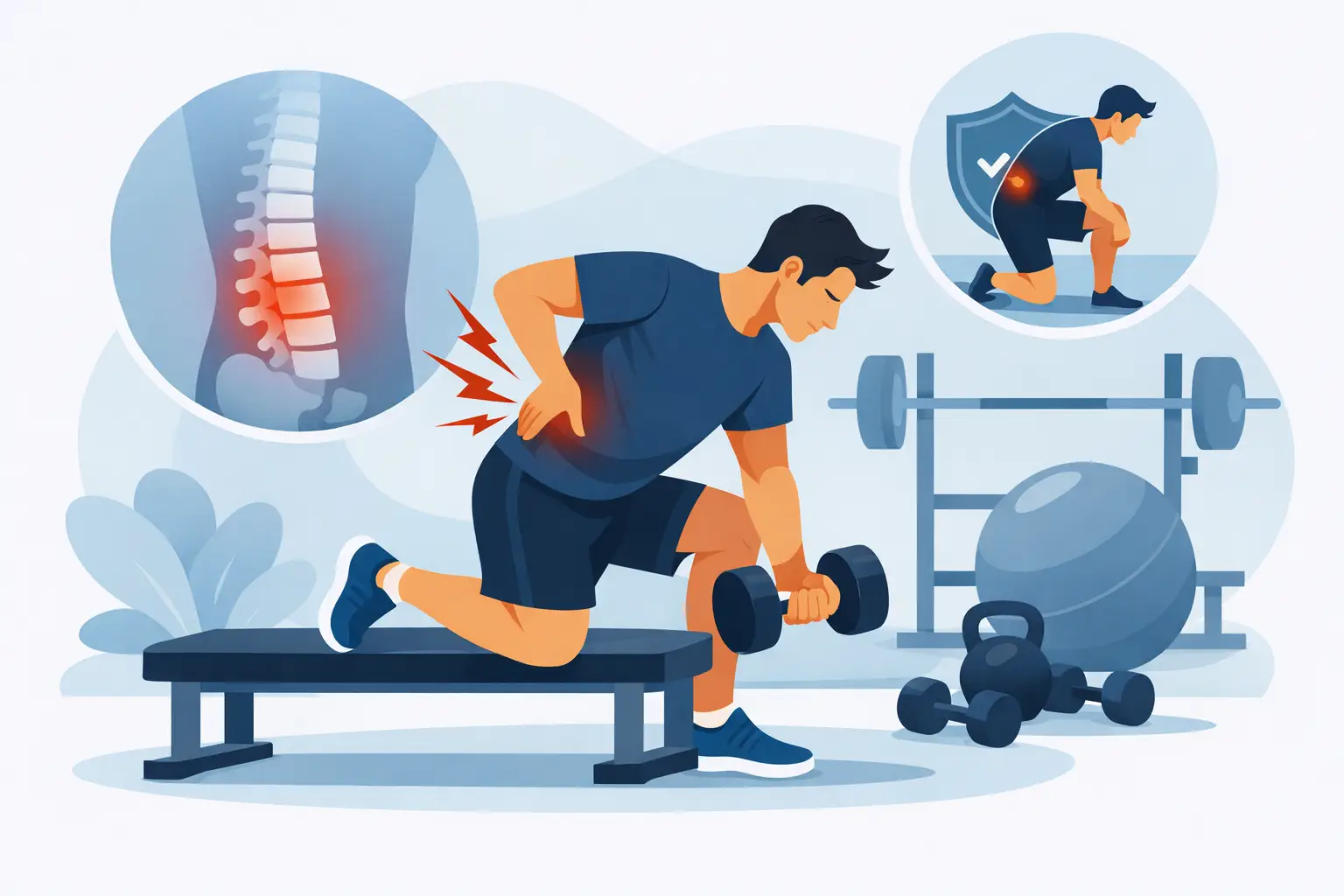
The worst advice active people hear after back pain starts is, “Just stop working out for a while.” Rest can calm things down for a few days, but complete shutdown usually creates a second problem: you get stiffer, weaker, and less confident. If you want to know how to train with back pain, the goal is not to choose between pushing through pain or doing nothing. The goal is to train in a way that reduces irritation, restores movement, and builds capacity.
That distinction matters. Back pain is common, but it is not all the same. Some people hurt most when they bend. Others flare up with extension, rotation, heavy loading, impact, or long periods of sitting. A training plan that helps one person can aggravate another. That is why generic advice often fails active adults and athletes. Good training decisions start with identifying what your back currently tolerates, what it does not, and how to progress from there.
How to train with back pain without making it worse
The first shift is mental. Pain does not automatically mean damage, and discomfort during training does not automatically mean you are causing harm. But pain is still useful information. It tells you that your current combination of movement, load, volume, speed, or fatigue is more than your system can handle right now.
A better approach is to treat training variables like adjustable dials. If barbell deadlifts are flaring your back, that does not always mean hinging is off-limits. It may mean the range is too deep, the load is too high, the tempo is too fast, the setup is poor, or your tissues are too sensitized for that variation today. In many cases, training can continue if the exercise is modified intelligently.
As a general rule, pain during or after exercise should be tolerable and should settle fairly quickly. If pain climbs sharply during a session, changes your mechanics, radiates farther, or leaves you worse for the next 24 to 48 hours, that session was too aggressive. If symptoms stay mild, your movement stays controlled, and you recover well by the next day, you are usually in a workable zone.
Start with your symptom pattern, not your favorite lift
Most people make the mistake of trying to force their normal program onto an irritated back. The smarter move is to build around your presentation.
If flexion bothers you, repeated bending, deep toe-touch positions, sit-ups, and rounded pulling patterns may need to be reduced temporarily. If extension is the trigger, aggressive arching, overhead pressing, prone press-up positions, or high-volume running hills may be the issue. If rotation or impact is the problem, golf swings, rotational med ball work, or jumping drills may need to be scaled.
This is where a thorough movement assessment changes the game. Instead of chasing symptoms, you identify the pattern driving the irritation. At Back In Motion, that root-cause approach is central to how progression is built. The right starting point is not the exercise you miss most. It is the one your body can perform well today without feeding the problem.
Use the “calm it, then build it” model
In the early phase, your job is to reduce sensitivity while staying active. That often means choosing exercises that create support and confidence without provoking the painful pattern. Walking, sled pushes, split squats, hip thrusts, carries, cable rows, and controlled core work are often tolerated better than high-load spinal flexion or extension work.
Once symptoms calm down, the next phase is capacity. This is where many people stop too soon. They feel better, go straight back to heavy training, and the pain returns because the system was never rebuilt. Capacity means restoring range, coordination, trunk control, hip strength, and tolerance to load over time.
The best exercise modifications for training with back pain
There is no universal list of safe exercises, but there are smart substitutions that let you keep training while reducing unnecessary stress.
If conventional deadlifts aggravate your back, trap bar deadlifts from blocks, Romanian deadlifts with a shorter range, cable pull-throughs, or heavy sled work may let you keep the hinge pattern without the same symptom response. If back squats are a problem, front-loaded squats, goblet squats, safety bar squats, or split squat variations may keep leg training productive with less irritation.
Upper body training usually stays in the program, but setup matters. A standing overhead press may bother one person while a half-kneeling landmine press feels strong and controlled. Bench pressing may be fine, or the arch and leg drive may need to be reduced for a period. Even rows can vary widely depending on torso angle and support.
Core training is another area where people often miss the mark. More intensity is not always better. If your back is irritated, repeated spinal bending and aggressive twisting may not be the best place to start. Instead, train the trunk to resist unwanted motion with variations like dead bugs, bird dogs, side planks, carries, and anti-rotation presses. That gives you a foundation to progress toward more dynamic work later.
Respect load, volume, and fatigue
Sometimes the exercise is not the issue. The dose is.
A movement that feels fine for three sets of six can become a problem at five sets of twelve. A lift that is tolerable early in the session can break down when fatigue hits. Running four miles may feel okay, but six miles at a faster pace on tired legs may be what pushes symptoms over the edge.
This is why pain-free movement in a clinic or gym does not always tell the full story. Your back responds to total stress, not just one rep. When training with back pain, adjust one variable at a time so you know what helped and what did not. Lower the load, shorten the range, slow the tempo, reduce session density, or cut a set before you scrap the entire movement.
How to progress when your back starts feeling better
Feeling better is not the finish line. It is the start of progression.
When symptoms improve, earn your way back to higher-demand training rather than jumping there. That usually means moving from supported positions to less supported ones, from slower to faster, from bilateral to unilateral where appropriate, and from lower loads to higher loads as technique holds up.
For example, if hinging was painful, you might progress from hip hinge patterning to kettlebell deadlifts, then to trap bar pulls, then to barbell work from a modified height, and eventually back to full-range pulling if your back tolerates it. The same principle applies to running, rotational sports, and strength training. You do not need a dramatic comeback workout. You need consistency that your body can absorb.
Keep training the rest of your body
One of the best ways to stay physically and mentally on track during a back pain flare is to keep training what is not limited. If your lower back is sensitive to loading, you may still be able to train single-leg strength, upper body pushing and pulling, conditioning, grip, and mobility.
This matters for more than fitness. It keeps your identity intact. Athletes and active adults do poorly when they feel like they have been benched from their own life. A smart plan preserves momentum while the irritated area improves.
When back pain during exercise is a sign to get evaluated
Not all back pain is something you should self-manage indefinitely. If your pain is severe, progressive, associated with numbness or weakness, travels down the leg, disrupts sleep consistently, or is not improving with sensible modifications, get evaluated.
The same applies if you keep having the same flare-up every time you return to lifting, running, golf, tennis, or court sports. Recurring pain usually means something in your movement strategy, mobility, strength profile, or training progression is being missed. You do not need more random stretches. You need a clear explanation for why your back keeps getting overloaded.
That is where individualized rehab and performance planning outperform generic exercise sheets. The right plan should show you what to avoid temporarily, what to train now, what to rebuild next, and how to return to the activities that matter to you without guessing.
Training with back pain is rarely about finding one magic exercise. It is about making precise decisions, building tolerance step by step, and refusing the false choice between inactivity and recklessness. If your plan gives your back a reason to trust movement again, strength usually follows.
About the Author: Dr. Scott Gray


Get Dr. Gray's Best-Selling Book, Free
Why pain keeps coming back, and how The Gray Method™ helps you fix it for good.
Send Me the Free BookOur Most-Read Articles
- 1Three Conditions That Mimic Sciatica PainBack
- 2The Great Plantar Fasciitis Debate: Why Boots & Cortisone Rarely Fix ItFoot
- 3Common Causes of Lower Back Pain: Herniated DiscBack
- 4The 3 Most Common Symptoms of Knee Meniscal TearsKnee
- 5What Is Hip Bursitis?Hip
- 6Pelvic Pain Explained: When It's Not a UTI but Feels Like OnePelvic
What Do You Need Help With?
- 🩺Back, neck & joint pain→
- 💪Fitness for adults 50+→
- 💙Pelvic health→
- ⚡Sports performance→
- ⛳Golf performance→
Talk to a Doctor of Physical Therapy
One-on-one care that finds the cause of your pain. Fort Myers, Cape Coral & Estero.
Inquire About an Appointment Or call (239) 223-0484
