
ACL Return to Sport Testing: What It Proves
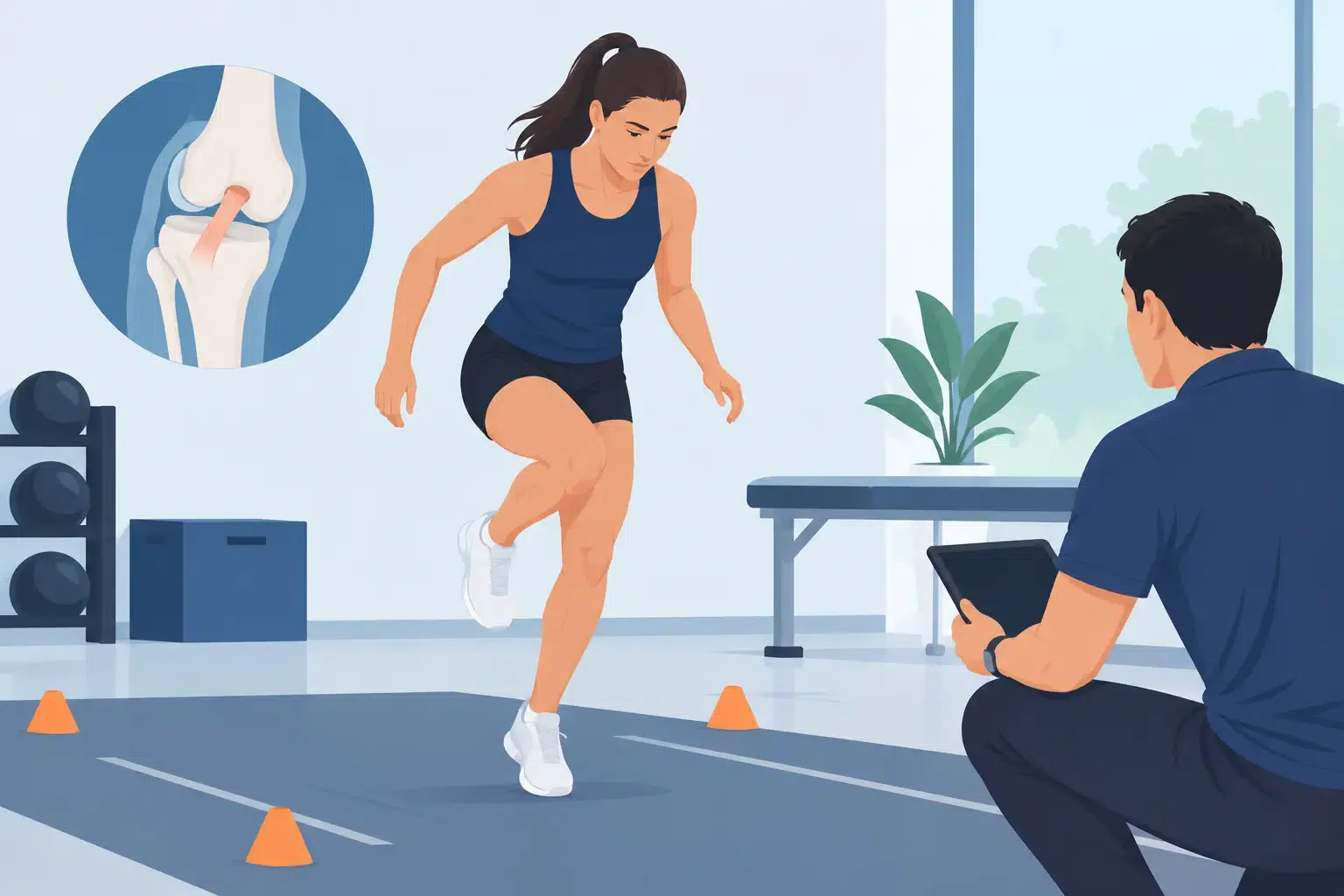
A calendar date cannot tell you whether your knee is ready to cut, land, decelerate, or compete. ACL return to sport testing can. After an ACL reconstruction or significant ACL injury, the goal is not simply to get back on the field, court, course, or running route. The goal is to return with the strength, control, and confidence to handle the demands that caused problems in the first place.
For active adults and athletes, that distinction matters. A knee can feel good during a straight-line jog and still lack the capacity for a hard stop, a single-leg landing, or an unexpected change of direction. Testing replaces guesswork with measurable information, giving your rehab plan a clear next step rather than an arbitrary finish line.
Why time since surgery is not enough
Healing time matters after ACL surgery. The graft, surgical tissues, and surrounding structures need time to recover. But time alone does not rebuild quadriceps strength, restore power, correct compensation patterns, or prepare an athlete for the speed and unpredictability of sport.
Many athletes are told they may return around a certain month after surgery. That can be a useful checkpoint, but it should not be the only criterion. Two people who are nine months post-op can have very different readiness levels. One may demonstrate strong single-leg control, near-symmetrical strength, and efficient landing mechanics. The other may still shift away from the surgical side, avoid loading the knee, or lack the braking capacity needed for cutting.
Returning before those gaps are addressed can increase the chance of a new injury, whether to the same knee or the opposite one. Waiting indefinitely is not the answer either. The right decision comes from combining healing timelines, objective testing, sport demands, symptoms, and the athlete’s movement quality.
What ACL return to sport testing measures
A quality return-to-sport assessment is not one hop test or one strength number. It is a structured look at how your knee and entire body perform under progressively demanding conditions. At Back In Motion, that progression reflects the same principle behind The Gray Method™: identify what is limiting movement, correct it, then build the capacity required for real life and sport.
Strength and side-to-side symmetry
The quadriceps are often the limiting factor after an ACL injury or reconstruction. They help control knee position during landing, absorb force when decelerating, and produce force when sprinting or jumping. If the quadriceps on the involved side remain significantly weaker, athletes often compensate without realizing it.
Testing may compare the strength of one leg to the other, but symmetry is only part of the picture. An athlete can appear symmetrical because both legs are undertrained. Absolute strength also matters. A soccer player, tennis player, or basketball athlete needs enough force capacity for their body size and sport, not merely a passing comparison to the other side.
Hamstring, hip, and calf strength deserve attention as well. The ACL does not operate in isolation. Strong hips help manage femur position, hamstrings contribute to knee control, and the calf complex supports running, jumping, and deceleration.
Single-leg control and landing mechanics
A knee may look stable during a controlled squat but lose position during a fast single-leg task. That is why movement analysis is central to effective ACL return to sport testing. A clinician may assess single-leg squats, step-downs, jumping, landing, hopping, and change-of-direction drills.
The goal is not to chase a perfect-looking rep. It is to see whether you can maintain control as speed, fatigue, and complexity increase. Does the knee collapse inward? Does the pelvis drop or rotate? Do you shift your weight away from the surgical side? Do you land stiffly, quietly, and with control, or does your body avoid force through the knee?
These details help direct treatment. A poor landing is not automatically a sign that someone is unmotivated or “not athletic.” It may reflect a strength deficit, ankle mobility restriction, incomplete motor control, fear of loading, or a mismatch between the drill and the athlete’s current capacity.
Hop, power, and deceleration testing
Hop tests can show how well an athlete produces and absorbs force on one leg. Depending on the person and their goals, testing may include single hops for distance, repeated hops, crossover hops, vertical jumps, or timed hopping drills.
The distance or time matters, but the quality of the movement matters just as much. An athlete who hops far while landing with poor control has not demonstrated full readiness. Likewise, someone who performs well in a simple forward hop may still need more work before reactive cutting or sport-specific drills.
Deceleration is especially valuable because many ACL injuries occur when an athlete plants, slows down, or changes direction. A return-to-sport plan should train and test the ability to absorb force before emphasizing top-end speed. You need to own the brakes before asking the knee to handle aggressive acceleration and cutting.
Confidence and psychological readiness
Fear after an ACL injury is common, even when physical progress is strong. Some athletes hesitate during a cut, hold back on a jump, or avoid contact because they do not trust the knee yet. That hesitation can change movement mechanics and make returning feel uncertain.
Confidence should not be forced with motivational talk alone. It is built through repeated evidence: controlled loading, successful progressions, objective improvements, and exposure to the movements an athlete has been avoiding. Psychological readiness tools and honest conversation can help identify whether fear remains a significant barrier.
A passing score is not automatic clearance
Testing results should guide a clinical decision, not replace one. A person may achieve strong numbers yet still have swelling, pain, instability, limited range of motion, or poor tolerance for their specific sport. Another athlete may fall slightly short on one metric but be progressing well in a lower-risk activity with appropriate modifications.
Sport also changes the standard. Returning to recreational cycling is different from returning to competitive soccer. A golfer needs rotational control and the ability to walk uneven terrain. A runner needs repetitive load tolerance. A court-sport athlete needs reactive lateral movement, deceleration, and repeated jumping. The test battery should match the demands ahead.
Age, prior injury history, surgical details, training background, and the level of competition all shape the decision. This is why generic online benchmarks should be treated as reference points, not personal clearance plans.
What happens if you are not ready yet?
A test that exposes a gap is useful information, not a failed rehab. It tells you where to focus. If quadriceps strength is low, the next phase may prioritize progressive knee-dominant strength work. If landing mechanics break down, training may emphasize single-leg control, force absorption, ankle and hip contributions, then more advanced plyometrics.
If your knee becomes swollen after higher-level drills, the training dose may need adjustment before intensity increases. If confidence is the main barrier, gradual exposure to cutting, jumping, or sport-specific situations can create a more reliable path forward.
The best programs do not simply hand you a home exercise sheet and hope for the best. They progress from rehabilitation into strength training, power development, conditioning, and sport-specific movement with clear criteria at each stage. That bridge is often where athletes either regain confidence or get stuck.
How to prepare for testing
Do not treat the assessment like a test you need to cram for. Continue following your prescribed strength and conditioning plan, arrive rested enough to give an honest effort, and tell your clinician about any pain, swelling, buckling, or new symptoms. Those details are clinically relevant, not signs of weakness.
It also helps to be clear about what you want to return to. “Working out again” is different from returning to pickleball three times per week, running a half marathon, or playing high-school soccer. Specific goals allow testing and training to reflect your actual lifestyle.
Your knee does not need to feel invincible before you return to activity. It needs to demonstrate that it can meet the demands you are asking of it, with a plan for continuing to build capacity after you resume play. The most confident return is earned one measurable progression at a time.
About the Author: Dr. Scott Gray




 Call (239) 788-0838