
Why Does My Squat Hurt? Causes and Next Steps
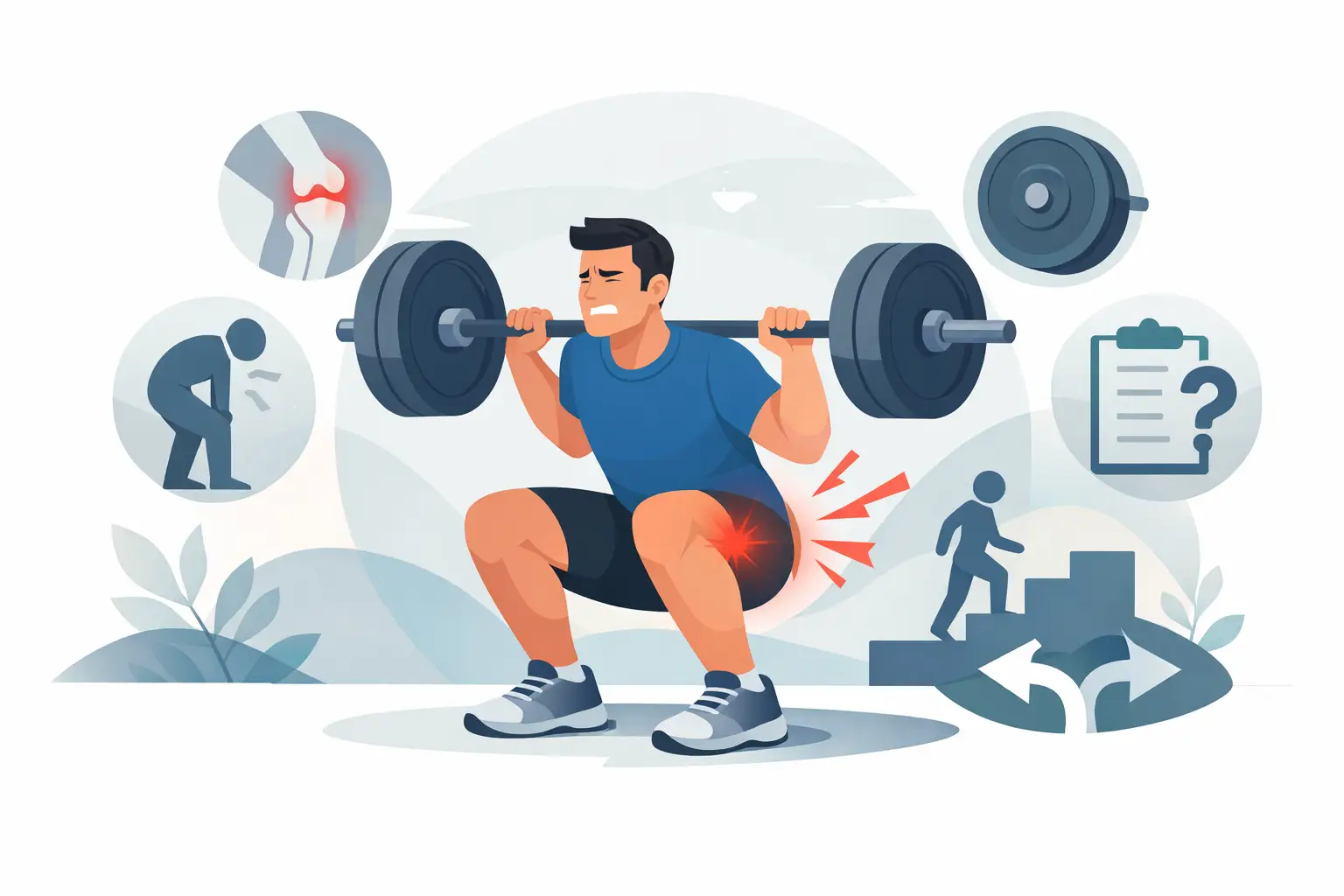
A squat that hurts changes more than your workout. It can make stairs, getting out of a chair, picking up your child, or getting back to golf and running feel uncertain. If you are asking, why does my squat hurt, the useful question is not simply which exercise to avoid. It is what your body is trying to compensate for, and whether the problem is coming from the painful area itself or from a limitation elsewhere in the movement.
Pain during a squat is common, but it is not something to train through blindly. The answer may involve training load, technique, mobility, strength, an old injury, or a combination of all four. A precise assessment separates a temporary irritation from a movement problem that will keep returning every time you add weight or volume.
Why Does My Squat Hurt? Start With the Location
Where you feel pain offers a clue, but it does not provide a diagnosis by itself. A knee that hurts in the bottom of a squat may be reacting to poor hip control, restricted ankle motion, a sudden increase in training, or sensitivity in the knee joint or tendon. The knee may be the loudest part of the movement without being the only part that needs attention.
Pain in the front of the knee is often aggravated by repeated deep knee bending, jumping, running, or a recent spike in squat volume. This does not mean your knees should never travel forward. In a well-executed squat, forward knee movement is normal. The issue is whether your knees, hips, feet, and trunk can share the load effectively at the depth and resistance you are using.
Hip pain can feel like a pinch in the front of the hip, a deep ache in the groin, or discomfort along the outside of the hip. A pinching sensation at the bottom may reflect limited hip motion, poor pelvic control, or a squat stance that does not match your anatomy. Forcing deeper range because someone else can squat lower is rarely a productive solution.
Low back pain often appears when the trunk loses position as you descend or rise. You may see your pelvis tuck sharply under at the bottom, your ribs flare, or your lower back round under a load you cannot yet control. Back discomfort can also be a load-management issue, especially after a jump in deadlifts, squats, running, or long days of sitting.
Pain in the groin, pelvis, or pelvic floor deserves equally thoughtful attention. Breath holding, excessive bracing, pressure, and poor coordination through the abdomen and pelvic floor can make squatting uncomfortable for some people, particularly after pregnancy, pelvic surgery, or a period of reduced activity. Pelvic symptoms are not something to dismiss as a normal cost of strength training.
The Most Common Reasons Squats Become Painful
Your training load moved faster than your capacity
The squat may not be the problem. The recent change may be. Adding weight, extra sets, deeper range, faster repetitions, hill running, new shoes, or a return to training after time off can exceed what your tissues are prepared to tolerate.
Muscles and joints adapt to progressive demand, not sudden demand. A manageable ache that settles quickly may respond to a temporary reduction in volume or range. Sharp pain, worsening symptoms, swelling, catching, giving way, or pain that lingers well after training calls for a more careful evaluation.
Your available mobility does not match the squat you are demanding
Squatting requires usable motion at the ankles, knees, hips, and trunk. Limited ankle dorsiflexion, for example, can make it difficult for the knees to move forward smoothly. The body may respond by lifting the heels, collapsing the arches, shifting into one side, or folding forward excessively.
Hip mobility matters too, but mobility is not just flexibility. You need control at the end of your available range. Stretching a stiff area can be helpful, yet it will not solve a problem if you cannot stabilize and load that new range. The goal is not maximum range. It is enough high-quality range for your body, your squat variation, and your goals.
Your squat strategy is placing too much stress in one area
Small technique changes can substantially change how a squat feels. Foot stance, toe angle, heel elevation, bar position, depth, tempo, and trunk angle all influence where the load goes. A narrow, upright squat may challenge the knees more. A wider stance with more forward torso lean may demand more from the hips and back. Neither pattern is automatically wrong.
The best variation depends on your structure, current symptoms, training history, and objective. A goblet squat, box squat, split squat, heel-elevated squat, or reduced-depth squat can be a smart bridge back to loading. It is not a failure to modify an exercise. It is how you keep building capacity while reducing unnecessary irritation.
Strength and control are not yet keeping up
You can have enough passive range of motion and still struggle because your muscles cannot control the position. Common examples include the knee drifting inward under load, a noticeable shift to one leg, the foot losing contact with the floor, or the trunk collapsing at the bottom.
These patterns are not corrected by yelling “knees out” or “chest up” for every rep. Coaching cues can help, but the lasting answer may require targeted strength work for the quads, calves, glutes, trunk, and single-leg control. It may also require slowing the movement down so your body can learn a better strategy before heavier loading returns.
What to Do When Your Squat Hurts
Start by changing the variable most likely to calm symptoms without abandoning training altogether. Reduce the load, limit depth to a tolerable range, slow the tempo, or choose a variation that feels more controlled. Use a simple rule: discomfort that stays mild, does not worsen set to set, and returns to baseline shortly afterward may be acceptable during a graded return. Pain that is sharp, escalating, or changes the way you move is a signal to stop and reassess.
Next, pay attention to the pattern. Does pain begin only below parallel? Does it appear after the third set? Is it worse with a barbell than a goblet squat? Does a heel lift improve it? Does one side shift or feel less stable? These details help identify whether the main driver is range, load, control, or a specific tissue that is irritated.
Avoid the common cycle of complete rest followed by an aggressive return to the same workout. Rest can settle symptoms, but it does not automatically restore the mobility, coordination, or strength needed to tolerate squatting again. A better plan builds from the version of the movement you can perform well, then progresses one variable at a time.
For example, someone with front-of-knee discomfort may begin with a controlled box squat at a comfortable depth, build quad and calf strength, then gradually increase range and resistance. Someone with back discomfort may benefit from improving trunk control, adjusting squat setup, and using a variation that allows a more comfortable torso position. The right progression is specific to the person, not copied from a generic mobility routine.
When Pain Needs a Professional Assessment
Seek prompt medical care after a significant fall or twist, if you cannot bear weight, or if you have major swelling, deformity, numbness, new weakness, fever, unexplained night pain, or bowel and bladder changes. Those symptoms require medical attention beyond workout modification.
For persistent pain, recurring pain, or pain that limits training and daily activity, a movement-based physical therapy assessment can provide clarity. At Back In Motion, the Gray Method™ looks beyond the painful rep. The process examines how you move, where you lack usable mobility or control, how your training load has changed, and what progression will get you back to strength without guessing.
That matters for active adults and athletes because the goal is not merely to make a squat less painful today. The goal is to restore confidence under load, whether that means lifting in the gym, getting low on the tennis court, carrying equipment on the golf course, or keeping up with your family.
A painful squat is useful information. Treat it as a signal to adjust, assess, and rebuild rather than a reason to stop moving altogether. With the right dose of mobility, strength, technique work, and progressive loading, many people can return to squatting with more control than they had before the pain started.
About the Author: Dr. Scott Gray


 Call (239) 223-0484
