
October 2025
Fix the cause of your pain—without relying on surgery or medications
A Personal Note from Dr. Scott:

October always feels like a season of transition. The mornings are a little cooler, the days feel shorter, and it’s a reminder that the year is moving quickly.
For many of us, this time of year can either be a fresh push toward our health goals—or a quiet slide into putting them off until “after the holidays.”
I want to encourage you not to wait.
I’ve seen firsthand how quickly strength, mobility, and energy can decline when we put ourselves on the back burner.
The good news? You don’t need to overhaul your life to see change.
Small, consistent steps—whether that’s a few workouts a week, eating just a bit better, or finally addressing that nagging pain—can transform the way you feel heading into the end of the year.
At Back In Motion, our mission is simple: to help you fix the cause of your pain, move better, and live stronger—without relying on surgery or medications.
And October is the perfect month to recommit to yourself before the holiday chaos begins.
Keep moving forward, one step at a time. Your future self will thank you.
—Dr. Scott Gray
Article of the Month
5 Hidden Reasons Why Sciatica Occurs (That Most People Miss)
If you’ve been told “it’s just aging” or you’ve been stretching your hamstrings for weeks with little relief, you’re not alone. Sciatica isn’t one problem; it’s a pattern—usually a mix of mechanics, habits, and overload that irritates the nerve along its path. Below are five under-the-radar drivers I see every week in clinic, plus simple ways to start turning the ship.
1) Overuse of the Hamstrings (because the quads and glutes are under-doing their job)
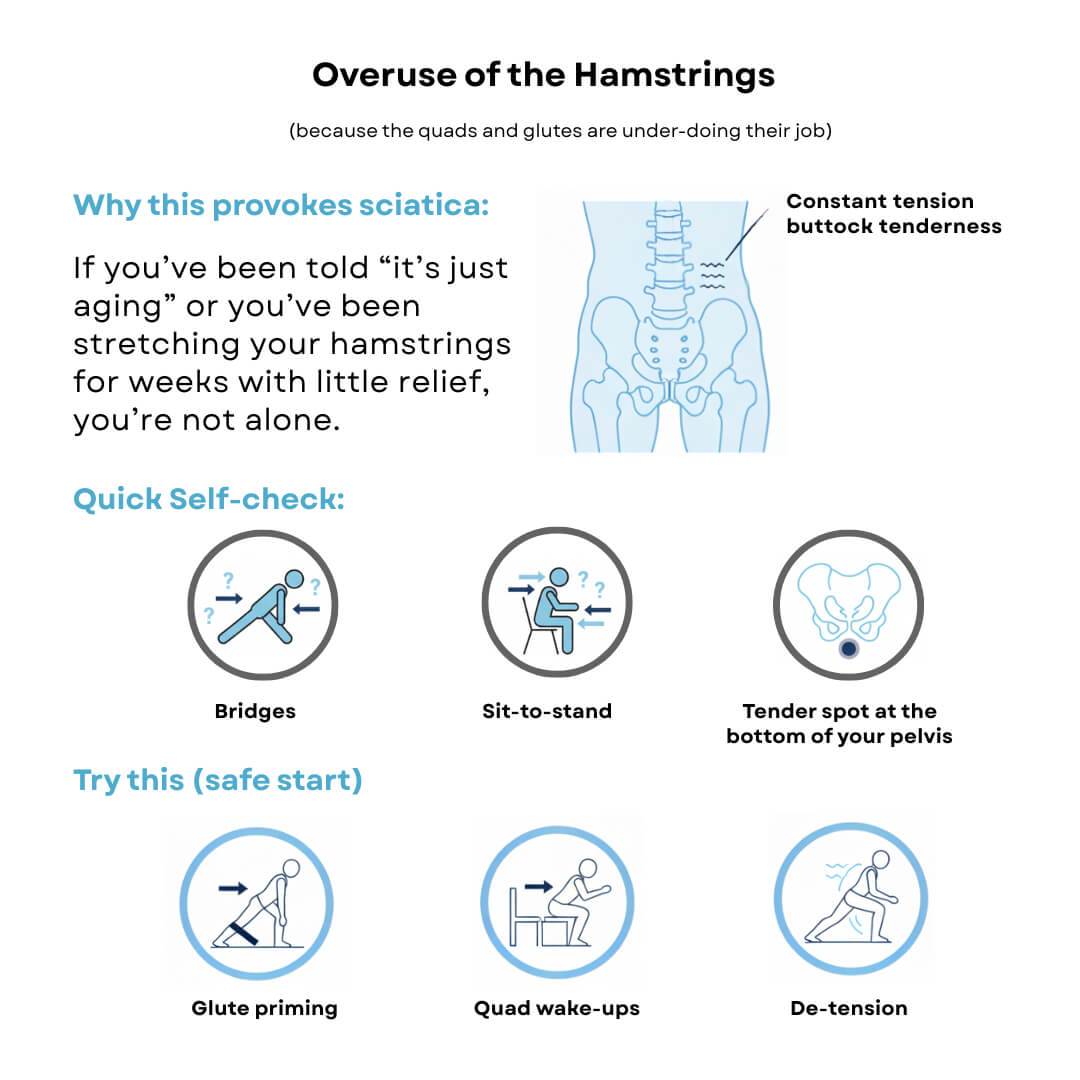
Why this provokes sciatica:
When glutes and quads check out, your hamstrings do all the lifting—especially during hinges, squats, and even standing up from a chair. That overreliance creates constant tension at the hamstring’s origin near the sit bone and along the sciatic nerve’s neighborhood. Result: buttock tenderness, “tugging” down the leg, and flare-ups after long sits or “hamstring stretches.”
Quick self-check:
- Bridges: do your hamstrings cramp before your glutes kick in?
- Sit-to-stand: do you feel it mostly in the backs of your thighs instead of your hips/quads?
- Tender spot at the bottom of your pelvis (sit bone)?
Try this (safe start):
- Glute priming: mini-band bridges (heels closer to hips), side-lying hip abduction (slow).
- Quad wake-ups: slow box squats to a chair, focus on knees tracking over the 2nd–3rd toe.
- De-tension: swap long hamstring holds for gentle nerve sliders (small, pain-free range).
2) Weak Glutes/Hips → Constant Femoral Internal Rotation
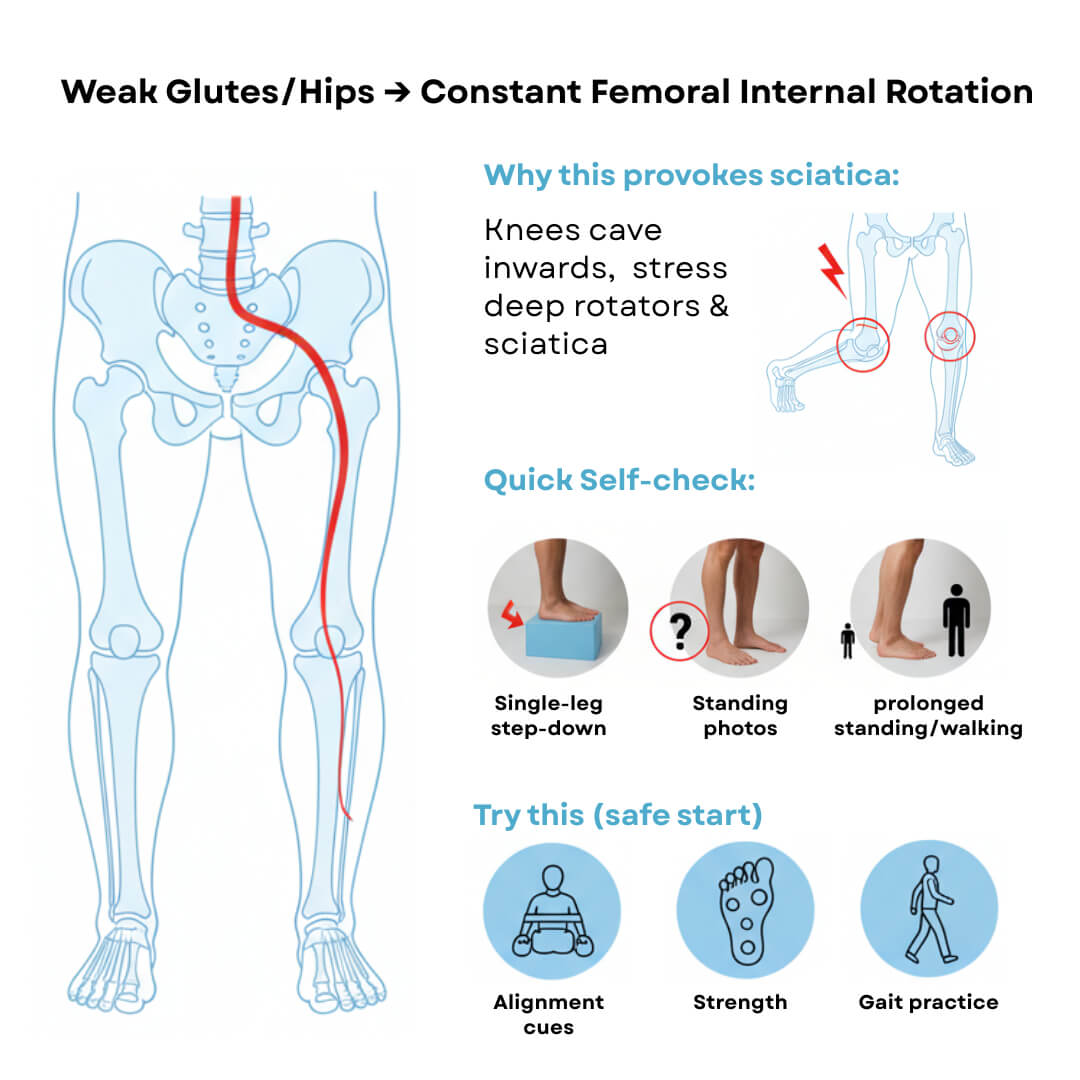
(lengthened piriformis + extra tension on the sciatic nerve)
Why this provokes sciatica:
When lateral hip stabilizers are weak, knees cave inward (dynamic valgus) and femurs live in internal rotation. That position lengthens/stresses the deep rotators (including piriformis) and can tension or irritate the sciatic nerve in the deep gluteal space.
Quick self-check:
- Single-leg step-down: do your knee and hip collapse inward?
- Standing photos: do your kneecaps point inward, arches collapse?
- Does prolonged standing/walking create a deep buttock ache?
Try this (safe start):
- Alignment cues: “knee over 2nd toe,” “tripod foot” (big toe, little toe, heel).
- Strength: clamshells (slow, band just above knees), lateral band walks, supported single-leg RDLs focusing on hip control—not weight.
- Gait practice: short walks, slow cadence, hips tall.
3) You’re Constantly Crossing Your Legs
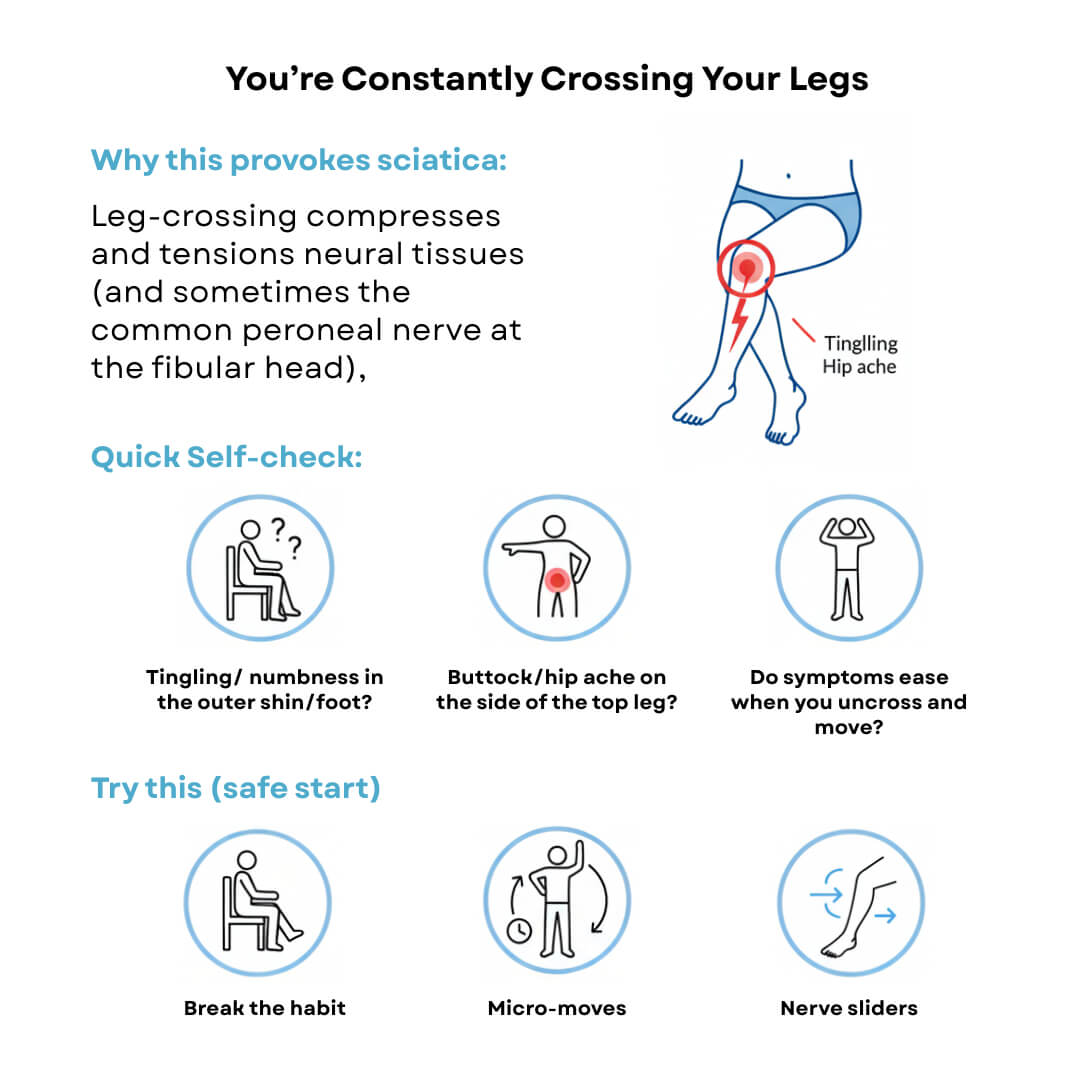
Why this provokes sciatica:
Leg-crossing compresses and tensions neural tissues (and sometimes the common peroneal nerve at the fibular head), while locking your pelvis and hip into positions that increase nerve sensitivity. Long, end-range postures are the nerve’s least favorite thing.
Quick self-check:
- Do you get tingling or numbness in the outer shin/foot after sitting cross-legged?
- Does your buttock/hip ache on the side of the top leg?
- Do symptoms ease when you uncross and move?
Try this (safe start):
- Break the habit: both feet flat or “ankle over ankle,” not knee over knee.
- Micro-moves: every 20–30 minutes, uncross, stand, and take 5–10 slow breaths.
- Nerve sliders: small, gentle reps—never into pain, never long holds.
4) You’re Sitting Too Much (and too still)

Why this provokes sciatica:
Prolonged sitting—especially slumped—raises disc pressure, tightens hip flexors, and decreases blood flow to the nerve. Nerves hate stillness; they prefer movement, variability, and space.
Quick self-check:
- Is the first step after a long drive the worst?
- Do symptoms ease with short walks or standing?
- Is your chair low, soft, or encourages “C-spine” slumping?
Try this (safe start):
- Movement snacks: set a 30–45 minute timer; stand, walk 60–90 seconds, or do 10 gentle back presses on the counter.
- Chair fix: hips slightly above knees, small lumbar support (towel roll), screen at eye level.
- Reset: 2–3 sets of prone props (on elbows) daily if comfortable.
5) A Real Tissue Irritant: Disc Herniation, SI Joint Irritation, or Hip Bursitis/Tendinitis
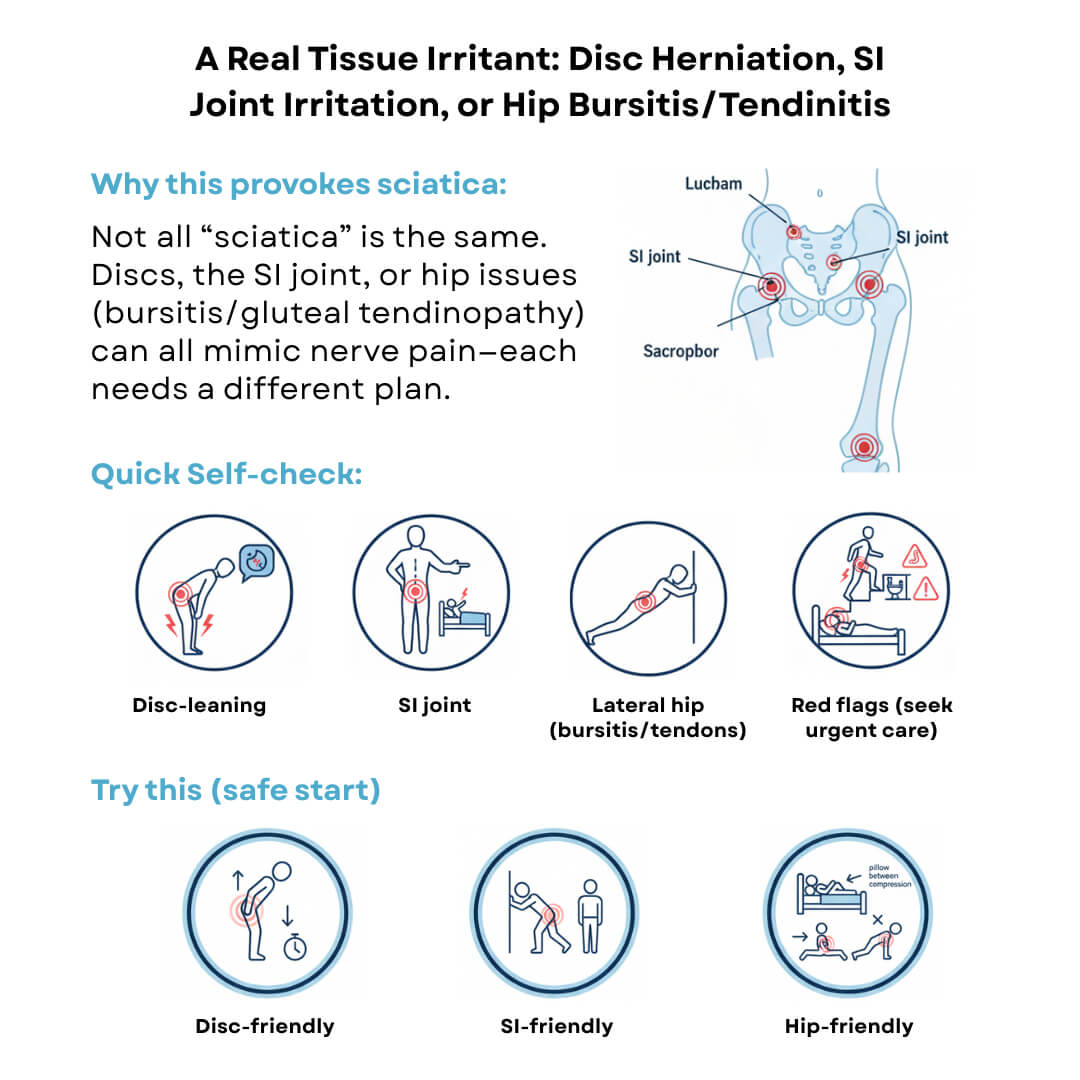
Why this provokes sciatica-like pain:
Not all “sciatica” comes from one source. A lumbar disc herniation can inflame a nerve root; a cranky sacroiliac (SI) joint can refer pain into the buttock/thigh; lateral hip bursitis or gluteal tendinopathy can mimic nerve pain with walking, stairs, or lying on your side. Each needs a slightly different game plan.
Quick self-check (clues):
- Disc-leaning: cough/sneeze or forward bending lights up the leg.
- SI joint: pain near the dimple of the low back, worse with rolling in bed or long standing.
- Lateral hip (bursitis/tendons): pain on the outside of the hip with side-lying, long walks, or stairs.
- Red flags (seek urgent care): new/worsening leg weakness, bowel/bladder changes, saddle numbness.
Try this (safe start):
- Disc-friendly: short, frequent standing breaks; gentle extension bias (if relieving).
- SI-friendly: avoid asymmetric long stands; practice tall stance and symmetrical loading; add glute med isometrics (short side-planks, wall press).
- Hip-friendly: reduce side-sleep compression (pillow between knees), start slow glute strengthening, avoid aggressive stretching early.
What Helps vs. What Hurts (Quick Rules)
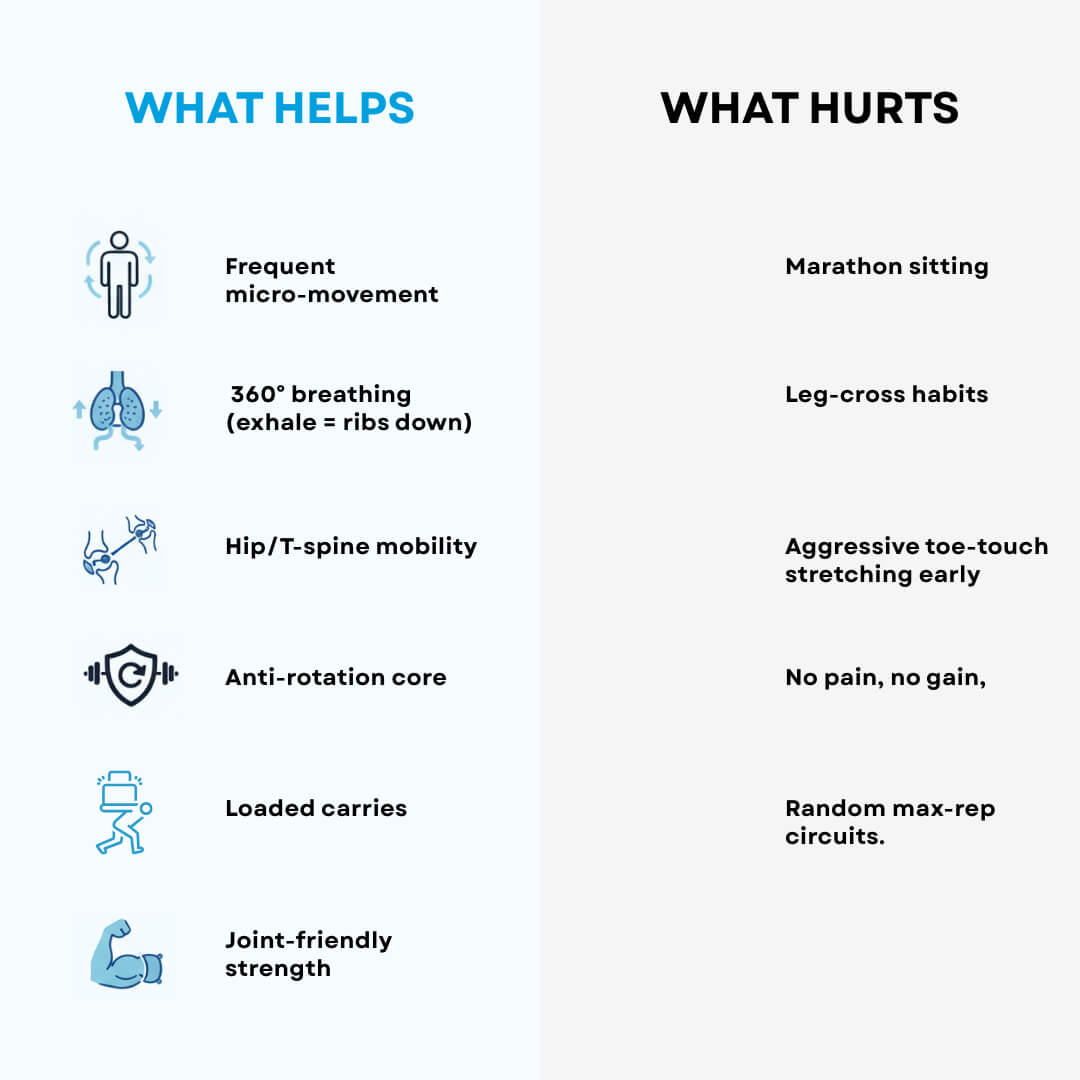
Helps: frequent micro-movement, 360° breathing (exhale = ribs down), hip/T-spine mobility, anti-rotation core, loaded carries, joint-friendly strength.
Hurts: marathon sitting, leg-cross habits, aggressive toe-touch stretching early, “no pain, no gain,” random max-rep circuits.
Next Step: Fix the Pattern, Not Just the Pain
You don’t need more willpower—you need the right inputs. If these hidden drivers sound familiar, our Fixing the Cause (Not the Symptom) assessment will pinpoint your exact pattern and map a joint-smart plan you can follow with confidence.
Prefer guided coaching that respects 50+ bodies? See how we train safely and effectively on our personal trainer Fort Myers page, or call 239-329-0256 to talk with our team.
As always: this is education, not diagnosis. If symptoms escalate or you notice red flags, seek care promptly.
Oliver’s Healthy Recipe

Oliver’s Corner Recipe

Oliver’s Corner: Roasted Sweet Potato & Black Bean Tacos
Strong hips need strong fuel — and these tacos deliver.
Ingredients:
- 2 medium sweet potatoes, diced
- 1 tbsp olive oil
- 1 tsp smoked paprika
- 1/2 tsp cumin
- 1 can black beans, rinsed & drained
- Corn tortillas
Ingredients
Toppings: avocado, cilantro, salsa, lime
Instructions:
- Toss sweet potatoes in olive oil, paprika, cumin, salt & pepper. Roast at 400°F for 25 minutes.
- Warm tortillas and fill with roasted sweet potatoes and black beans.
- Top with avocado, cilantro, salsa, and a squeeze of lime.
Serve With:
- A side of mixed greens with olive oil & lemon
- Fresh mango slices for natural sweetness
- Sparkling water with lime for a refreshing finish
Why It’s Great:
- Sweet potatoes = complex carbs for sustained energy
- Black beans = protein and fiber to fuel muscles
- Anti-inflammatory spices = joint and tissue support
- Quick, plant-based, and delicious
Fitness Corner
Fitness Corner: The Single-Leg Bridge Test
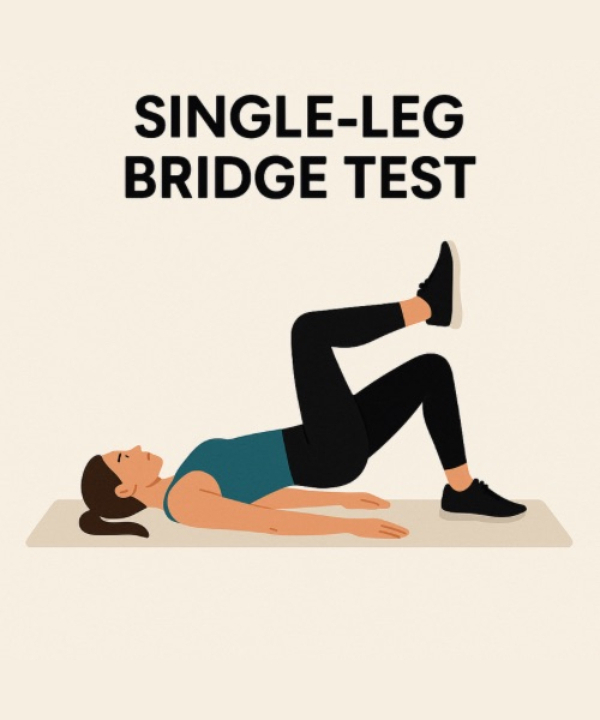
Want to see if your hips are really pulling their weight? Try this quick test.
Here’s how:
- Lie on your back with knees bent, feet flat.
- Lift one foot off the ground.
- Press through the other heel to lift your hips into a bridge.
- Hold for 10 seconds, then switch sides.
What to watch for:
- Do your hips stay level, or does one drop?
- Do you feel it in your glutes — or just your hamstrings/lower back?
- Can you hold steady without wobbling?
If your hips drop or you can’t feel your glutes working, it’s a sign your hip strength or control needs work.
Pro tip: Adding just 1–2 sets of single-leg bridges daily can improve hip stability, protect your back, and power up your stride.
Staff Spotlight

Meet Dr. Joseph Molina — Physical Therapist
Dr. Joe is a Doctor of Physical Therapy from Miami, FL, who earned his degree from Florida International University. His decision to enter the field of physical therapy was influenced by his personal experiences with injuries as a high school athlete. Witnessing the lack of adequate support for non-professional athletes fueled his passion for providing high-quality care to those in similar situations.
He focuses on treating orthopedic and sports injuries using a hands-on approach that blends advanced therapeutic techniques with individualized attention. Wanting to further his knowledge, he obtained the Certified Strength and Conditioning Specialist (CSCS) credential during his studies, which enhances his ability to integrate strength and conditioning principles into his practice.
Outside of the clinic, he enjoys boating and fishing while spending time with family.
FAVORITES:
Place: Beach
Food: BBQ
Vacation Spot: Florida Keys
TV show: The Office
Film: Forrest Gump
Guilty Pleasure Song: Location by Khalid
Celebrity: Luke Combs
Book: The Lost Symbol by Dan Brown
Sport: Baseball/Formula 1
Team: Boston Red Sox/ McLaren F1 Team
Hobbies: Boating, Reading, Exercising
Fitness Client Of The Month
Fitness Client of the Month — Debbie T.
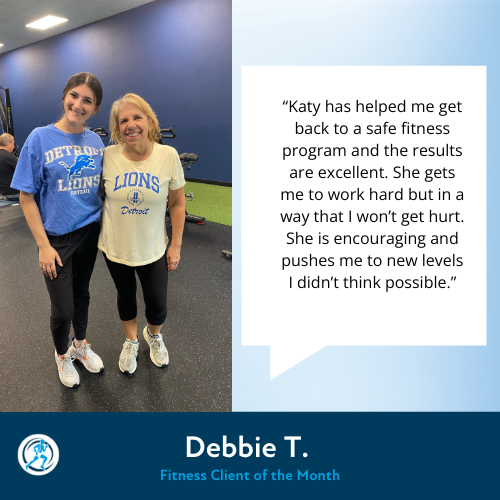
“Katy has helped me get back to a safe fitness program and the results are excellent. She gets me to work hard but in a way that I won’t get hurt. She is encouraging and pushes me to new levels I didn’t think possible.”
Patient Case Study of the Month
How Jessica Overcame a Herniated Disc Without Surgery or Drugs
Meet Jessica
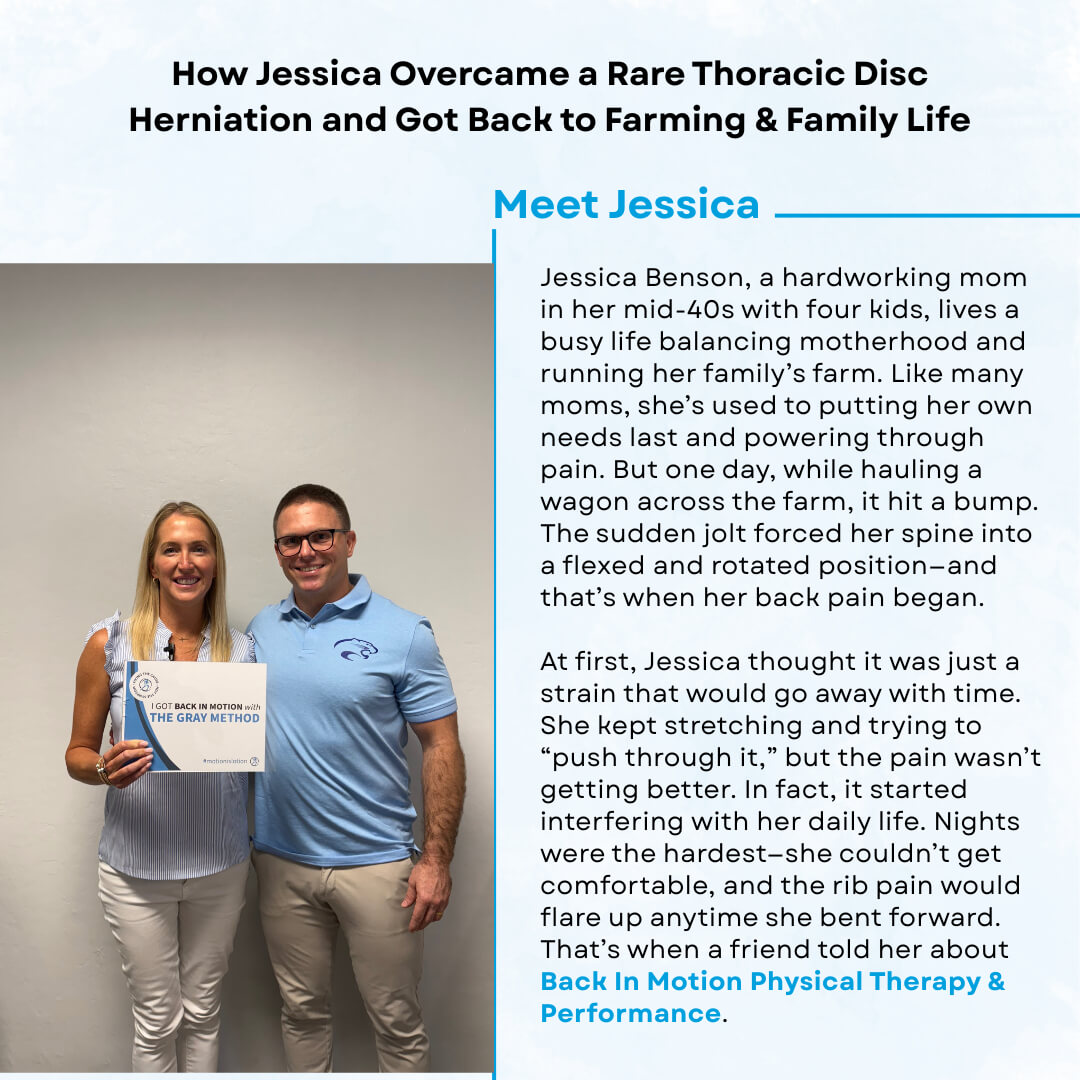
Jessica B., a hardworking mom in her mid-40s with four kids, lives a busy life balancing motherhood and running her family’s farm. Like many moms, she’s used to putting her own needs last and powering through pain. But one day, while hauling a wagon across the farm, it hit a bump. The sudden jolt forced her spine into a flexed and rotated position—and that’s when her back pain began.
At first, Jessica thought it was just a strain that would go away with time. She kept stretching and trying to “push through it,” but the pain wasn’t getting better. In fact, it started interfering with her daily life. Nights were the hardest—she couldn’t get comfortable, and the rib pain would flare up anytime she bent forward. That’s when a friend told her about Back In Motion Physical Therapy & Performance.
The Problem
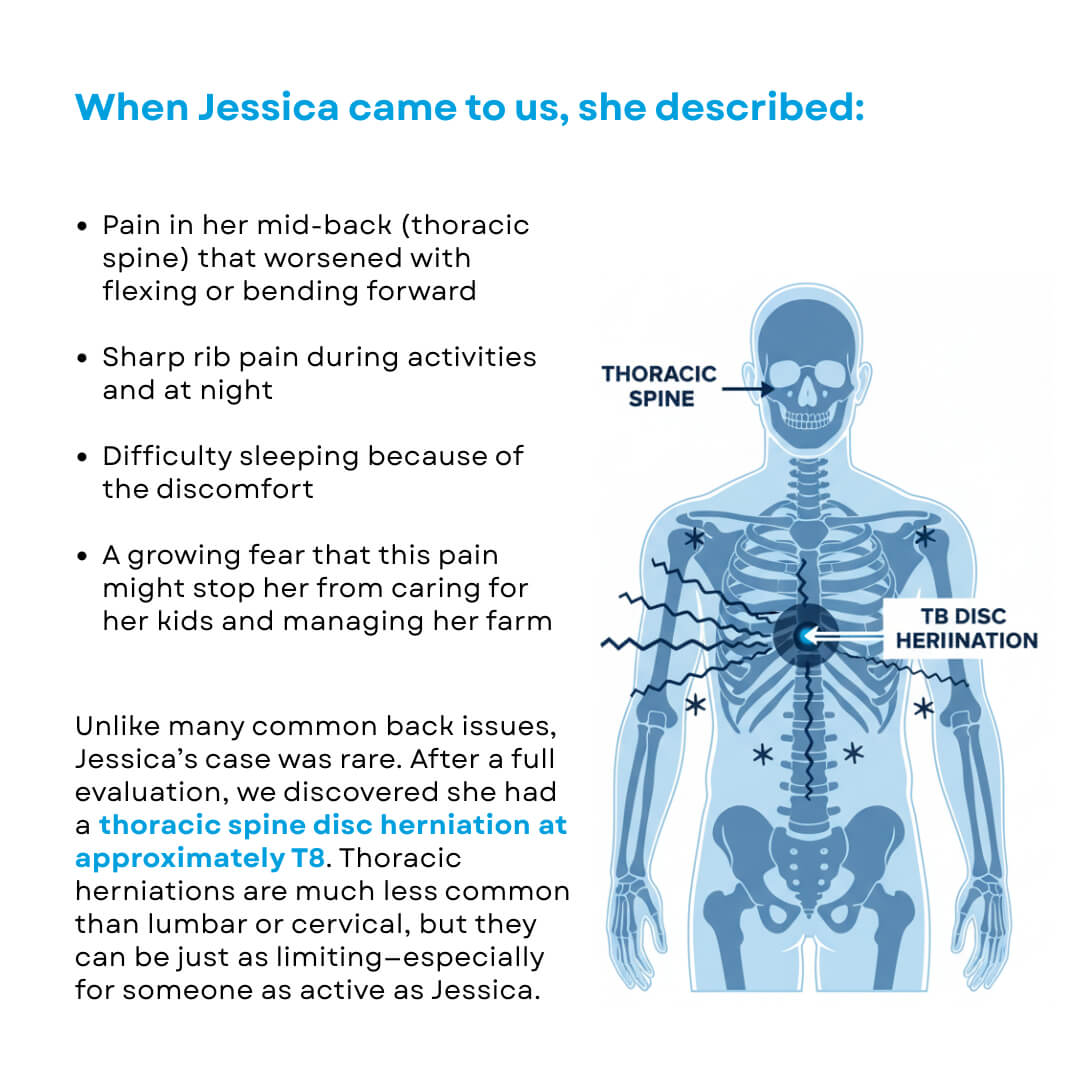
When Jessica came to us, she described:
- Pain in her mid-back (thoracic spine) that worsened with flexing or bending forward
- Sharp rib pain during activities and at night
- Difficulty sleeping because of the discomfort
- A growing fear that this pain might stop her from caring for her kids and managing her farm
Unlike many common back issues, Jessica’s case was rare. After a full evaluation, we discovered she had a thoracic spine disc herniation at approximately T8. Thoracic herniations are much less common than lumbar or cervical, but they can be just as limiting—especially for someone as active as Jessica.
The Gray Method™ Approach
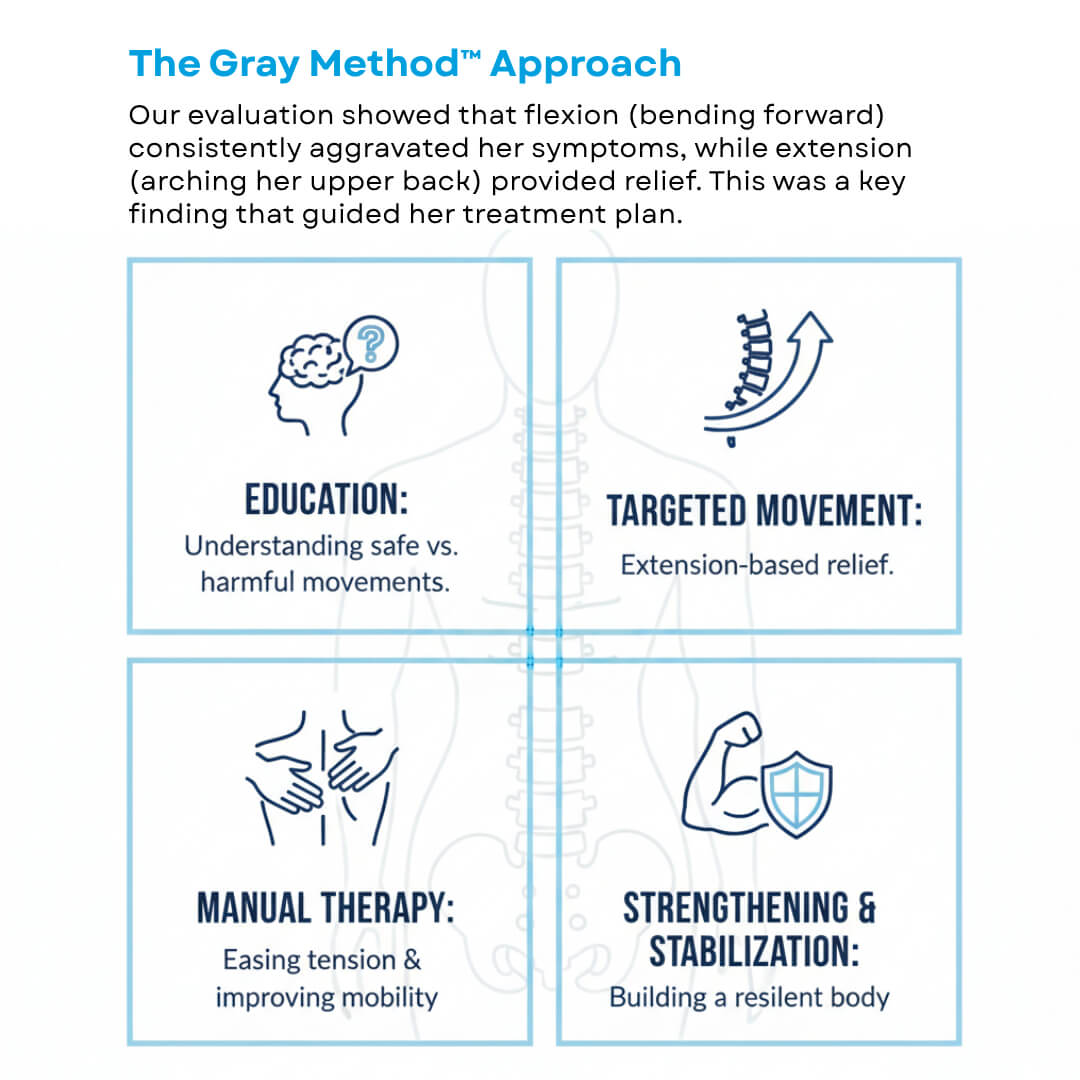
Our evaluation showed that flexion (bending forward) consistently aggravated her symptoms, while extension (arching her upper back) provided relief. This was a key finding that guided her treatment plan.
With the Gray Method™, we focused on:
- Education: Helping Jessica understand that stretching into flexion was making her symptoms worse.
- Targeted movement strategies: Teaching her safe, extension-based movements to reduce pressure on the disc and rib structures.
- Manual therapy: Hands-on techniques to ease surrounding muscle tension and improve thoracic mobility.
- Strengthening & stabilization: Progressively rebuilding her core and mid-back strength so her body could support farm work and daily life without irritation.
The Transformation
Over time, Jessica began to notice that her pain lessened when she avoided flexion-based stretches and stuck with the corrective exercises we prescribed. Her night pain improved, she felt less rib discomfort, and she could finally rest again.
Most importantly, she regained the confidence to get back to what mattered most—running her farm, caring for her kids, and living life without the constant worry of back pain.
Final Thoughts
Jessica’s story is a reminder that pushing through pain isn’t always the answer. Sometimes, what seems like a “stubborn muscle strain” is something deeper—and getting the right evaluation can make all the difference.
At Back In Motion, we don’t just treat symptoms—we identify the root cause and create a plan tailored to your body and your life, especially if you have a herniated disc.
If you’ve been struggling with back pain that isn’t going away, don’t wait. Inquire about cost and appointment availability today and take the first step toward getting your life back.
Events of the Month
Events of the Month – October Highlights
Fitness Workshop – How to Ignite Your Metabolism and Burn Fat After 50
Date: Thursday, October 23rd
Time: 5:15 to 6:00 PM EST
https://learn.backinmotionsspt.com/2025-how-to-improve-your-metabolism-workshop/
Urinary Incontinence Workshop – 3 Secrets to Overcoming Urinary Incontinence Without Pills or Pads
Date: Wednesday October 8th
Time: 5:15 to 6:00 PM EST
https://backinmotionsspt.com/urinary-incontinence//
Pumpkin Workout- Last Week of October
Testimonials

“I’m a little apprehensive about driving from Naples to Fort Myers, just physical therapy several times a week, but I’m glad I did. The outcome has been absolutely spectacular!
“

“I really like that you were more focused on getting me back in the gym because you knew that was really important to me.”

 Call (239) 223-0484
