
Guide to Return to Sport After Injury
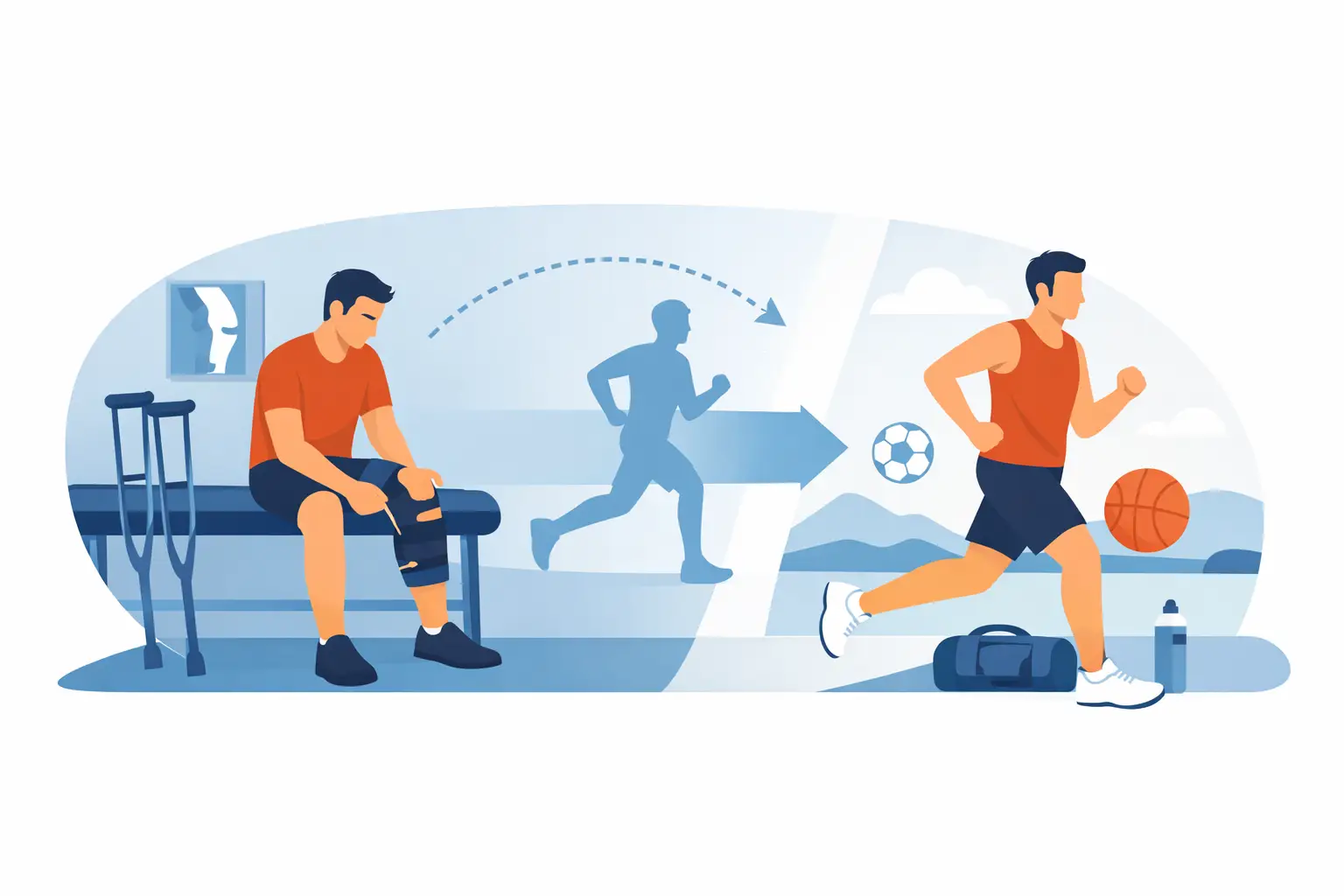
You can feel pain-free walking around, crush a basic workout, and still not be ready for your sport. That gap is where reinjuries happen. A real guide to return to sport has to do more than ask whether symptoms are gone. It should answer a harder question: can your body handle the speed, load, repetition, and unpredictability of competition again?
For active adults and athletes, that distinction matters. Running, golf, tennis, pickleball, CrossFit, field sports, and strength training all place different demands on the body. If rehab stops at pain relief, you may feel better but still lack the mobility, strength, coordination, and tissue tolerance needed to perform confidently. That is why return to sport should be treated as a progression, not a guess.
What a guide to return to sport should actually include
The best return-to-sport plan is specific, measurable, and tied to your sport’s demands. It is not built around a calendar alone. Time matters after an injury or surgery, but healing timelines do not tell you whether you can cut, land, rotate, sprint, or absorb force well enough to play.
A better approach looks at four things together: symptoms, movement quality, strength capacity, and sport-specific readiness. If one is missing, the process is incomplete. You may be able to jog without pain, but if your hip control is poor and your single-leg strength is still limited, that matters. You may have excellent strength numbers, but if your ankle mobility is restricted and your mechanics break down under fatigue, that matters too.
This is where individualized care changes the outcome. The body rarely follows a simple script. Sometimes the painful area is not the main problem. A shoulder issue can be tied to thoracic stiffness or poor trunk control. Knee pain can be driven by foot mechanics, hip weakness, or load-management errors. If the root cause is missed, return to sport becomes a temporary fix instead of a durable result.
Start with the right question, not the right date
Many athletes want a date. That is understandable. You want to know when you can race again, get back on the court, or resume heavy lifting. But the better first question is this: what does my sport require, and what capacities do I need to meet those demands safely?
A runner returning from Achilles pain needs repeated calf loading, tendon tolerance, stride efficiency, and enough hip and trunk strength to control impact over distance. A golfer coming back from low back pain needs rotational mobility, force transfer, and enough strength to swing repeatedly without compensating. A soccer player returning from an ACL injury needs acceleration, deceleration, cutting mechanics, single-leg control, and confidence under reactive conditions.
When you define the actual demands, rehab becomes much more precise. You stop chasing generic exercises and start rebuilding the capacities that matter.
The phases of return to sport
Phase 1: Calm symptoms and restore baseline movement
Early rehab should reduce irritation and restore enough mobility and control to move normally again. That does not mean total rest in every case. In fact, complete shutdown often delays progress. The goal is to load the body at a level it can tolerate while protecting healing tissue.
This phase usually includes pain-guided exercise, mobility work where it is limited, and foundational strength. The key is dosage. Too little load and tissues do not adapt. Too much load and symptoms flare. Finding that middle ground is one reason cookie-cutter rehab falls short.
Phase 2: Build strength and capacity
This is the phase many people underestimate. Once daily pain drops, they assume they are close to done. But sport demands reserve capacity. You do not just need enough strength to get through one movement. You need enough strength to repeat it, control it, and absorb force when you are tired.
This is where structured progressive loading matters. Tendons need load. Muscles need strength. Joints need support. Your rehab should move from light, controlled exercises toward heavier, more challenging patterns that resemble real athletic demands.
If an athlete cannot generate or absorb force well in the clinic, that problem will not magically disappear on the field or in the gym.
Phase 3: Rebuild power, speed, and coordination
Sport is rarely slow and predictable. At some point, rehab has to bridge the gap between strength and performance. That may include jumping, hopping, sprinting, rotational power, agility work, reactive drills, and multi-plane loading.
This stage often exposes issues that basic rehab misses. An athlete may squat well but struggle to land on one leg. A runner may tolerate easy mileage but not faster paces. A tennis player may have no pain during drills but symptoms return during overhead serves at full speed.
These are not setbacks. They are useful data. They show where the body still needs work before full return.
Phase 4: Gradual return to practice and competition
The final phase is not all-or-nothing. It should be graded. Practice volume, intensity, frequency, and complexity should rise step by step. A smart progression might start with skill work, then controlled practice, then modified competition, then full participation.
This is also where load management matters most. Too many athletes feel good, jump back into full training, and overload tissues that are not ready for that spike. Being cleared to play does not mean you are ready for unlimited volume on day one.
Milestones that matter before full return
A useful guide to return to sport should include objective benchmarks. Exact measures depend on the injury and the sport, but a few principles apply across the board.
Pain should be minimal during and after activity, and any soreness should settle quickly. Range of motion should be adequate for your sport rather than merely acceptable for daily life. Strength should be symmetrical enough, or at least appropriate enough, to handle sport demands without visible compensation. Movement quality should hold up not only in controlled tests but also under speed and fatigue.
Confidence matters too. Athletes often overlook this, but hesitation changes mechanics. If you do not trust the leg, shoulder, or back, you will move differently. That can reduce performance and increase risk elsewhere.
None of these markers should be used in isolation. Passing one hop test or finishing one workout does not prove full readiness. Return to sport is stronger when decisions are based on a pattern of consistent findings.
Why setbacks happen after “clearance”
Clearance is often treated as a finish line. It is not. It is a checkpoint.
Setbacks usually happen for one of three reasons. The first is that underlying deficits were never fully addressed. Pain improved, but mobility, strength, or mechanics did not. The second is that the athlete returned to volume too quickly. The third is that rehab never progressed far enough into sport-specific work.
This is especially common in active adults who are motivated and used to pushing through discomfort. That mindset can help training, but after injury it can blur the line between productive loading and reckless loading. Discipline matters just as much as motivation.
When the plan should change
Not every recovery is linear. If symptoms keep returning, that does not always mean you are doing too much. Sometimes it means you are doing the wrong things, or that the real driver has not been identified.
If pain shifts locations, if one area keeps compensating for another, or if progress stalls despite consistency, your program likely needs a more precise reassessment. At Back In Motion Physical Therapy & Performance, that is the point where a root-cause approach becomes especially valuable. Instead of chasing the sore spot again, the focus shifts to why the system is breaking down under load.
Sometimes the answer is mobility. Sometimes it is strength. Sometimes it is pelvic control, breathing strategy, training volume, or technique. The right answer depends on the person in front of you, not just the diagnosis on paper.
The goal is not just getting back
A strong return-to-sport plan should leave you more capable than you were before the injury. That means better movement options, better force production, better recovery habits, and a clearer understanding of how to train without repeating the same cycle.
For some athletes, that means addressing old limitations they had learned to work around. For others, it means building a transition from rehab into performance training so the gains do not disappear once formal treatment ends. The handoff matters. If rehab and training are disconnected, progress often fades.
The most successful athletes do not just ask, “Am I cleared?” They ask, “Have I rebuilt the qualities my sport demands, and do I have enough margin to handle real play?” That question leads to better decisions.
If you are working your way back from injury, be patient enough to do it right and demanding enough to expect more than symptom relief. Your body should not just tolerate sport again. It should be prepared for it.
About the Author: Dr. Scott Gray




 Call (239) 788-0838