
8 Best Exercises for Hip Stability
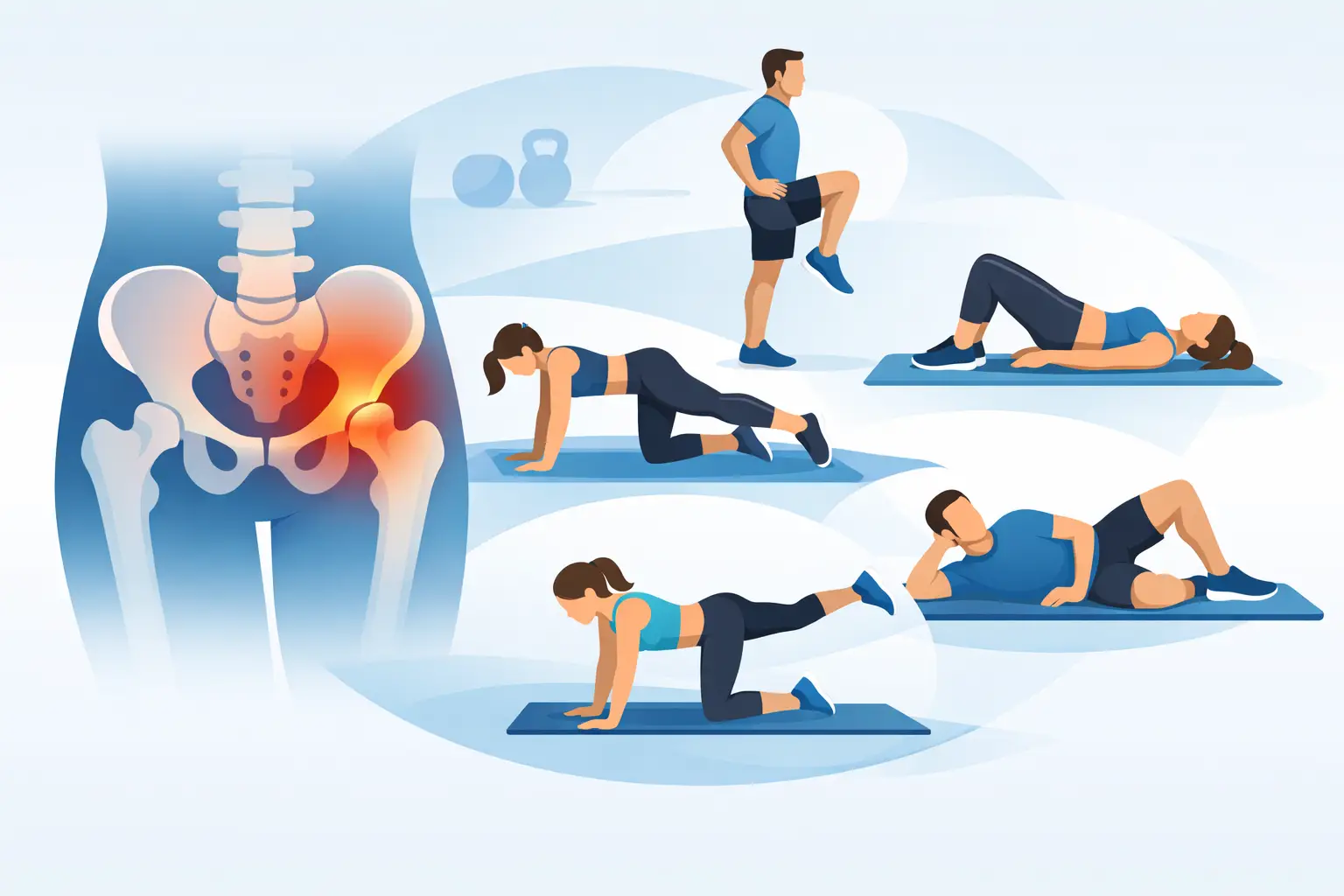
Hip instability rarely announces itself with a clear label. More often, it shows up as a knee that caves in during squats, low back tightness after a run, groin irritation, or a feeling that one leg just does not feel as strong or controlled as the other. That is why the best exercises for hip stability are not just about making your hips burn. They are about restoring control, force transfer, and confidence so your body can handle walking, lifting, cutting, running, and changing direction without compensating.
At Back In Motion, we look at hip stability as a movement problem first, not just a muscle weakness problem. Strong hips matter, but strength without control does not hold up well under speed, fatigue, or load. The right exercises train your hip to do its job in positions that actually matter.
What hip stability really means
Your hips sit at the center of almost everything you do. They help control your pelvis, absorb force from the ground, and transfer power between your lower and upper body. When hip stability is poor, other areas often pick up the slack. That can mean extra stress at the knees, low back, hamstrings, or pelvic floor.
This is where people get tripped up. They assume hip stability means doing endless clamshells with a mini band. Those can help in the right case, but they are not the full answer. True stability combines strength, alignment, balance, coordination, and the ability to control rotation. It also depends on whether the issue is mobility-driven, weakness-driven, or related to how you move under load.
Who benefits from the best exercises for hip stability
If you are a runner with recurring IT band irritation, a golfer who loses control during rotation, a tennis player who struggles to push off, or an active adult who feels unsteady on one leg, hip stability work usually belongs in the plan. It is also common after ankle injuries, knee pain, pregnancy and postpartum changes, and periods of reduced training.
The key is choosing exercises that match your current level. If you jump straight to advanced single-leg drills before you can control your pelvis in a basic bridge or step-up, you are building on a shaky foundation.
1. Single-leg bridge
The single-leg bridge is one of the best starting points because it teaches the hip to produce force while the pelvis stays level. Lie on your back with one foot planted and the other leg held up. Press through the planted foot and lift your hips without letting your pelvis twist or drop.
You should feel the glute working more than the low back or hamstring. If the hamstring dominates, bring the foot a little closer to your body and focus on keeping the ribs down. This is a great early exercise for people who need better posterior chain activation before progressing to standing work.
2. Side plank with top leg abduction
This exercise challenges the lateral hip, trunk, and pelvic control at the same time. In a side plank, the bottom side works to support the body while the top leg lifts into abduction. That combination demands much more from the glute medius than a basic side-lying leg raise.
It is effective because the hip does not work in isolation during sport or daily life. It works with the trunk. If you cannot maintain a straight line through the body or you feel strain in the neck, start with the knees bent or hold a regular side plank first.
3. Lateral step-down
The lateral step-down is one of the most useful drills for exposing poor control. Stand on a step or low box, slowly lower the opposite heel toward the floor, then return to standing. The goal is to keep the stance knee tracking well and the pelvis level.
This exercise matters because it looks a lot like real life. Stairs, hills, deceleration, and landing all require similar control. If the knee dives inward or the hip drops, that is a sign the system is not managing load efficiently. Start with a low height and earn more depth rather than forcing range you cannot control.
4. Single-leg Romanian deadlift
If you want an exercise that builds hip stability and athletic usefulness, this is high on the list. The single-leg Romanian deadlift trains balance, hip hinging, posterior chain strength, and rotational control. Stand on one leg, hinge at the hip, and reach the other leg back as your torso comes forward.
What makes this one valuable is the demand for precision. The pelvis should stay relatively square, the stance foot should stay grounded, and the movement should come from the hip, not the low back. Many people rush this exercise and turn it into a balance trick. Slow reps with clean form are far more productive.
5. Banded lateral walk
The banded lateral walk is common for a reason. It is simple, accessible, and effective when done correctly. Place a band around the ankles or just above the knees, stay in a slight athletic stance, and step sideways without letting the knees collapse inward.
The mistake is making it sloppy. If you sway side to side, drag the trailing leg, or let your toes turn out, the exercise loses value. Done well, it builds endurance in the lateral hip and teaches better lower-body alignment. Done poorly, it becomes just another band exercise.
6. Front-foot elevated split squat
Hip stability is not only about standing on one leg without wobbling. It is also about controlling the pelvis and femur under meaningful load. The front-foot elevated split squat is excellent for this. With the front foot slightly raised, you get more hip range and a greater demand for control through the front leg.
This exercise helps active adults and athletes who need strength in positions that transfer to climbing stairs, getting out of the car, sprint mechanics, and change of direction. It also reveals side-to-side differences quickly. If one side feels unstable, weaker, or less coordinated, that information matters.
7. Copenhagen plank
The Copenhagen plank is a more advanced option, but it deserves a spot on this list because hip stability is not just about the glutes. The adductors play a major role in controlling the pelvis and stabilizing the lower body, especially in cutting sports, field sports, and rotational athletes.
In this exercise, the top leg is supported on a bench while the body lifts into a side plank. It is demanding, and it is not for everyone right away. But for athletes with groin issues, side-to-side weakness, or poor frontal plane control, it can be a missing piece when introduced at the right time.
8. Loaded carry variations
Carries do not always get included in conversations about the best exercises for hip stability, but they should. A suitcase carry, where you hold weight on one side and walk with control, challenges your hips and trunk to resist side bending and unwanted shifting.
This is the kind of stability that shows up in real life. Carrying groceries, walking on uneven ground, and maintaining posture under load all depend on it. Start lighter than you think and focus on smooth, controlled steps rather than just surviving the set.
How to choose the right hip stability exercises
Not everyone needs all eight. If you have pain with weight bearing, you may need to start with more supported options like bridges or side planks. If you are returning to sport, your program should eventually include single-leg control, deceleration, and loaded movement.
It also depends on what is driving the problem. Limited ankle mobility can make the hip look unstable. Weak trunk control can make the pelvis drift. A mobility restriction at the hip can prevent you from getting into positions where stability should happen. This is why assessment matters. The right exercise in the wrong progression still gives mediocre results.
How often should you train hip stability?
For most people, two to four sessions per week works well, depending on the total training load. The goal is not to annihilate the hips with high-volume band work. The goal is to practice quality reps often enough that better control becomes automatic.
Early on, fewer exercises done with better intent usually works better than a long circuit of random drills. As you improve, hip stability should not stay in the rehab category forever. It needs to blend into strength training, running mechanics, jumping, and sport-specific movement.
Common mistakes that slow progress
The biggest mistake is chasing fatigue instead of control. Burning muscles are not proof of good training. If your pelvis shifts, your foot collapses, or your low back takes over, your body is rehearsing compensation.
Another issue is staying too basic for too long. Activation drills have a role, but eventually you need to control the hip while standing, moving, and producing force. That transition is where many generic programs fall short.
If your knee pain keeps returning, your running form breaks down late in workouts, or your hip still feels unreliable despite doing the usual exercises, the answer may not be more volume. It may be better progression, better coaching, and a clearer look at the root cause.
Better hip stability changes more than one joint. It changes how confidently you move, how well you absorb force, and how much capacity you have for training and life. Start with the exercise you can control, progress with purpose, and let the quality of your movement set the standard.
About the Author: Dr. Scott Gray




 Call (239) 223-0484
