
Example of Return to Play Protocol After Injury
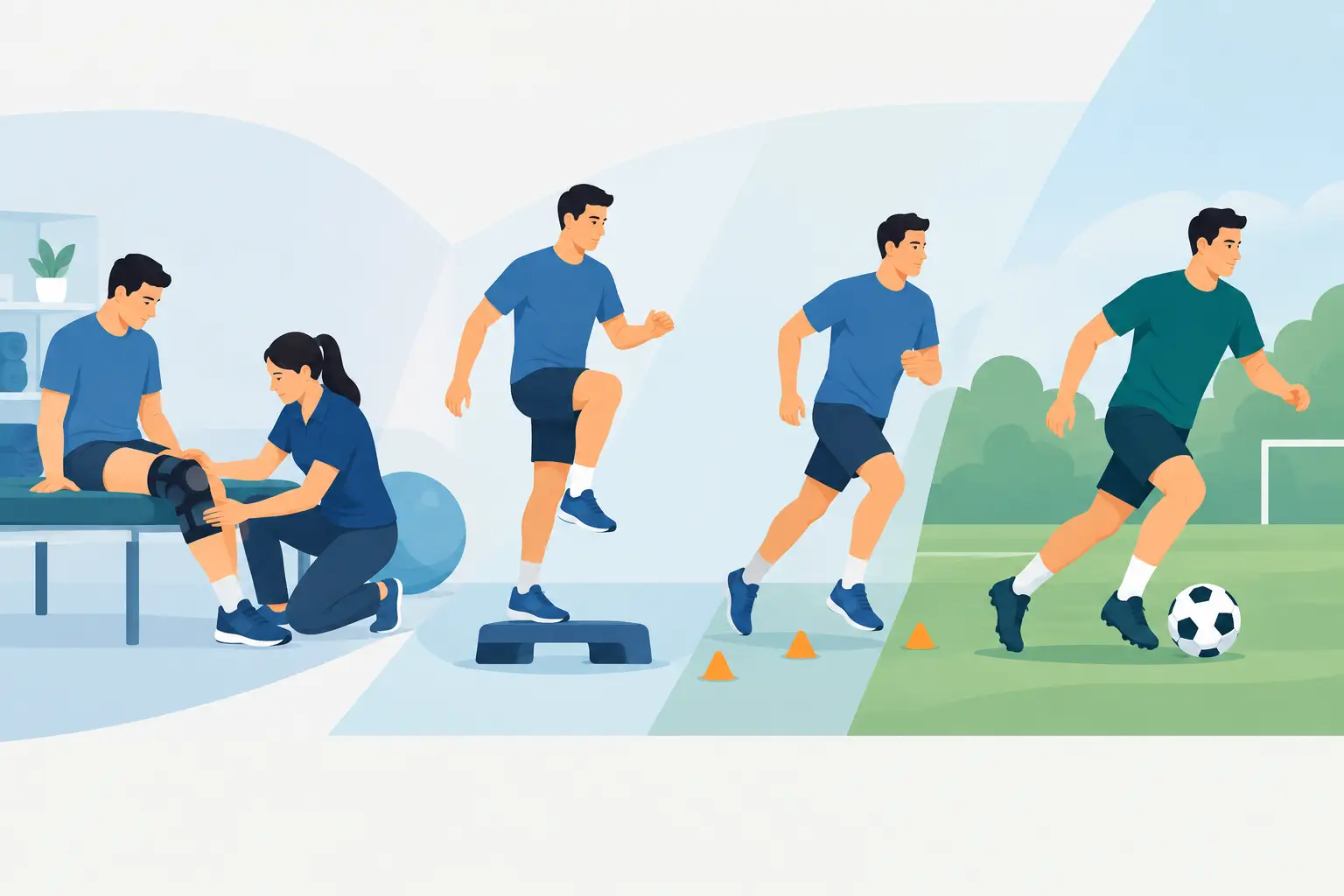
A return to sport is not the same thing as feeling a little better. An athlete can walk without pain, jog for five minutes, or complete a few bodyweight exercises and still be unprepared for cutting, landing, sprinting, contact, or a full practice. That gap is where reinjury often happens. This example of return to play protocol shows how a structured plan moves an athlete from injury recovery to confident, sport-ready performance.
The exact timeline will vary. A mild ankle sprain and an ACL reconstruction do not follow the same calendar, and neither should a runner, golfer, tennis player, and soccer player receive the same final tests. The standard, however, should stay high: restore the limiting factors, build capacity, test the demands of the sport, and earn each progression with objective performance.
What a return to play protocol is designed to do
A return to play protocol is a staged decision-making process, not a set number of rest days. It helps a physical therapist, coach, athlete, and when appropriate, physician determine whether the body can tolerate the next level of activity without a meaningful flare-up or elevated risk of reinjury.
The process begins with the actual source of the problem. Pain at the knee, for example, may involve local tissue irritation, but it can also reflect limited ankle motion, poor hip control, reduced quad strength, poor landing mechanics, training errors, or a combination of factors. Treating symptoms without addressing those contributors can produce a quick return and a short-lived result.
At Back In Motion, this progression fits the same principle behind The Gray Method™: assess the movement system, correct the restriction, strengthen the solution, and build the person back to the demands that matter to them. For an athlete, that means more than a pain-free clinic exercise. It means being able to perform when the pace is high and fatigue is present.
An example of return to play protocol in five phases
Consider a recreational soccer player who sustained a moderate lateral ankle sprain. She wants to return to league matches, which require repeated acceleration, deceleration, cutting, uneven-field tolerance, and occasional contact. Her protocol should be built around those requirements rather than a generic ankle exercise sheet.
Phase 1: Protect the injury and settle symptoms
Early care aims to reduce irritability while maintaining as much safe movement as possible. The athlete may need temporary activity modification, bracing or taping, and guidance on swelling management. Complete rest is not automatically the answer. When appropriate, controlled loading often helps preserve mobility and confidence.
Progression is based on signs such as decreasing swelling, a normalizing walking pattern, improving ankle range of motion, and an ability to tolerate basic weight-bearing activity. Pain should be monitored, not ignored. Mild discomfort during rehabilitation can be acceptable in some cases, but sharp pain, increasing swelling, limping, or symptoms that worsen over the next 24 hours signal that the load was too high.
Phase 2: Restore motion, control, and baseline strength
Once basic walking is comfortable, rehabilitation shifts toward the deficits that can alter movement. The athlete works to restore ankle mobility, regain calf and lower-leg strength, and improve balance. Hip and trunk strength matter here as well because the ankle does not absorb force in isolation.
This phase may include progressive calf raises, resisted ankle work, single-leg balance, step-downs, split squats, and controlled single-leg strength training. Quality matters as much as quantity. A knee collapsing inward, a trunk shifting excessively, or an athlete avoiding the injured side can reveal compensations that need to be corrected before higher-speed work begins.
A useful benchmark is the ability to walk briskly, climb stairs, perform controlled single-leg calf raises, and balance on the involved side with minimal symptoms and no major side-to-side difference. The specific targets depend on the athlete’s injury history, sport, and baseline ability.
Phase 3: Build strength and reintroduce impact
Running and jumping are not simply cardio activities. They are repeated force-absorption tasks. Before returning to them, the athlete needs sufficient strength through the foot, ankle, calf, knee, hip, and trunk to control landing and push-off.
Training becomes more demanding in this phase. It may include loaded squats, deadlifts or hinges, lunges, step-ups, calf loading, low-level hopping, and landing drills. The athlete first learns to land quietly and symmetrically, then progresses from two legs to one leg and from predictable drills to more reactive tasks.
Impact typically returns in doses. A walk-jog progression may start with short jogging intervals on a flat, controlled surface. Hops may begin in place before advancing forward, sideways, and over a line. The athlete earns more speed and volume when the current dose does not cause pain, swelling, apprehension, or deterioration in movement quality.
Phase 4: Train the specific demands of the sport
This is where many return plans become incomplete. An athlete may pass a basic strength test yet still lack the conditioning or decision-making ability required in competition. Soccer demands lateral shuffling, sharp cuts, acceleration, deceleration, dribbling, visual distraction, and unpredictable opponents. Tennis, basketball, running, and golf each require a different final progression.
For the soccer player, sport-specific work might begin with straight-line running, then controlled changes of direction, figure-eight runs, shuttle drills, lateral bounds, ball work, and eventually reactive cutting drills. Practice exposure also needs a plan. A brief noncontact session is not equivalent to a full match.
A sensible build may move from individual drills to limited practice minutes, then controlled team practice, then full practice, and finally competition. Training load should rise gradually enough for the body to adapt but quickly enough to rebuild the fitness the athlete needs. The best pace depends on symptoms, tissue healing, conditioning, and the athlete’s response after each session.
Phase 5: Test readiness and return with a plan
Final clearance should combine clinical findings, performance testing, sport exposure, and athlete confidence. No single test can guarantee safety. Still, objective testing gives the return decision more substance than “it feels okay.”
For a lower-body injury, testing may compare single-leg strength, calf endurance, hop distance, hop control, landing mechanics, change-of-direction ability, and sport-specific conditioning. In many cases, clinicians look for minimal asymmetry between sides, often within roughly 10 percent, but that number is not a universal pass-fail rule. An athlete’s preinjury level, movement quality, and sport demands matter.
Confidence deserves attention too. An athlete who hesitates to plant, land, or sprint may protect the injury in ways that create a new problem elsewhere. Confidence is built through successful exposure to progressively harder tasks, not by being told to stop worrying.
What can delay a safe return
The most common mistake is treating the calendar as the protocol. Tissue healing timelines offer useful guidance, but they cannot show whether an athlete has restored strength, control, work capacity, and readiness for the demands ahead.
Another mistake is jumping from rehab exercises directly into a game. The middle ground – controlled impact, speed, cutting, and practice exposure – is where the body learns to handle real-world stress again. Skipping it can leave an athlete physically underprepared even when daily life feels normal.
A flare-up does not always mean the recovery has failed. It may mean the progression needs adjustment. Red flags include persistent swelling, increasing pain, instability or giving way, loss of motion, a new limp, or symptoms that are worse the next day. These signs warrant reassessment rather than pushing through.
Return to play should mean return with capacity
A strong protocol does not rush an athlete back to the field, court, course, or gym. It gives them a clear path to return stronger, more capable, and better prepared for the movements that caused trouble in the first place. If you are recovering from an injury in Fort Myers, the right question is not simply, “When can I play?” It is, “What do I need to prove my body can handle before I play again?”
About the Author: Dr. Scott Gray




 Call (239) 223-0484
