
How to Improve Squat Depth Without Forcing It
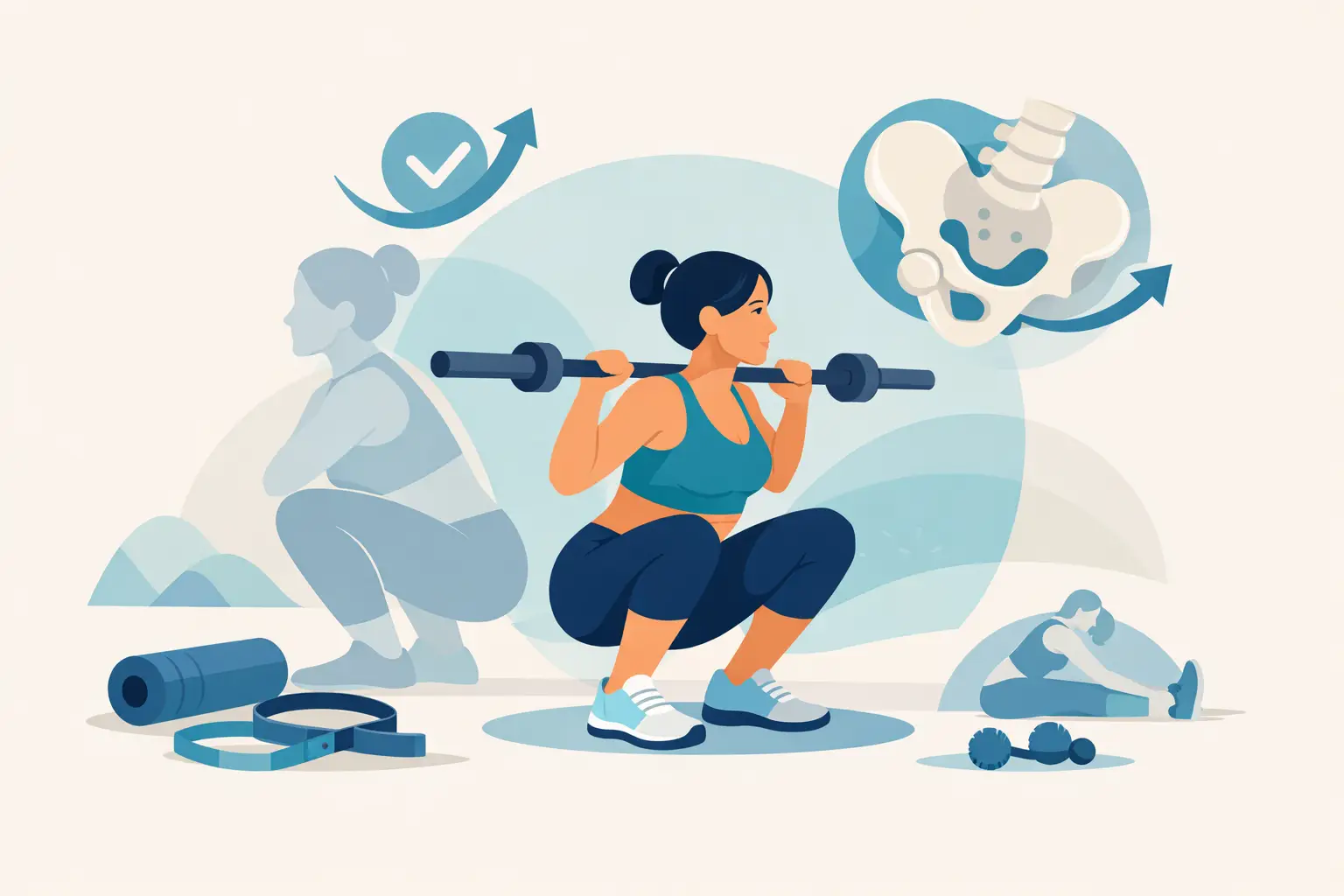
A squat that stops above parallel is not automatically a problem. But if you used to move deeper, feel pinching or pain, lose your balance, or cannot reach the depth your sport or training goals require, there is a reason to investigate. Knowing how to improve squat depth starts with identifying what is actually limiting you instead of forcing your body into a position it cannot yet control.
For some people, the restriction is at the ankle. For others, it is hip control, trunk positioning, strength, confidence after an injury, or simply a squat stance that does not fit their anatomy. The goal is not to chase an arbitrary depth. The goal is to build a squat you can own: stable, strong, repeatable, and appropriate for your body and your goals.
What Actually Limits Squat Depth?
Squat depth is a whole-body movement problem, not just a flexibility test. Your ankles need enough forward motion for the knees to travel forward. Your hips need room to flex and rotate. Your trunk must stay controlled over your base of support. Your knees, feet, and pelvis need to work together under load.
When one area cannot contribute, another area compensates. You may lift your heels, collapse your arches, round your low back at the bottom, shift to one side, or tip forward excessively. Those compensations are useful clues. They tell you where to assess, rather than where to blindly stretch.
Body proportions matter, too. A long-femured lifter may naturally use more forward torso lean than someone with shorter femurs. Hip socket shape varies from person to person, so the stance and toe angle that feels strong for your training partner may feel restricted for you. A good squat is not defined by one identical posture.
Start With a Better Squat Setup
Before adding mobility drills, adjust the variables that can immediately change your movement. Try a stance slightly wider than hip width, then test a few positions wider or narrower. Turn the toes out modestly and allow your knees to track in the same general direction as your toes.
As you descend, think about sitting down between your hips rather than pushing your hips straight back. Let your knees travel forward if your feet remain grounded and your heels stay heavy. Many active adults have been told that knees should never move past toes. That cue can unnecessarily limit depth, especially when the ankles need to contribute.
Keep pressure distributed through the whole foot: heel, base of the big toe, and base of the little toe. If the big toe loses contact or the arch collapses, your knee and hip may struggle to stay organized. A controlled exhale as you lower can also help you avoid gripping through the low back or holding unnecessary tension.
Use a light counterbalance if needed. Holding a small plate or dumbbell in front of your chest during a goblet squat can help you stay more upright and explore depth with better control. It is not cheating. It is a practical way to find out whether balance and trunk position are part of the limitation.
Check the Ankles Before You Stretch the Hips
Limited ankle dorsiflexion is one of the most common barriers to a deeper squat. If your shin cannot move forward over your foot, your body will often compensate by lifting the heels, turning the feet out dramatically, or shifting the torso forward.
A simple screen is the knee-to-wall test. Stand facing a wall with one foot flat on the floor. Drive your knee toward the wall without allowing your heel to rise or your arch to collapse. Move the foot back gradually until you find the farthest distance where the knee can still touch the wall. Compare sides.
A meaningful side-to-side difference, pain at the front of the ankle, or a clear inability to move the knee forward may warrant a closer look. Stiff calves can contribute, but the answer is not always aggressive calf stretching. Prior ankle sprains, joint irritation, foot mechanics, and motor control can all affect the result.
For a training-focused approach, use ankle mobility in the position you want to improve. Controlled knee-over-toe rocks, split squats with the front heel down, and slow tempo goblet squats can teach the ankle to tolerate and use more range. Stay within a tolerable range. Sharp pain, catching, or a blocked sensation is not a cue to push harder.
Build Hip Range You Can Control
Hip mobility is often blamed for shallow squats, but the more useful question is whether your hips can flex, rotate, and stabilize in your chosen stance. A deep squat requires the femur to move relative to the pelvis while the pelvis remains controlled.
If you feel a broad stretch or muscular tightness around the glutes or inner thigh, controlled exposure may help. Supported deep squat holds, adductor rock-backs, and split squat variations can build comfort in deeper hip flexion. Use slow breathing and maintain a neutral, controlled pelvis rather than forcing the low back to round for extra range.
If you feel a sharp pinch at the front of the hip, a catching sensation, or pain that worsens as you go deeper, do not treat it like ordinary tightness. Change the stance, reduce depth, use a heel lift temporarily, or choose a different squat variation while the issue is assessed. Pushing through joint symptoms can turn a manageable limitation into a persistent training problem.
Train Strength at the Edge of Your Current Range
Mobility without strength rarely sticks. Your nervous system is more likely to allow depth when it believes you can control that position. This is why the best answer to how to improve squat depth usually includes progressive strength training, not just stretching on the floor.
Start with a depth you can reach without pain or major compensation. A box squat can provide a consistent target, but use the box as feedback, not as something to crash into. Lower under control, lightly touch, and stand with even pressure through both feet.
Tempo is one of the most effective tools. A three- to five-second descent exposes the point where you lose position and gives you time to correct it. Pausing for one or two seconds just above your current limit can build confidence and strength without forcing a deeper range before you are ready.
Goblet squats are often an excellent bridge because the front-loaded position encourages a more upright torso. Front squats, landmine squats, and heel-elevated squats can also be useful depending on your structure, training experience, and symptoms. Heel elevation is not a permanent requirement for everyone, but it can be a smart training modification while ankle range and lower-body strength improve.
Do not neglect unilateral work. Split squats, step-downs, and single-leg strength drills reveal whether one side lacks ankle motion, hip stability, or knee control. They can also help athletes who consistently shift during a barbell squat.
Respect Pain, Pelvic Symptoms, and Compensation
Muscular effort is normal. Mild stretching discomfort may be acceptable. Pain that is sharp, escalating, or lingering after training deserves a different response. The same applies to numbness, instability, obvious side-to-side shifting, or repeated low-back rounding that you cannot correct with a lighter load or setup change.
Pelvic floor symptoms matter as well. Leaking, pelvic pressure, or pain during squats are not issues to ignore or normalize. Breathing strategy, load management, abdominal pressure, and pelvic floor coordination can all affect squat tolerance. A pelvic health physical therapist can help identify the right progression without asking you to stop strength training altogether.
Your training history also changes the plan. Someone returning after a knee injury may need gradual tendon and quad loading. A runner with limited ankle motion after repeated sprains may need foot and calf capacity work. A competitive athlete may need a deep squat for sport-specific positions, while a recreational lifter may be well served by a pain-free depth that supports long-term strength.
Progress Depth With a Clear Plan
Track one or two measurable markers instead of testing your maximum depth every workout. That could be the height of a box, the depth of a goblet squat with clean form, the distance in a knee-to-wall test, or your ability to pause at the bottom without shifting.
Train the pattern two to three times per week, leaving enough recovery to adapt. Add range before adding substantial load when movement quality is the primary limitation. Once the new depth is controlled, gradually increase resistance so the position becomes useful in real life, sport, and training.
If your squat has stalled despite consistent work, or if pain is part of the picture, a detailed movement assessment can remove the guesswork. At Back In Motion Physical Therapy & Performance, the focus is on identifying the movement restriction, addressing its source, and progressing strength so improvements hold up beyond the treatment table.
A deeper squat is earned through better options, not forced through stiffness or pain. Find the position your body can control, strengthen it patiently, and let depth become the result of improved movement rather than the test you keep failing.
About the Author: Dr. Scott Gray




 Call (239) 223-0484
