Rehab to Performance Training: Closing the Gap After Pain
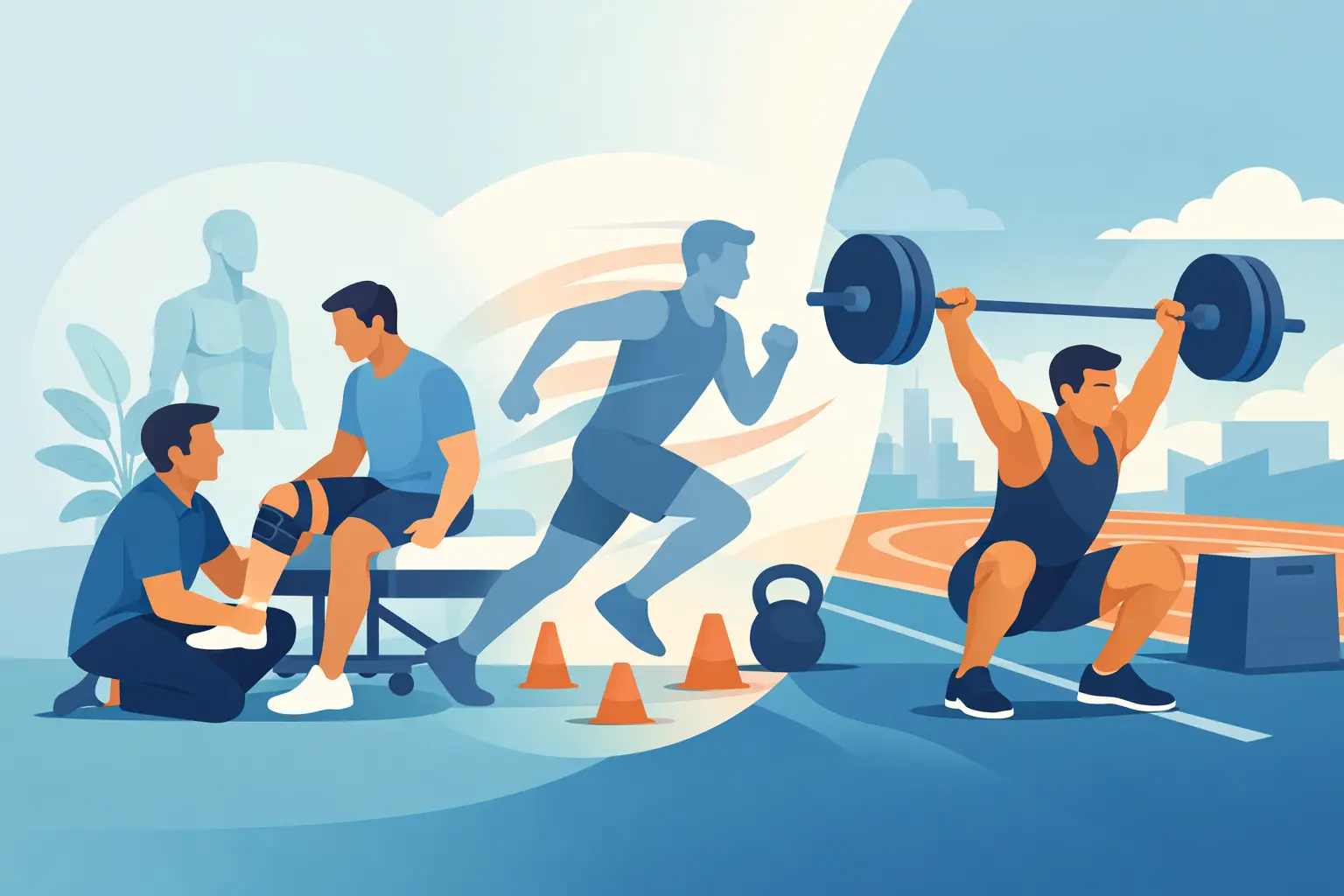
Pain-free isn’t the same as prepared. If your knee no longer hurts on the stairs but buckles when you cut on a tennis court, or your back feels fine until a heavy deadlift, the job isn’t finished. Rehab to performance training closes the gap between feeling better in the clinic and trusting your body when life, work or sport asks for more.
For active adults and athletes, that gap is where recurring injuries often start. Traditional rehab may reduce symptoms, restore basic motion and discharge you once daily tasks feel OK. Those are real milestones, but they don’t automatically prepare you to run, golf, lift, carry a child, play pickleball or compete at full speed. A better plan treats pain relief as the starting point for rebuilding capacity, not the finish line.
Why Pain Relief Alone Doesn’t Equal Readiness
Pain is a useful signal, but it isn’t a complete measure of how well you move or how much you can handle. Pain may settle before strength returns. You may regain motion without restoring balance, coordination, tissue tolerance or confidence under load.
Think of a runner recovering from Achilles pain. Walking comfortably and doing a few calf raises are early wins. Running asks for much more: repeated force through the foot and ankle, single-leg control, hip stability and conditioning, thousands of times per run. Skipping that progression can turn a good recovery into another flare-up.
The same goes for someone with back pain going back to the gym. Hands-on care, mobility work and core exercises can calm symptoms. But jumping straight back to old lifting volume, poor bracing or rushed technique can bring the problem back. The goal isn’t to protect your body from every challenge. It’s to build a body that can handle the challenges you care about.
What Rehab to Performance Training Should Include
This isn’t a generic workout bolted onto physical therapy. It’s a structured progression based on where you are now, what your body needs and what you want it to do next. At Back In Motion, it follows The Gray Method™: find the true source of the problem, restore the movement that’s limited, build strength around those gains, and gradually expose your body to real-world or sport-specific demands.
Start With a Clear Movement Assessment
A diagnosis matters, but it rarely tells the whole story. Two people with the same MRI finding may move differently and need completely different plans. One lacks hip mobility. Another has plenty of mobility but poor single-leg control. A third is strong but can’t tolerate volume after time off.
A good assessment looks beyond the painful spot. Knee pain when squatting can come from ankle stiffness, hip weakness, poor landing mechanics, training errors or a sudden jump in workload. Shoulder pain may connect to upper-back mobility, shoulder blade control or how often you press and throw. Treating only where it hurts may bring short-term relief. Finding why that area got overloaded is what creates lasting change.
Restore Mobility Without Chasing Flexibility
Mobility is the ability to control a movement through a usable range, not just stretch farther. Someone who can touch their toes may still lack the hip control for a deadlift. An athlete with loose shoulders may need stability and strength, not more stretching.
Early rehab may include hands-on treatment, targeted mobility drills, breathing strategies and low-load exercise that helps the nervous system tolerate movement again. For pelvic health clients, it can mean coordinating the pelvic floor with the diaphragm, hips and trunk, rather than assuming the answer is always more tightening. Mobility work is valuable when it improves a movement you need. It isn’t productive when it never turns into strength.
Build Strength in the Positions That Matter
Strength is the bridge between restored movement and confident activity. It gives joints and tissues the capacity to handle force, repetition and the unexpected.
Early strength work is often specific: controlled split squats after knee pain, slow rows for a shoulder, hip hinges for a back that has avoided loading, or single-leg calf work after an ankle injury. As control improves, exercises get harder through load, range, speed, complexity or volume. A golfer may need rotational control in the swing. A tennis player may need deceleration, lateral movement and overhead endurance. A parent may need the confidence to lift and carry through a busy day without guarding every move. Technique, dose, recovery and progression decide whether an exercise helps.
Progress From Controlled Strength to Real Demands
The final phase is where people need the most guidance. They may be strong in a controlled setting but unsure about running, jumping, changing direction, getting back under a barbell or playing a full match. Performance training introduces those demands in a logical order.
- Athletes: basic landing drills, then hops, acceleration work, cutting and finally sport-specific conditioning.
- Lifters: from a goblet squat to a barbell squat, rebuilding volume gradually.
- Active adults: heavier carries, uneven ground or a return to group fitness with a plan that respects current capacity.
Progress should be measurable. Useful markers include strength compared side to side, range of motion, movement quality, balance, work capacity, and how your symptoms respond the day after training. International return-to-sport guidance also describes it as a gradual process with checkpoints along the way, not a single date on the calendar.
There’s no universal timeline. A mild irritation in a well-trained person may progress quickly. A post-surgical recovery, long-standing pain or a demanding season may take more patience. The right pace is the fastest one your body can adapt to consistently.
The Mistakes That Keep People Stuck
- Stopping when pain drops: the most common mistake, and it leaves a big capacity gap.
- Jumping from easy exercises straight to full activity: motivation is high, but the body isn’t ready yet.
- Treating every flare-up as damage: mild soreness can be part of adapting. Intensity, duration, location and how it feels over the next day or two tell the story.
- Relying on passive care alone: hands-on treatment can reduce pain and improve movement, but it doesn’t replace the progressive loading that makes your body more capable.
Who Benefits From This Approach?
Rehab-to-performance care isn’t only for elite athletes. It’s for the runner who keeps stopping every few months because the same pain returns, the golfer whose back tightens after 12 holes, the busy professional who wants to get back to the gym safely, and the youth athlete rebuilding confidence after an injury.
It’s also for people who don’t think of themselves as athletic but want to stay strong and independent. Strength, balance, mobility and confidence are performance qualities when your goal is to keep up with your life.
It works best when your team understands both sides: how to manage pain and injury, and how to coach the movement and loading that come next. With physical therapy and sports performance training under one roof, you don’t have to choose between rehab and training when your goal needs both.
Keep reading: strength training after physical therapy, returning to lifting after injury and return to sport after injury.
Research
- Ardern CL, Glasgow P, Schneiders A, et al. 2016 Consensus statement on return to sport from the First World Congress in Sports Physical Therapy, Bern. Br J Sports Med. 2016;50(14):853-864. PubMed
Get Back to Full Strength, Not Just Pain-Free
At Back In Motion, every visit is one-on-one with a Doctor of Physical Therapy at our clinics in Fort Myers, Cape Coral and Estero. Using The Gray Method™, we find the cause, fix it, then help you rebuild with performance training after rehab so your results hold up.
Start with our Fixing the Cause & Not Just the Symptoms Assessment, or Inquire About an Appointment →
Call our office at (239) 223-0484 to schedule your appointment.
About the Author: Dr. Scott Gray


Get Dr. Gray's Best-Selling Book, Free
Why pain keeps coming back, and how The Gray Method™ helps you fix it for good.
Send Me the Free BookOur Most-Read Articles
- 1Three Conditions That Mimic Sciatica PainBack
- 2The Great Plantar Fasciitis Debate: Why Boots & Cortisone Rarely Fix ItFoot
- 3Common Causes of Lower Back Pain: Herniated DiscBack
- 4The 3 Most Common Symptoms of Knee Meniscal TearsKnee
- 5What Is Hip Bursitis?Hip
- 6Pelvic Pain Explained: When It's Not a UTI but Feels Like OnePelvic
What Do You Need Help With?
- 🩺Back, neck & joint pain→
- 💪Fitness for adults 50+→
- 💙Pelvic health→
- ⚡Sports performance→
- ⛳Golf performance→
Talk to a Doctor of Physical Therapy
One-on-one care that finds the cause of your pain. Fort Myers, Cape Coral & Estero.
Inquire About an Appointment Or call (239) 223-0484