Sports Rehabilitation Techniques: What Actually Speeds Recovery

When an injury interrupts your training, you want two things: to get back quickly, and to not get hurt again. Good sports rehabilitation delivers both by treating the injured area, finding what caused it, and rebuilding you for the demands of your sport.
Here are the sports rehabilitation techniques that make the biggest difference, how they fit together, and what a complete program looks like.
What Makes Sports Rehabilitation Different?
General rehab often ends when daily life feels normal. Sports rehabilitation keeps going until you can sprint, cut, jump, throw, swing, or lift again. It looks at the whole kinetic chain instead of just the painful spot, because a stiff ankle, weak hip, or limited upper back can overload a knee, shoulder, or elbow. It also accounts for real life: your training schedule, your season, your job, and your goals.
Technique 1: Hands-On Manual Therapy
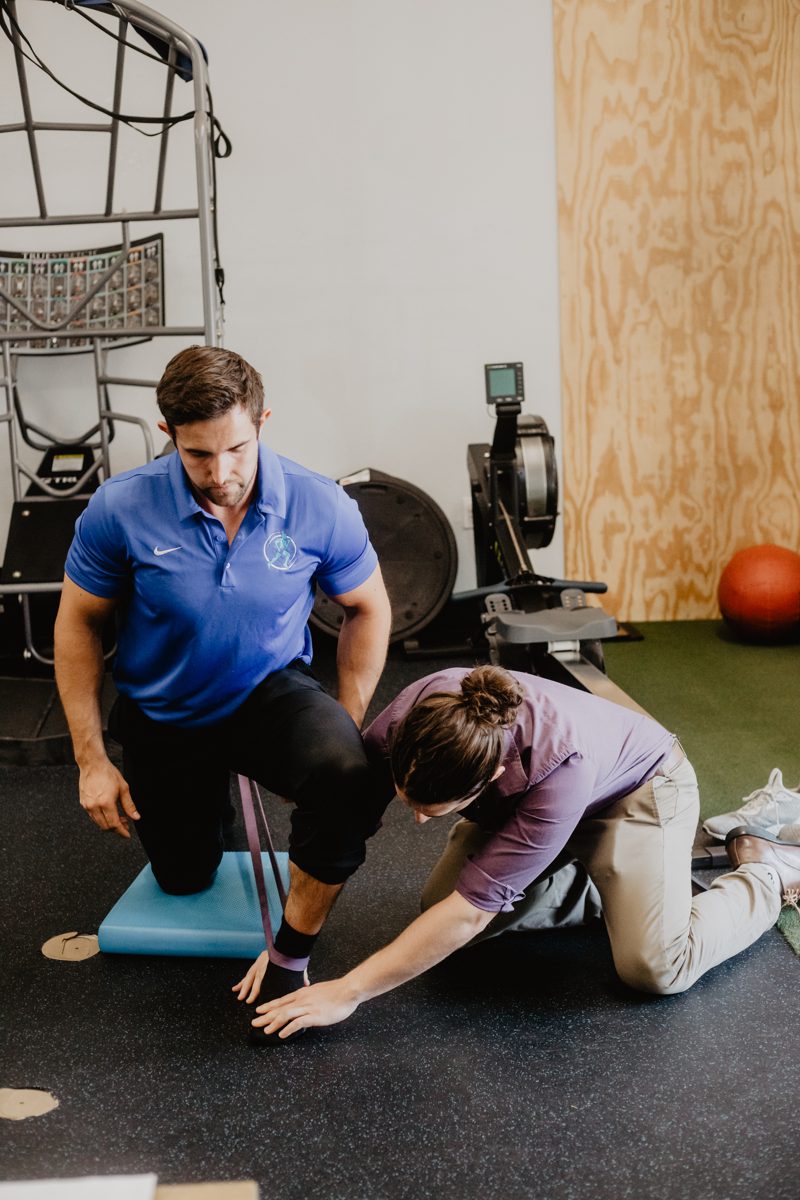
Manual therapy restores movement quality so strength training works better. Options include:
- Hands-on manual therapy and joint mobilization to restore stiff joints
- Spinal manipulation when the spine is limiting movement
- Soft tissue release with myofascial release and Active Release Technique
- Instrument-assisted soft tissue work with the Graston Technique® for scar tissue and stubborn restrictions
- Cupping therapy to ease deep muscle tension and improve tissue mobility
Technique 2: Dry Needling
Dry needling targets tight, irritable muscle and trigger points that keep pain going. It’s most useful as part of a plan that includes movement and strength work, not as a stand-alone fix.
Technique 3: Progressive Strength and Functional Training
Strength is what keeps you healthy once you’re back. A good program moves from basic activation to real-world patterns: pushing, pulling, rotating, jumping, decelerating, and single-leg control. Key tools include:
- Eccentric loading for tendons and muscles that get hurt while lengthening, like hamstrings and the Achilles
- Tempo and control work before speed
- Plyometric preparation and return-to-running and jumping progressions
- Therapeutic exercise tailored to your injury and sport
Technique 4: Blood Flow Restriction (BFR) Training
When pain, surgery, or injury keeps you from lifting heavy, blood flow restriction training lets you build strength with light loads. It’s especially helpful early after surgery or when a joint can’t tolerate heavy weight yet.
Technique 5: Seeing the Injury With MSK Ultrasound
When it’s unclear what’s really going on, musculoskeletal (MSK) ultrasound lets your therapist look at muscles, tendons, ligaments, and joints in real time, even while you move. It’s safe and radiation-free, and it helps base the plan on what’s actually seen.
Technique 6: Support While You Return
Kinesio taping can support muscles and joints as you get back to activity, and custom foot orthotics can help when foot mechanics contribute to recurring pain with sport.
Rehab Built Around the Injury
Each body area has its own priorities:
- Knee: quad activation, hip control, and gait and landing mechanics. Patellofemoral pain often improves with better hip and ankle mobility and progressive loading.
- Foot and ankle: mobility, balance, single-leg loading, and landing mechanics to prevent re-sprains.
- Shoulder: rotator cuff loading, shoulder blade control, and overhead stability for throwers, swimmers, and racket sports.
- Low back: core stability, hip strength, movement retraining, and loading progressions to get back to lifting, running, and rotational sports.
Progress One Step at a Time
One of the fastest ways to restart an injury is to feel better and jump straight back into full training. Pain often settles before strength and tissue capacity have fully returned, and that gap is where setbacks happen.
A better approach is to progress one thing at a time:
- Runners: build duration before speed, and easy miles before hills.
- Lifters: restore range and control before adding load. See our guide to returning to lifting after injury.
- Field and court athletes: build straight-line running before hard cuts, reaction drills and full-speed practice.
Mild, short-lived soreness can be normal during a well-designed progression. Sharp pain, swelling, loss of function or symptoms that build from session to session are signs to reassess the load.
Return-to-Sport Testing
Feeling better and being ready aren’t the same thing. Before full practice or competition, testing shows whether your body can handle your sport. Depending on the injury, that includes strength comparisons between sides, hop and jump tests, movement quality (landing, cutting, squatting, rotating), and sport-specific drills at real speed. See an example of a return-to-play protocol.
Confidence Is Part of Recovery
Fear of getting hurt again can hold you back as much as weakness. Rehab should rebuild trust step by step: controlled exposure to jumping, sprinting, cutting, or overhead work, clear milestones so you can see progress, and practice under game-like conditions before you’re back in real games.
From Rehab to Performance
Once you’re out of pain, the work isn’t done. Sports performance training picks up where rehab ends, building the speed, strength, and power that keep you on the field. Golfers can add a golf swing analysis to find the movement limits behind swing-related pain.
Frequently Asked Questions
How long does sports rehabilitation take?
It depends on the injury, how long you’ve had it, and what your sport demands. Progress should be measured by milestones and testing, not a fixed number of weeks.
Which technique is best?
No single technique fixes an injury. Hands-on care and tools like dry needling or BFR help you move and train better, but lasting results come from fixing the cause and rebuilding strength for your sport.
When can I return to my sport?
When your strength, movement quality, and sport-specific skills are back and you can perform without pain or hesitation. Testing replaces guessing with clear checkpoints.
Start Your Sports Rehabilitation at Back In Motion
At Back In Motion Physical Therapy & Performance, every visit is one-on-one with a Doctor of Physical Therapy. Using The Gray Method™, we find the root cause, fix it, and help you return to sport with confidence, with rehab, strength, and performance training under one roof.
Start with our Fixing the Cause & Not Just the Symptoms Assessment, a one-on-one visit that finds what’s driving your injury and maps out your plan.
Inquire About an Appointment →
Call our office at (239) 223-0484 to schedule your appointment.
About the Author: Dr. Scott Gray


Get Dr. Gray's Best-Selling Book, Free
Why pain keeps coming back, and how The Gray Method™ helps you fix it for good.
Send Me the Free BookOur Most-Read Articles
- 1Three Conditions That Mimic Sciatica PainBack
- 2The Great Plantar Fasciitis Debate: Why Boots & Cortisone Rarely Fix ItFoot
- 3Common Causes of Lower Back Pain: Herniated DiscBack
- 4The 3 Most Common Symptoms of Knee Meniscal TearsKnee
- 5What Is Hip Bursitis?Hip
- 6Pelvic Pain Explained: When It's Not a UTI but Feels Like OnePelvic
What Do You Need Help With?
- 🩺Back, neck & joint pain→
- 💪Fitness for adults 50+→
- 💙Pelvic health→
- ⚡Sports performance→
- ⛳Golf performance→
Talk to a Doctor of Physical Therapy
One-on-one care that finds the cause of your pain. Fort Myers, Cape Coral & Estero.
Inquire About an Appointment Or call (239) 223-0484