
Why Does My Hip Pinch During Squats or Runs?
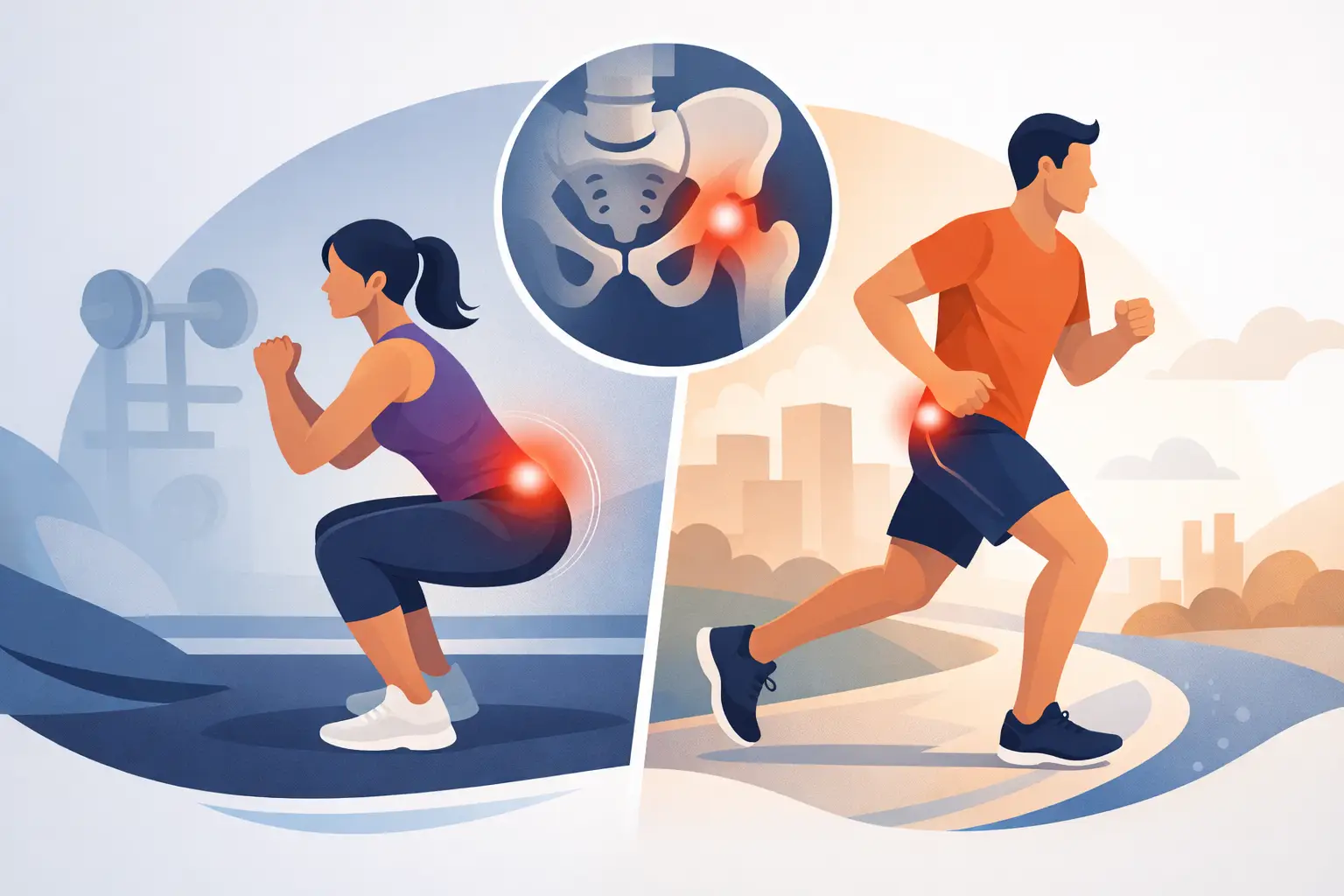
A hip pinch is rarely random. It often shows up at a very specific point: the bottom of a squat, the top of a deadlift, when bringing your knee toward your chest, getting out of a low car, or driving your leg behind you while running. If you are asking, why does my hip pinch, the more useful question is: what position, load, and movement strategy consistently creates it?
That distinction matters. A pinching sensation can come from the hip joint itself, the tissues around it, or a movement limitation elsewhere that forces the hip to do more than it should. Resting until it feels better may quiet the symptom, but it does not automatically correct the reason it returns when training resumes.
Why Does My Hip Pinch in Certain Positions?
The word “pinch” describes a sensation, not a diagnosis. Many people feel it at the front of the hip or deep in the groin when the hip moves into flexion, especially when flexion is combined with inward rotation or moving the knee toward the midline. Think deep squats, low chairs, lunges with poor control, cycling, or sitting with a leg crossed.
For others, the pinch is more lateral or on the outside of the hip. That may be related to how the pelvis and thigh are moving, irritation of tissues on the side of the hip, or reduced control during single-leg work. A sharp catch in the back of the hip can have a different set of contributors again.
The exact location matters, but so does the pattern. Does it occur only under load? Only after a long run? Only on one side? Does a wider squat stance reduce it? Does it happen after sitting but disappear once you warm up? Those details help separate a temporary sensitivity from a movement problem that needs a closer look.
The Hip Joint May Not Be Moving Well Under Load
One possible contributor is femoroacetabular impingement, often called FAI. This term describes a shape-related interaction between the ball and socket of the hip that can make certain positions less comfortable for some people. It is common to hear FAI blamed whenever the front of the hip hurts, but the picture is more nuanced.
Hip shape findings are common even in people with no pain at all. An X-ray or MRI alone cannot tell you whether a structural finding is the source of your symptoms. What matters is whether your symptoms, physical exam, movement tolerance, and activity demands all point in the same direction.
A hip can also pinch because it lacks usable motion, not necessarily because something is permanently “blocked.” If the joint, surrounding capsule, or muscles cannot comfortably access a position, your body may compensate by shifting the pelvis, twisting the femur, or forcing the range. Add a barbell, mileage, speed, or fatigue, and that compensation becomes more obvious.
Your Pelvis, Low Back, and Core Affect Hip Space
The hip does not work in isolation. The pelvis is the platform the hip moves from, and the low back contributes to how you reach a squat, hinge, stride, or split squat position.
A common example is someone who runs out of hip flexion during a squat and tucks the pelvis aggressively under at the bottom. Another person may arch through the low back and tip the pelvis forward to create range they do not truly own at the hip. Neither pattern is automatically wrong, but either can increase stress when repeated under load.
This is why stretching the front of the hip is not always the answer. If the real issue is poor pelvic control, limited ankle motion, a stiff upper back, or a squat setup that does not fit your body, repeatedly forcing a hip-flexor stretch can aggravate the area instead of improving it.
Strength and Control Can Be the Missing Link
Hip pinching often appears when the demand exceeds your current control. You might move well for three clean repetitions, then lose alignment on rep eight. You may feel fine jogging but notice a catch during hills, sprinting, cutting, or fatigue late in a tennis match.
The muscles around the hip need to coordinate the position of the femur and pelvis while you produce force. That includes the glutes, deep hip rotators, adductors, trunk musculature, and muscles that control the foot and ankle. Weakness is sometimes part of the issue, but timing, endurance, and load tolerance can be equally important.
This is also why generic “hip strengthening” may not solve the problem. A person who pinches in a deep squat needs more than a random band routine. They need to identify the range that causes symptoms, build control near that range, and progress back to the specific task that matters – whether that is lifting, golf, running, or simply picking up a child without hesitation.
Common Triggers That Give Useful Clues
A consistent trigger is valuable information. Pinching at the bottom of a squat may point toward limited hip flexion tolerance, stance issues, pelvic compensation, or a load that exceeds current capacity. Pinching during a lunge can reveal a difference between sides or difficulty controlling the pelvis in a split stance.
Running-related pinching can be influenced by stride length, hill volume, pace changes, training spikes, or reduced hip extension tolerance. A runner who suddenly adds speed work after a quiet offseason is dealing with a different problem than a runner who has had groin discomfort for two years.
Sitting pain is worth noting as well. Long periods with the hip flexed can make an irritable joint or surrounding tissue more sensitive. But if sitting is fine and only loaded training causes symptoms, your plan should focus heavily on progressive loading and movement mechanics rather than avoiding chairs.
What to Do When Your Hip Starts Pinching
Do not try to push through sharp pain. At the same time, do not assume you need to stop all activity. The best short-term adjustment is usually to reduce the movement that provokes the pinch while preserving training options that feel controlled.
For example, temporarily limit squat depth, use a box squat, adjust stance width, elevate the heels, reduce load, or substitute a pain-free lower-body pattern. Runners may need to reduce hills, speed, or total mileage while maintaining fitness with strength work or another tolerable conditioning option. The right modification depends on what changes the symptom.
Treat symptom reduction as information, not a permanent workaround. If a wider stance eliminates the pinch, that is a clue. If slowing the descent improves it, that is another clue. If every variation hurts the same way, the issue may need a more detailed assessment before you continue experimenting.
Avoid chasing the sensation with aggressive stretching, deep mobility drills, or repeated self-mobilization. If a drill produces a sharp catch, forcing more range can increase irritation. Mobility work should improve your ability to move and load, not create more pain during the process.
When a Hip Pinch Needs an Evaluation
A focused evaluation can identify whether the main driver is joint irritability, reduced mobility, poor load tolerance, a training error, or a combination. The goal is not simply to name a condition. It is to determine what you can do now, what needs to change, and how to rebuild capacity without guessing.
At Back In Motion Physical Therapy & Performance, that means assessing the painful movement in context. A squat pinch is evaluated differently from a pain pattern in a distance runner or a golfer who cannot rotate through the trail hip. Hip motion, strength, pelvic and trunk control, gait or lifting mechanics, training history, and side-to-side differences all matter.
Get assessed promptly if you have severe pain after a fall, cannot bear weight, have fever or unexplained illness with hip pain, notice significant swelling, numbness, progressive weakness, or pain that repeatedly wakes you at night. Persistent catching, locking, giving way, or groin pain that is not improving with sensible modifications also deserves professional attention.
Build Back to the Movement You Want
A successful plan does not end when the hip stops pinching during daily activity. It should restore confidence in the positions and loads your life requires. For an active adult, that might mean getting back to deep gardening, stairs, and travel. For an athlete, it may mean squatting, accelerating, cutting, rotating, and tolerating a full training week.
That progression usually begins by calming the irritated pattern and improving the movement options available to you. Then it advances through targeted strength, controlled range, and task-specific loading. The final stage matters most: returning to the exact depth, speed, volume, and unpredictability of your sport or training without relying on constant modifications.
Your hip pinch is not a verdict on what you can do forever. It is a signal that a particular movement strategy, range, or load needs attention. With a precise assessment and a progression built around your goals, you can move from avoiding that position to owning it again.
About the Author: Dr. Scott Gray


 Call (239) 223-0484
