
Rehab Program for Pickleball Injuries
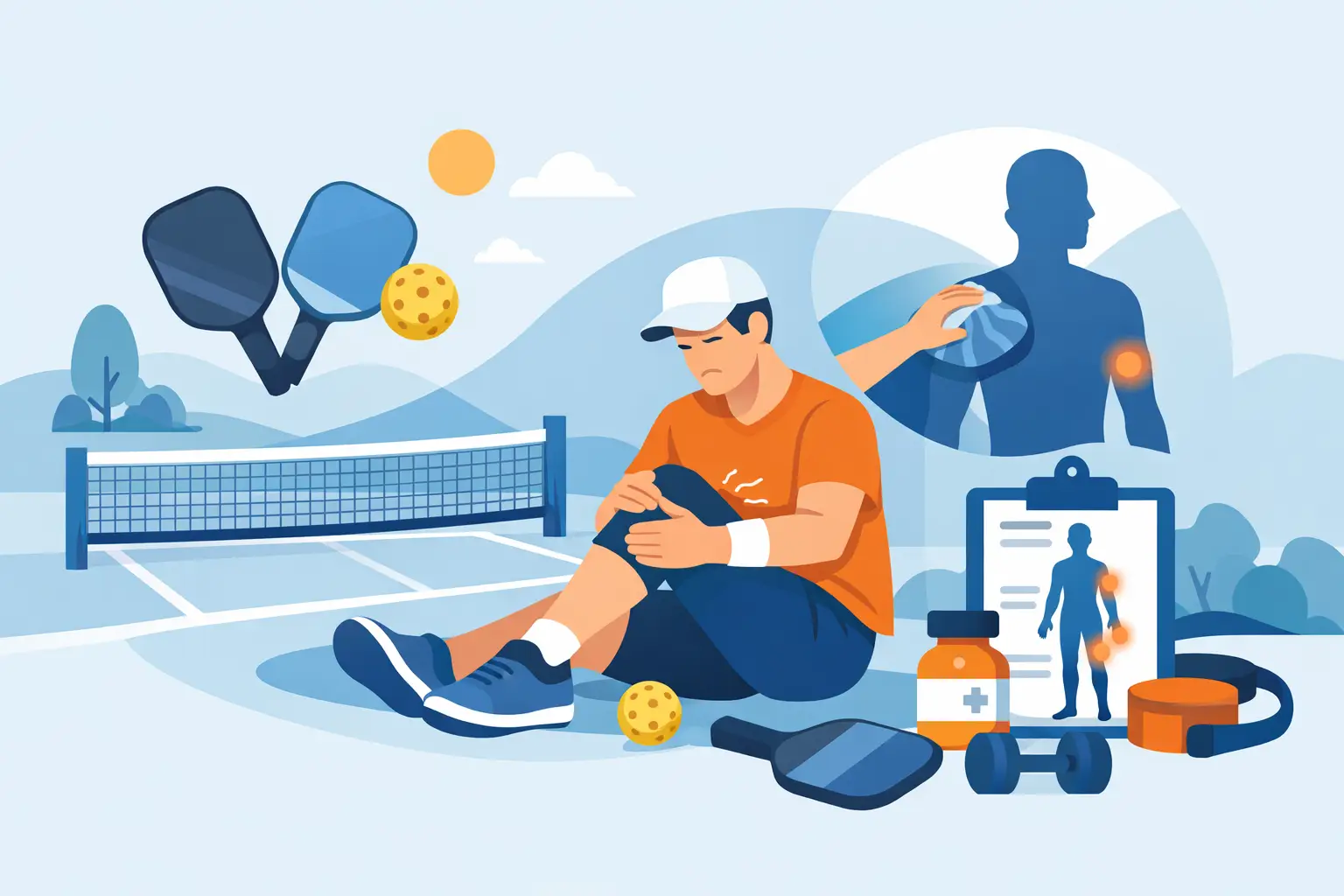
Pickleball injuries usually do not start with one dramatic moment. More often, they build from repeated serves, quick lateral cuts, rushed deceleration, and a shoulder, elbow, knee, or Achilles that was already working around a limitation. That is why an effective rehab program for pickleball injuries cannot stop at pain relief. If you want to get back on the court and stay there, the plan has to restore how you move, load, rotate, and recover.
For active adults, this matters because pickleball looks simple until your body has to react fast. Short sprints, awkward reaches, low balls, overhead shots, and repeated rotation place real demands on tissues that may not be prepared for them. A generic handout and a few stretches may calm symptoms for a week, but they rarely fix the reason the injury keeps coming back.
What a rehab program for pickleball injuries should actually do
The right program has a clear job. First, it should settle down pain and irritation. Second, it should identify what is driving the problem. Third, it should rebuild the specific capacity you need for pickleball, not just basic daily function.
That distinction matters. Being able to walk without pain is not the same as being ready to push off for a wide forehand. Having full shoulder motion on an exam table is not the same as controlling an overhead shot late in a match. Rehab that ends too early often creates the illusion of recovery. Then the same elbow pain, calf strain, or back tightness returns as soon as play intensity goes up.
A stronger plan looks at joint mobility, tissue tolerance, balance, lower body power, trunk control, and stroke-related loading. It also considers your schedule, age, conditioning level, and injury history. A player who competes three times per week needs a different progression than someone returning after months away from activity.
The most common pickleball injuries and why they happen
Pickleball can irritate almost any area, but a few patterns show up again and again. Elbow pain is common because repeated gripping and paddle impact can overload the forearm tendons, especially when wrist control and shoulder mechanics are poor. Shoulder pain often appears when players lack thoracic rotation, scapular control, or overhead strength. The shoulder becomes the area that absorbs the demand the rest of the body is not sharing.
In the lower body, knee pain, calf strains, and Achilles irritation are frequent. Quick changes of direction and sudden push-off require strong ankles, calves, hips, and good deceleration mechanics. If those systems are undertrained, the load shifts to the most irritated tissue. Low back pain also shows up when rotation, hip mobility, and core control are limited. The body still has to generate force somewhere.
This is where a root-cause approach matters. The painful area is not always the starting point. The elbow may hurt, but the issue may begin with shoulder weakness and poor trunk rotation. The Achilles may flare, but the bigger problem may be ankle stiffness and poor landing control. Treating symptoms without addressing those links usually leads to a short-term result.
Phase 1: Calm pain without shutting everything down
Early rehab should reduce irritation, but that does not always mean complete rest. In many cases, strategic loading is better than total shutdown. The goal is to keep the tissue active enough to heal and maintain your baseline strength while avoiding the spike in demand that keeps provoking symptoms.
That may mean modifying frequency, reducing court time, avoiding overhead shots for a period, or stepping back from aggressive lateral play. It can also mean targeted isometrics, controlled mobility work, and low-irritability strengthening for the involved area. If your pain increases for days after a session, the dosage is off. If the tissue never gets challenged at all, recovery tends to stall.
This phase should also address the basics that influence healing: sleep, recovery time between matches, warm-up quality, and how quickly you increased playing volume. Many pickleball injuries are not just movement problems. They are load management problems too.
Phase 2: Restore the mobility and control you actually need
Once symptoms are settling, the next step is not random stretching. It is targeted mobility and control based on what your body is missing. That might include ankle dorsiflexion for better push-off and deceleration, hip rotation for cleaner directional changes, thoracic mobility for overhead mechanics, or wrist and forearm function for paddle control.
Mobility alone is not enough. You need to own that motion. That means strength and control at the new range, not just passive flexibility. A player with more hip rotation but no lateral stability is still going to compensate. A player with improved shoulder motion but poor scapular control is still likely to overload the front of the shoulder.
This is often where progress starts to feel more meaningful. Movements become smoother. The body stops guarding as much. Pain with daily activity decreases, but more importantly, athletic movement starts to look cleaner.
Phase 3: Build strength that transfers to the court
This is the phase many people skip, and it is often the reason they plateau. Pickleball may not look like a power sport, but it demands repeated force production and force absorption. If your rehab never rebuilds strength, you are relying on tissues that are still underprepared.
Lower body strength matters for lunging, stopping, pushing laterally, and getting low to the ball. Hip strength helps control knee position and reduce sloppy side-to-side movement. Calf strength matters for every quick first step. In the upper body, shoulder and scapular strength support cleaner stroke mechanics, while forearm capacity helps the elbow tolerate repetitive contact.
The key is progressive loading. That means choosing the right exercises, but also advancing them at the right time. Early strength work may be controlled and bilateral. Later work should become more single-leg, more rotational, and more reactive. If the program never progresses beyond basic table exercises or light bands, it is not preparing you for match play.
Phase 4: Retrain speed, rotation, and deceleration
A true rehab program for pickleball injuries has to bridge the gap between clinic strength and court movement. This is where many athletes realize they are not as ready as they thought. They may feel fine in straight lines or during simple exercises, but symptoms return when movement becomes fast, lateral, or unpredictable.
Return-to-sport progression should include split-step timing, lateral shuffling, crossover patterns, rotation under control, and the ability to decelerate without collapsing through the knee, ankle, or trunk. For shoulder and elbow injuries, it should also include graded hitting volume and stroke-specific loading. You do not go from pain-free band work to a full weekend tournament without consequences.
This phase should feel athletic. Not reckless, but specific. The body needs practice absorbing and producing force in the same patterns that pickleball demands.
When the plan needs to be more individualized
Not every pickleball injury follows the same timeline. Tendon pain often responds differently than a muscle strain. Back pain may improve quickly, then flare if rotation volume rises too fast. Balance deficits, prior surgeries, and age-related stiffness can all affect progression.
This is why cookie-cutter protocols fall short. The right plan depends on what structure is involved, how irritable it is, what movement deficits are present, and what your return goal looks like. Getting back to social doubles once a week is different from preparing for high-volume league play. Both are valid goals, but they require different benchmarks.
At Back In Motion Physical Therapy & Performance, this is where a system like The Gray Method™ makes a difference. Instead of chasing symptoms, the process looks at what is driving the breakdown, corrects those limitations, and then progresses the athlete toward resilient movement and performance.
Signs you are ready to return to play
Pain reduction is part of the picture, but it is not the whole picture. You should also be able to move through key ranges without compensation, tolerate strengthening without lingering flare-ups, and handle sport-specific drills with control. Your confidence matters too. Hesitation changes mechanics, and changed mechanics often create new problems.
A solid return involves graded exposure. Start with shorter sessions, fewer explosive points, and enough recovery between play days to judge how the body responds. If symptoms spike the next morning or build across the week, the issue is not that you failed. It usually means the progression was too aggressive.
The best rehab does not just get you cleared. It makes you better prepared than you were before the injury.
Pickleball is one of the fastest-growing sports because it is fun, social, and competitive enough to keep people engaged. That also means it deserves more respect than many players give it. If your shoulder, elbow, knee, or Achilles keeps talking to you after every match, listen early. The right rehab plan can do more than get you out of pain. It can help you move with more confidence, play with fewer setbacks, and stay in the game longer.
About the Author: Dr. Scott Gray


 Call (239) 223-0484
