
How to Improve Hip Mobility That Lasts
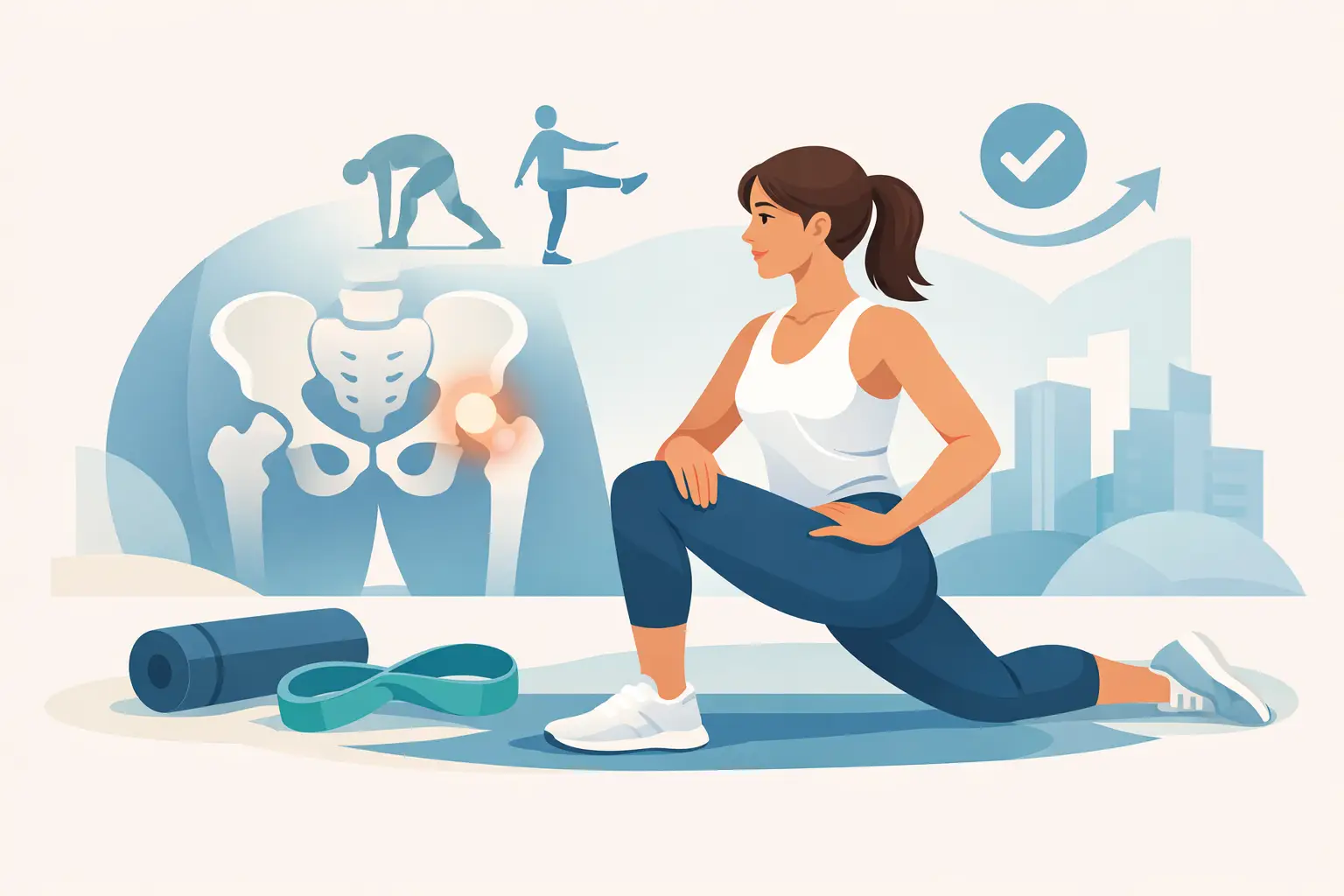
If your hips feel tight every time you squat, run, lunge, or get up from the floor, stretching harder usually is not the answer. How to improve hip mobility starts with a better question: are your hips actually stiff, or are they protecting you because you lack control, strength, or movement options somewhere else?
That distinction matters. Many active adults and athletes spend months chasing looser hips with random stretches, only to keep feeling pinching in the front of the hip, pulling through the hamstrings, or low back compensation during training. Real improvement comes from identifying what is limiting the motion, then building usable range you can control under load.
What hip mobility actually means
Hip mobility is not just how far you can pull your knee to your chest or how deep you can sit in a squat. It is your ability to access hip motion in multiple directions, with the pelvis and spine working well together, and then use that motion during real activity.
The hip is a ball-and-socket joint, so it needs flexion, extension, internal rotation, external rotation, abduction, and adduction. If one of those motions is limited, your body will usually find a workaround. That workaround might come from your low back, knees, feet, or even your ribcage position. The result is often not just stiffness, but pain, poor mechanics, and inconsistent performance.
This is why two people can both say their hips feel tight and need completely different solutions. One may need more internal rotation and better pelvic control. Another may have enough passive range but no strength or stability to use it.
Why your hips feel tight in the first place
Tightness is often a signal, not a diagnosis. Sometimes the joint is truly restricted. Sometimes the muscles around it are guarding because the body does not trust the position. Sometimes your training volume, sitting time, past injuries, or breathing mechanics are all adding to the problem.
Common contributors include limited hip rotation, poor core and pelvic control, weakness in the glutes and deep hip stabilizers, reduced ankle mobility, and lumbar spine compensation. For runners, golfers, tennis players, and lifters, repetitive movement patterns can also push stress into the same positions over and over. The body adapts, but not always in a way that helps performance.
There is also a trade-off to keep in mind. More range is not automatically better. If you gain motion but cannot control it, you may simply become more unstable. The goal is not loose hips. The goal is strong, coordinated hips that move well when you need them to.
How to improve hip mobility without wasting time
If you want to know how to improve hip mobility in a way that actually carries over to workouts and daily life, think in three steps: restore motion, own the motion, then load the motion.
Restoring motion means choosing drills that match your restriction. Owning the motion means building control at the edges of your range. Loading the motion means integrating that range into squats, split squats, hinges, step-ups, running mechanics, and rotational movement.
That progression is where many people get stuck. They do mobility work before a workout, feel better for ten minutes, then lose the gain because they never trained the new range.
Step 1: Target the actual limitation
Start by noticing where movement breaks down. If deep hip flexion causes a pinch in the front of the hip, forcing more aggressive stretching may make it worse. You may need better femur position, core engagement, or posterior hip activation rather than more passive range.
If you cannot rotate well, especially internally, that can affect squatting, cutting, sprinting, and changing direction. In that case, mobility drills for hip rotation often matter more than a generic hamstring stretch.
A few useful starting points include 90/90 hip rotations, adductor rock-backs, controlled hip airplanes with support, and half-kneeling hip flexor work done with proper pelvic position. The key is precision. If the low back is moving instead of the hip, the drill is missing the target.
Step 2: Build control at end range
This is where mobility becomes durable. Once you access a little more range, teach the body to hold and use it.
Isometric work is especially effective here. That might mean pausing in a 90/90 position and trying to lift the ankle or knee slightly off the ground, holding a split squat at the bottom with excellent alignment, or using slow tempo reps that challenge the hip to stay centered.
Control reduces the body’s need to guard. When your nervous system feels stable in a position, it is more likely to allow motion there.
Step 3: Strengthen the hips through full range
This is the part that changes how you move. Strength work should not be separate from mobility work. In many cases, it is the mobility work.
Deep goblet squats, split squats, Romanian deadlifts, lateral lunges, step-downs, and single-leg work can all improve hip mobility when performed with good mechanics and appropriate range. The exercise itself is less important than whether you can maintain alignment, breathing, and control without shifting stress somewhere else.
For example, a deep squat may help one person and irritate another. If your structure, current symptoms, or available control do not support that position yet, a heel-elevated squat, box squat, or supported split squat may be the better entry point.
The mobility mistakes that keep hips from improving
The biggest mistake is treating every hip the same. Front-of-hip tightness does not always mean your hip flexors are short. Hamstring tension does not always mean you need to stretch your hamstrings. Low back tightness during hinging does not always mean your back is the issue.
Another common mistake is doing mobility work only when you feel stiff. That creates a cycle of symptom chasing. Better results come from consistent exposure to the right drills and progressions, even on days when you feel fine.
People also tend to move too fast. If you rush through reps, force range, or turn every drill into a stretch contest, you lose the feedback that makes the exercise useful. Slower reps with cleaner mechanics almost always win.
Finally, many active adults ignore the role of programming. If your weekly training repeatedly overloads the same tissues and never addresses your movement limitations, mobility work becomes a temporary patch. Your warm-up, lifting plan, running volume, and recovery habits all affect what your hips will tolerate.
When hip mobility is really a movement strategy problem
Sometimes the issue is not your hip joint at all. It is how your body organizes movement.
A runner may have enough passive hip extension on a table, yet still overuse the low back because they cannot maintain trunk position during stride. A golfer may rotate poorly not because the hips are locked, but because the ribcage and pelvis are not coordinating well. A lifter may feel blocked at the bottom of a squat because the ankles, pelvis, and breathing mechanics are limiting the setup before the hips ever get a fair chance.
This is where a root-cause approach makes a difference. At Back In Motion Physical Therapy & Performance, that is why assessment comes first. If you do not know whether the limiter is joint restriction, motor control, strength, symptom irritability, or compensation from another area, you are guessing.
Signs you should get your hips evaluated
If your hips always feel tight on one side, if you get pinching in the front of the hip, if your low back takes over during leg training, or if you keep losing range despite doing mobility work, it is worth getting a closer look.
The same applies if pain shows up with squats, running, lunges, deadlifts, or rotational sports. Persistent stiffness after a previous injury can reflect unresolved mechanics, not just leftover tightness. And if pelvic health symptoms, groin discomfort, or recurrent hamstring strains are part of the picture, hip mobility usually needs to be addressed in a more specific way.
A good evaluation should tell you what motion is limited, what is compensating, what positions are currently irritable, and what progression makes sense for your goals. That is a much faster path than trying ten random exercises from social media.
What better hip mobility should feel like
You should not need a forty-minute mobility routine just to feel normal. Better hip mobility looks like smoother squats, cleaner lunges, easier stride mechanics, less low back compensation, and more confidence changing direction or training at higher intensity.
It also tends to feel less dramatic than people expect. Often the first win is not a huge increase in range. It is less pinching, better balance, stronger positions, and more freedom in movements that used to feel blocked. That is real progress because it transfers.
If your goal is to move well, train hard, and stay active without recurring setbacks, treat hip mobility as part of a bigger system. Restore the range you need, strengthen it, and make sure the rest of your body supports it. When the plan matches the problem, your hips stop feeling like the thing holding you back.
About the Author: Dr. Scott Gray


Get Dr. Gray's Best-Selling Book, Free
Why pain keeps coming back, and how The Gray Method™ helps you fix it for good.
Send Me the Free BookOur Most-Read Articles
- 1Three Conditions That Mimic Sciatica PainBack
- 2The Great Plantar Fasciitis Debate: Why Boots & Cortisone Rarely Fix ItFoot
- 3Common Causes of Lower Back Pain: Herniated DiscBack
- 4The 3 Most Common Symptoms of Knee Meniscal TearsKnee
- 5What Is Hip Bursitis?Hip
- 6Pelvic Pain Explained: When It's Not a UTI but Feels Like OnePelvic
What Do You Need Help With?
- 🩺Back, neck & joint pain→
- 💪Fitness for adults 50+→
- 💙Pelvic health→
- ⚡Sports performance→
- ⛳Golf performance→
Talk to a Doctor of Physical Therapy
One-on-one care that finds the cause of your pain. Fort Myers, Cape Coral & Estero.
Inquire About an Appointment Or call (239) 223-0484
