
What Causes Recurring Hamstring Strains?
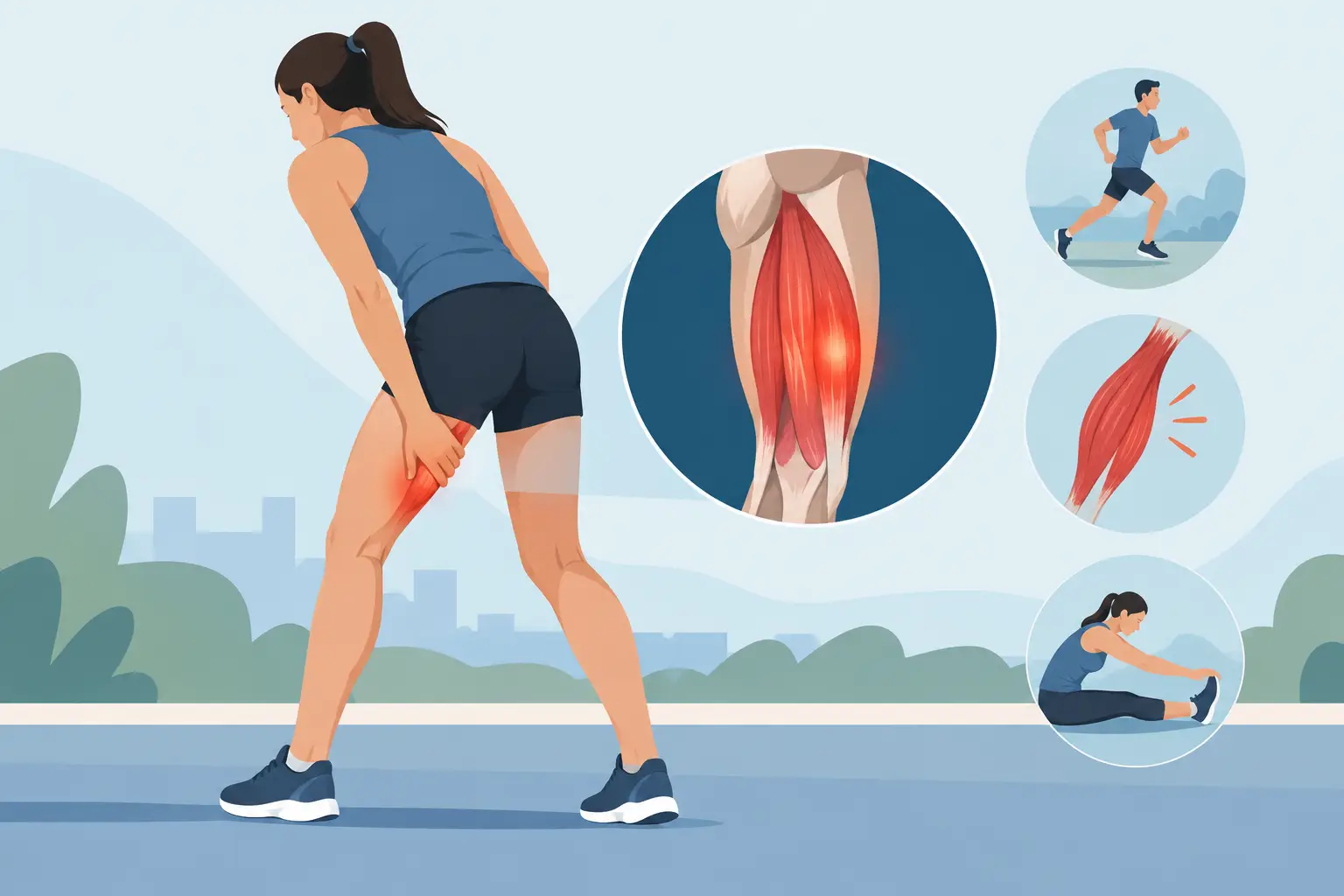
A hamstring strain that returns during the next sprint, pickup game, tennis match, or heavy deadlift is rarely just bad luck. When athletes ask what causes recurring hamstring strains, the answer is usually not one weak muscle or one missed stretch. It is a gap between what the hamstring can currently tolerate and what the body is being asked to do.
The hamstrings work hard during acceleration, deceleration, jumping, hinging, and rapid changes of direction. They must produce force while lengthening, coordinate with the glutes and trunk, and respond to the demands of the sport in milliseconds. If rehab only calms symptoms without rebuilding those capacities, the athlete may feel better long before they are truly ready.
Why recurring hamstring strains happen
A hamstring strain often improves quickly enough to create false confidence. Walking feels normal. Light jogging may be pain-free. Daily life no longer reminds you that an injury happened. But the final stages of recovery are where many reinjuries occur because high-speed running and explosive movement place demands on the tissue that everyday activity does not.
Recurring strains usually reflect a combination of incomplete tissue recovery, reduced strength at longer muscle lengths, movement compensations, and a training load that progressed too quickly. The exact mix depends on the person. A recreational runner returning after a long break has different demands than a soccer player who strained a hamstring during a maximal sprint, but both need more than rest and a few generic exercises.
Returning before high-speed capacity is restored
The hamstrings are especially vulnerable late in the swing phase of running, just before the foot contacts the ground. At that moment, they are lengthening under substantial force to slow the lower leg and prepare for ground contact. This is why someone can be pain-free during slow jogging yet feel a sudden pull during an all-out sprint.
A return-to-play decision should account for more than whether tenderness has disappeared. Can you accelerate, reach near-maximal sprint speed, decelerate, and repeat those efforts without symptoms or protective movement? Can you tolerate the fatigue that occurs in the fourth quarter, late in a race, or during the final sets of training? If the answer is no, the hamstring may not have regained the capacity required for the activity.
Strength deficits, especially at longer lengths
Hamstrings need strength through a wide range of motion. After a strain, people often regain strength in the positions that feel safe while avoiding the lengthened positions that challenge the injured area. That can leave a critical weakness during movements such as sprinting, a Romanian deadlift, a kick, or a forward reach.
This does not mean every person needs the same exercise. Nordic hamstring work can be valuable, but it is not a complete plan by itself. Some athletes need more controlled eccentric loading. Others need single-leg hinge strength, posterior chain endurance, or a better progression from slow strength work to high-velocity power. The right choice depends on symptoms, sport demands, available range of motion, and how the athlete moves.
The glutes, trunk, and pelvis are not doing their share
The hamstrings do not work in isolation. If the glutes are not contributing effectively during hip extension, the hamstrings may take on extra work. If the trunk and pelvis lose control during running, cutting, or hinging, the hamstring can be placed under unnecessary tension.
This is one reason a hamstring problem can persist despite dedicated hamstring exercises. The painful area may be where the overload shows up, not the only reason it developed. Limited hip motion, poor single-leg control, reduced ankle mobility, or an inefficient running pattern can all change how force is distributed through the lower body.
At Back In Motion, this is the difference between chasing the sore spot and assessing the full movement system. A precise evaluation looks at the injury, but also at the joints, strength patterns, and sport-specific tasks that may be feeding the problem.
Training load changed faster than the body adapted
A major spike in workload is one of the most common contributors to hamstring injuries. It may be obvious, such as returning to full-speed soccer after several weeks off. It can also be subtle: adding hill sprints, increasing weekly mileage, joining a new league, lifting heavier, or stacking hard workouts with poor recovery.
The issue is not that hard training is harmful. Progressive training builds resilience. The problem is asking for a level of speed, volume, or intensity that exceeds recent exposure. Hamstrings adapt to load when it is introduced consistently and progressed appropriately. They are more likely to flare when the body goes from low demand to high demand without enough preparation.
For active adults, this often happens on the weekend. A desk-based week with limited movement is followed by a hard round of golf, a competitive tennis match, or a long run in Florida heat. The hamstring is not weak because you are inactive in every sense. It may simply be underprepared for the specific demand placed on it that day.
Other factors that can keep a hamstring strain recurring
Previous injury changes the equation
A prior hamstring strain is one of the strongest predictors of another. The muscle may have residual weakness, altered coordination, or reduced confidence at high speed. Scar tissue itself is not automatically a problem, but returning to sport without restoring strength and movement quality can leave the area less prepared for future loading.
Pain can also change how you move. Many people unconsciously shorten their stride, avoid a deep hinge, or shift weight away from the injured side. Those strategies may protect the area early on, but they can become part of the pattern if they are never addressed.
Mobility matters, but stretching is not the whole answer
Tightness is often blamed for recurrent hamstring strains, yet feeling tight does not always mean the hamstring needs more stretching. Tightness can be a protective response to weakness, fatigue, neural tension, or poor control elsewhere. Aggressive stretching into a recently strained hamstring may aggravate symptoms rather than solve the cause.
Mobility should be evaluated in context. Some people benefit from restoring hip motion or improving tolerance to lengthened hamstring positions. Others need less stretching and more strength. The goal is not to become unusually flexible. It is to move through the ranges your sport or training requires with control and confidence.
The diagnosis may not be as simple as a muscle strain
Pain in the back of the thigh is not always a straightforward hamstring strain. Irritation from the lower back, sciatic nerve sensitivity, proximal hamstring tendon issues near the sit bone, or referred pain from the hip can feel similar. Persistent pain with sitting, numbness or tingling, pain traveling below the knee, or repeated symptoms without a clear mechanism deserve a thorough assessment.
This is also why an individualized plan matters. Treating nerve-related symptoms, tendon irritation, and a mid-muscle strain with the same protocol can delay progress.
How to break the repeat-injury cycle
A durable recovery follows a progression, not a calendar date. Early care may focus on calming symptoms and restoring comfortable movement. From there, the plan should rebuild strength, especially eccentric strength, along with hip and trunk control. Then it must progress to the specific demands that caused the problem: faster running, cutting, kicking, jumping, lifting, or repeated efforts under fatigue.
Testing matters. Side-to-side strength comparisons, single-leg control, range of motion, sprint tolerance, and sport-specific drills provide better information than guessing based on how the hamstring feels at rest. An athlete does not need perfect symmetry to return, but obvious deficits and symptoms at higher speeds should not be ignored.
Recovery also depends on the load outside the clinic or gym. Sleep, nutrition, total weekly activity, hydration, and schedule all affect how well tissues adapt. For athletes training in Southwest Florida, heat can raise fatigue quickly, which can expose movement breakdown late in a session. That does not mean avoiding hard work. It means planning it with enough recovery and progression to make the work productive.
The most useful question is not, “How do I make this hamstring stop hurting?” It is, “What does my body need to handle the activity I want to return to?” When that question guides assessment and training, the goal becomes more than getting back on the field or into the gym. It becomes staying there with stronger, more confident movement.
About the Author: Dr. Scott Gray





 Call (239) 788-0838