The #1 Mistake That Leads to Pickleball Injuries
Pickleball has exploded in popularity over the past decade, drawing millions of new players across the United States and beyond. In fact, according to the Sports & Fitness Industry Association (2023), pickleball participation grew by nearly 159% over three years, making it the fastest-growing sport in the country. Courts are being built everywhere, from retirement communities to public parks, and more people than ever are picking up a paddle.
But with rapid growth comes a new challenge: pickleball injuries.
A national study of U.S. emergency-department visits found that senior pickleball injuries grew so quickly from 2010 to 2019 that by 2018 they matched senior tennis injuries, and more than 85% of pickleball injury cases were players 60 or older (Weiss et al., 2021). The sport’s quick pivots, sudden stops, repetitive swings, and explosive movements can take a toll on joints and muscles, especially for adults who may already be dealing with age-related stiffness or weakness.
Yet here’s the real issue: the number one mistake most players make isn’t playing pickleball itself, it’s ignoring the root cause of their pain.
Instead of addressing why an injury is happening, most players simply chase the symptoms: ice an elbow, stretch a sore shoulder, or pop ibuprofen before a match. While these may provide short-term relief, they don’t fix the underlying dysfunction that keeps the pain coming back.
This article takes a deep dive into why that mistake is so costly, what science says about the root causes of pickleball injuries, and, most importantly, how to prevent them so you can stay on the court for years to come.
Pickleball’s Injury Problem
Who’s Getting Injured?
Pickleball has unique demographics compared to other sports. While players of every age are picking up a paddle, older adults make up most of the injuries: in emergency-department data from 2013 to 2022, the average injured player was 64 (Yu et al., 2025). This is the same group more likely to deal with reduced flexibility, lower bone density, and age-related muscle loss (Fragala et al., 2019).
The Most Common Pickleball Injuries
Research and clinical reports highlight the following as the most frequent injuries seen in pickleball players:
- Pickleball Elbow (Lateral Epicondylitis): Similar to tennis elbow, caused by repetitive wrist extension and gripping the paddle too tightly.
- Rotator Cuff Strains & Shoulder Impingement: From overhead smashes and repetitive swinging.
- Wrist Sprains: Sudden impact or awkward paddle positioning.
- Knee Injuries (Meniscus Tears, Patellofemoral Pain): Due to lunges, twisting motions, and stop-start running.
- Ankle Sprains: One of the most common acute injuries from quick side-to-side movement.
- Achilles Tendon Strains or Ruptures: Explosive pushes off the line without adequate warm-up.
- Plantar Fasciitis: Heel pain worsened by poor footwear or repetitive pounding.
- Low Back Pain: Rotational strain, especially in players with limited hip mobility.
What the Data Shows
- In a nationwide survey of 1,758 pickleball players (average age about 63), 69% reported at least one injury or physical complaint in the past year, and overuse problems were the most common “most serious” injury. About one in three were still playing through pain (Owoeye et al., 2025).
- Falls caused about two out of three pickleball injuries seen in U.S. emergency departments, fractures were the most common diagnosis, and the wrist was the most injured body part (Yu et al., 2025).
- A meta-analysis of 25 trials found that strength training cut sports injuries to less than one third, which shows how many of these injuries can be prevented (Lauersen et al., 2014).
The Symptom-Chasing Mistake
Most players believe that pain originates where they feel it. If their elbow hurts, they treat the elbow. If their knee swells, they ice the knee. This symptom-focused approach may quiet the discomfort temporarily, but it rarely prevents the injury from recurring.
Why Symptom Chasing Fails
The concept of regional interdependence explains why chasing symptoms is ineffective. This clinical model, described by Wainner et al. (2007), explains how problems in one region can contribute to pain in another.
- Elbow pain often comes from weak scapular stabilizers or poor thoracic rotation, forcing the forearm muscles to overwork.
- Knee pain frequently results from hip weakness or limited ankle mobility that alters lower limb mechanics.
- Low back pain is commonly tied to stiff hips or a restricted thoracic spine.
By ignoring these upstream and downstream dysfunctions, players repeatedly treat the wrong area, masking pain instead of fixing its source.
The True Root Causes of Pickleball Injuries
1. Limited Hip Mobility
Hips are the power center for athletic movement. Limited hip rotation increases stress on the knees and spine.
- Evidence: Neumann (2010) describes how the hip muscles power and control movement of the pelvis and trunk.
- Application to Pickleball: During lunges or side steps, poor hip mobility shifts forces into the knee, predisposing players to meniscus or ligament strain.
2. Weak Core and Glutes
Without core stability, the spine and smaller joints absorb forces they aren’t built to handle.
- Evidence: Hibbs et al. (2008) reviewed the research on core stability and core strength training for athletes, including reported improvements in low back injuries when core stability improves.
- Application to Pickleball: Quick reactions, lunges, and paddle swings require a stable base. Weak glutes and abs mean the back and knees overcompensate.
3. Restricted Thoracic Spine Rotation
Most paddle strokes involve trunk rotation. When the thoracic spine is stiff, the body compensates at the shoulder or low back.
- Evidence: Borstad (2006) found that upper-back and shoulder-blade posture is linked to a shorter pectoralis minor muscle, part of a proposed path from posture to movement problems and shoulder impairment.
- Application to Pickleball: Reaching for overhead shots with limited rotation stresses the rotator cuff tendons.
4. Age-Related Muscle Loss (Sarcopenia)
Muscle mass and function decline with age, a condition called sarcopenia (Fielding et al., 2011).
- Impact: Reduced type II muscle fibers impair quick reactions and increase risk of falls or ankle sprains.
- Application to Pickleball: Quick pivots and sudden changes of direction demand fast-twitch response that many older players lack without strength training.
5. Poor Recovery and Load Management
Pickleball is addictive. Many players log multiple hours, multiple days per week, often more than their body can handle.
- Evidence: In the national player survey, playing more days per week raised the odds of injury, and so did having fewer than 5 years of experience (Owoeye et al., 2025).
- Application to Pickleball: Without recovery days, micro-injuries in tendons and joints accumulate until they become chronic.
Research-Backed Solutions for Pickleball Players
1. Warm-Up & Mobility Drills
Skipping warm-ups is a major risk factor for injury.
- Evidence: A systematic review found that dynamic stretching gave small-to-moderate performance gains when done within minutes of activity (Behm et al., 2016).
- Practical Tip: Perform 5–10 minutes of hip openers, trunk rotations, and dynamic lunges before play.
2. Strength Training
Strength training is the single most effective intervention for injury prevention.
- Evidence: Lauersen et al. (2014) found that strength training cut sports injuries to less than one third, and that exercise programs overall nearly halved overuse injuries.
- Practical Tip: Incorporate squats, deadlifts, glute bridges, and resistance band work 2–3 times per week.
3. Movement Retraining
Correcting faulty patterns reduces stress on vulnerable joints.
- Evidence: Poor knee control when landing predicted ACL injury in athletes (Hewett et al., 2005), which is why we train how you land and change direction.
- Practical Tip: Practice controlled lunges and balance drills off the court.
4. Load Management
The body adapts best to gradual increases in stress.
- Practical Tip: Apply the “10% rule”, don’t increase play time or intensity by more than 10% per week.
5. Footwear & Equipment
Shoes and paddles matter more than players realize.
- Practical Tip: Wear shoes designed for lateral movement, not running. Choose paddle grip sizes that reduce wrist and elbow strain.
6. Flexibility & Recovery
Recovery is as important as training.
- Practical Tip: Incorporate foam rolling and light stretching post-match. Sleep and hydration also accelerate tissue repair.
How the Gray Method™ Is Different
Most clinics treat where it hurts. At Back In Motion, we treat why it hurts.
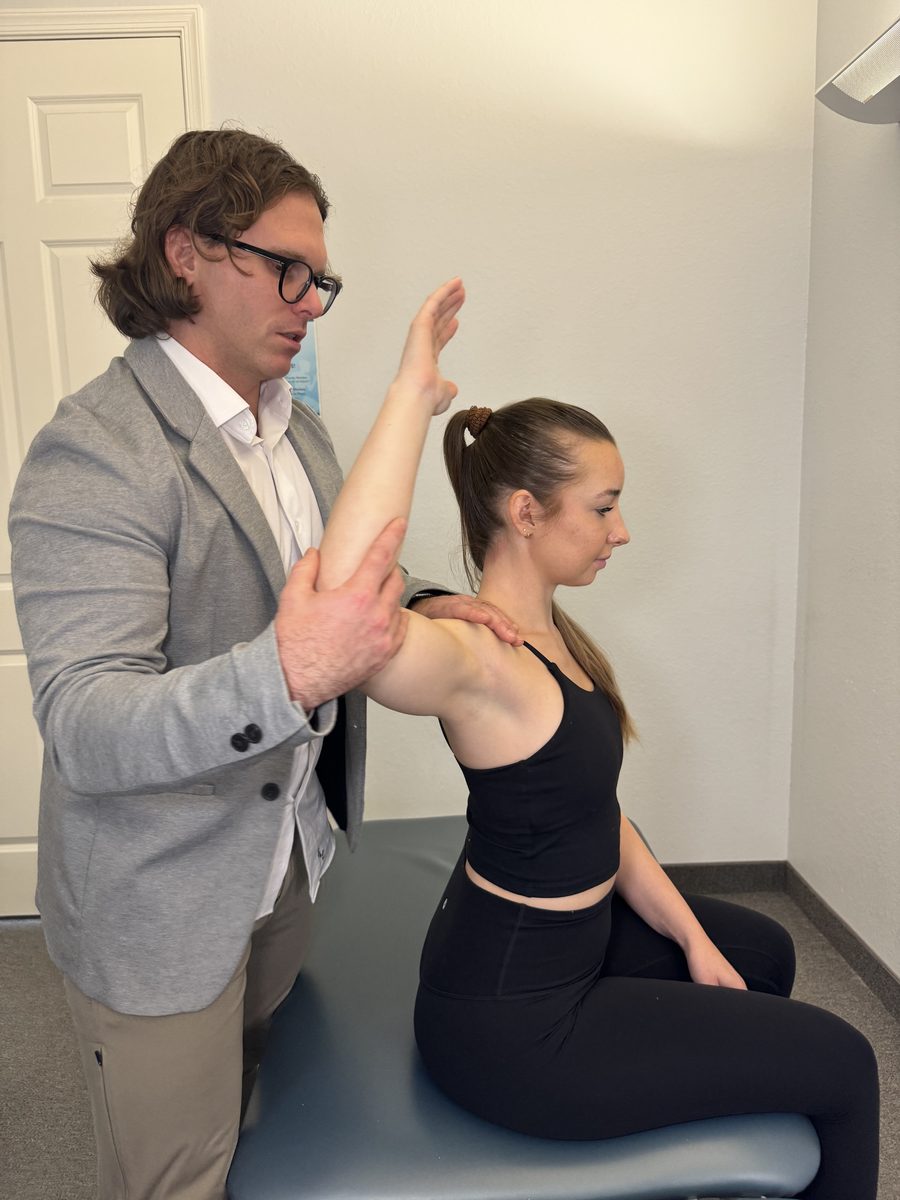
The Gray Method™ is the core of our pickleball injury treatment in Fort Myers. It evaluates the entire kinetic chain, hips, spine, shoulders, and more, to identify the weak links behind recurring pain. Instead of chasing symptoms, we fix the root cause.
Example Case:
A 62-year-old pickleball player came in with elbow pain. Instead of focusing only on the elbow, our assessment revealed:
- Limited thoracic spine rotation.
- Weak scapular stabilizers.
- Tight forearm flexors from poor grip mechanics.
By improving thoracic mobility, strengthening the shoulder blade muscles, and retraining his grip, the elbow pain resolved, and he returned to playing without fear of re-injury.
This root-cause approach is what sets us apart. You can see it in Susan’s story, and step by step in our rehab program for pickleball injuries.
When to Get Checked Right Away
Don’t play through these. See a doctor or physical therapist first:
- A pop or sudden sharp pain: followed by swelling or bruising
- You can’t bear weight: or a joint gives way or feels unstable
- Numbness, tingling or weakness: in an arm or leg
- Swelling that keeps building: or pain that is worse every session
- Night pain, fever or feeling unwell: along with the pain
Conclusion
Pickleball injuries aren’t just a matter of bad luck. They are the predictable outcome of one critical mistake: ignoring the root cause of pain.
Icing, stretching, and anti-inflammatories may get you through a match, but they don’t solve the problem. To stay healthy, mobile, and competitive, you need to:
- Improve mobility in your hips and thoracic spine.
- Build strength and stability in your core and glutes.
- Manage your training load.
- Invest in recovery.
And when pain persists, the smartest move is to get a full-body assessment that identifies why you’re hurting, not just where.
That’s what the Gray Method™ was built for. It’s how we help pickleball players across Fort Myers and Cape Coral not just recover from pain, but perform better than before.
Research
Peer-reviewed studies on pickleball injuries and injury prevention:
- Forrester, M. B. (2020). Pickleball-related injuries treated in emergency departments. Journal of Emergency Medicine, 58(2), 275–279. PubMed
- Weiss, H., Dougherty, J., & DiMaggio, C. (2021). Non-fatal senior pickleball and tennis-related injuries treated in United States emergency departments, 2010-2019. Injury Epidemiology, 8(1), 34. PubMed
- Vitale, K., & Liu, S. (2020). Pickleball: Review and clinical recommendations for this fast-growing sport. Current Sports Medicine Reports, 19(10), 406–413. PubMed
- Yu, J., et al. (2025). Increasing incidence of pickleball injuries presenting to US emergency departments: A 10-year epidemiologic analysis of mechanisms and trends. Orthopaedic Journal of Sports Medicine, 13(1). PubMed
- Owoeye, O. B. A., et al. (2025). Understanding injury patterns and predictors in pickleball players: A nationwide study of 1,758 participants. Sports Medicine – Open, 11(1), 100. PubMed
- Lauersen, J. B., Bertelsen, D. M., & Andersen, L. B. (2014). The effectiveness of exercise interventions to prevent sports injuries: A systematic review and meta-analysis of randomised controlled trials. British Journal of Sports Medicine, 48(11), 871–877. PubMed
Other References
- Behm, D. G., et al. (2016). Acute effects of muscle stretching on physical performance, range of motion, and injury incidence in healthy active individuals: a systematic review. Applied Physiology, Nutrition, and Metabolism, 41(1), 1–11.
- Borstad, J. D. (2006). Resting position variables at the shoulder: Evidence to support a posture–impairment association. Physical Therapy, 86(4), 549–557.
- Chodzko-Zajko, W. J., et al. (2009). American College of Sports Medicine position stand: Exercise and physical activity for older adults. Medicine & Science in Sports & Exercise, 41(7), 1510–1530.
- Fielding, R. A., et al. (2011). Sarcopenia: an undiagnosed condition in older adults. Journal of the American Medical Directors Association, 12(4), 249–256.
- Fragala, M. S., et al. (2019). Resistance training for older adults: Position statement from the National Strength and Conditioning Association. Journal of Strength and Conditioning Research, 33(8), 2019–2052.
- Hewett, T. E., et al. (2005). Biomechanical measures of neuromuscular control and valgus loading of the knee predict ACL injury risk in female athletes. American Journal of Sports Medicine, 33(4), 492–501.
- Hibbs, A. E., et al. (2008). Optimizing performance by improving core stability and core strength. Sports Medicine, 38(12), 995–1008.
- Neumann, D. A. (2010). Kinesiology of the hip: A focus on muscular actions. Journal of Orthopaedic & Sports Physical Therapy, 40(2), 82–94.
- Wainner, R. S., et al. (2007). Regional interdependence: A musculoskeletal examination model whose time has come. Journal of Orthopaedic & Sports Physical Therapy, 37(11), 658–660.
Don’t Wait Until You’re Sidelined
Fix the cause, and keep enjoying the game you love for years to come. Our pickleball injury treatment starts with The Gray Method™, one-on-one with a Doctor of Physical Therapy at our clinics in Fort Myers, Cape Coral and Estero.
Start with our Fixing the Cause & Not Just the Symptoms Assessment, or Inquire About an Appointment →
Call our office at (239) 223-0484 to schedule your appointment.
About the Author: Dr. Scott Gray


Get Dr. Gray's Best-Selling Book, Free
Why pain keeps coming back, and how The Gray Method™ helps you fix it for good.
Send Me the Free BookOur Most-Read Articles
- 1Three Conditions That Mimic Sciatica PainBack
- 2The Great Plantar Fasciitis Debate: Why Boots & Cortisone Rarely Fix ItFoot
- 3Common Causes of Lower Back Pain: Herniated DiscBack
- 4The 3 Most Common Symptoms of Knee Meniscal TearsKnee
- 5What Is Hip Bursitis?Hip
- 6Pelvic Pain Explained: When It's Not a UTI but Feels Like OnePelvic
What Do You Need Help With?
- 🩺Back, neck & joint pain→
- 💪Fitness for adults 50+→
- 💙Pelvic health→
- ⚡Sports performance→
- ⛳Golf performance→
Talk to a Doctor of Physical Therapy
One-on-one care that finds the cause of your pain. Fort Myers, Cape Coral & Estero.
Inquire About an Appointment Or call (239) 223-0484