
Corrective Exercise Versus Traditional Workouts
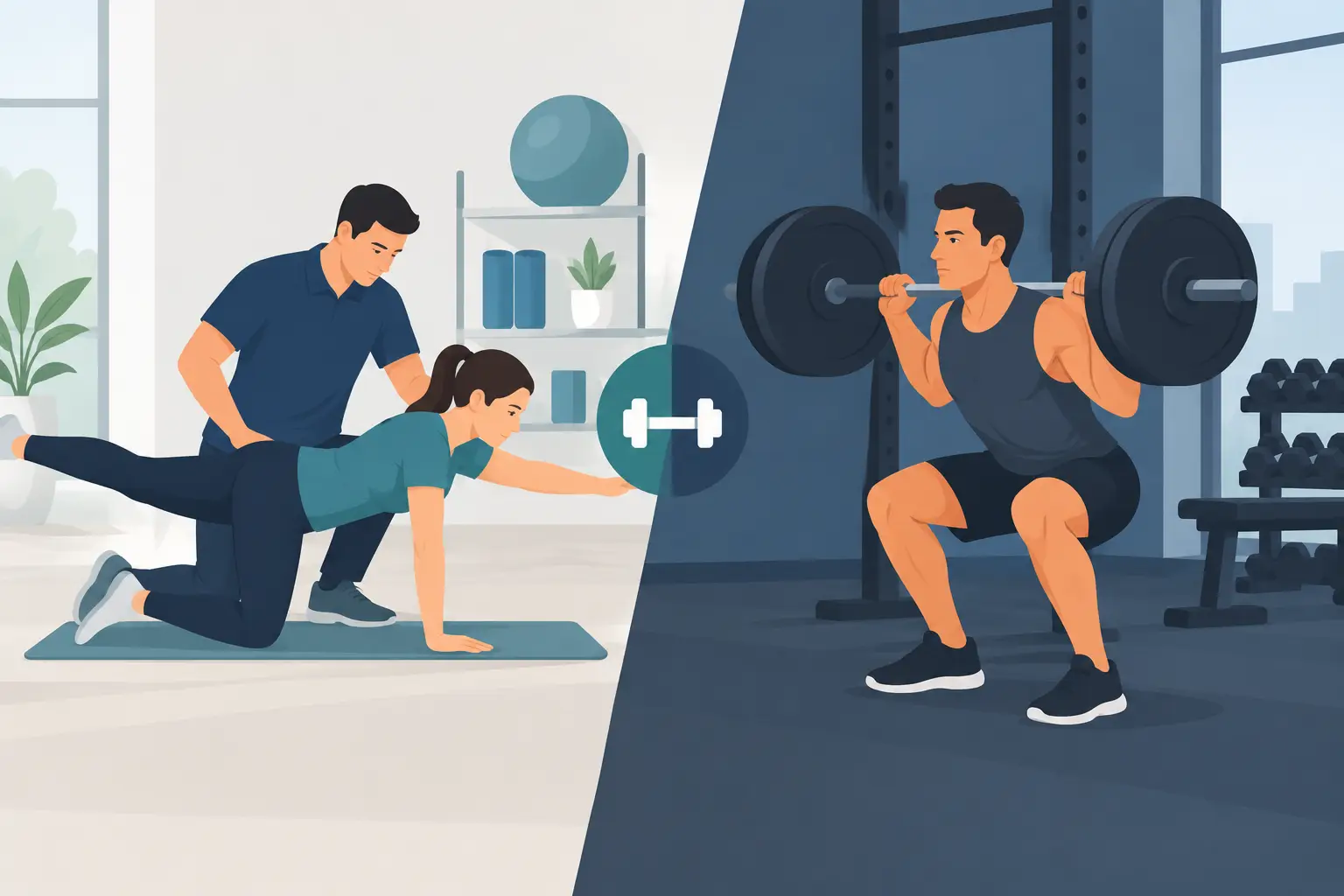
A squat, deadlift, or overhead press is not automatically a problem. But if your knee caves in every time you squat, your back tightens after deadlifts, or your shoulder pinches during presses, repeating the same workout harder rarely fixes the issue. The question of corrective exercise versus traditional workouts matters because the right choice depends on what your body needs before it can safely handle more load.
For active adults and athletes, the goal should not be choosing one approach forever. It should be building a body that moves well, gets stronger, and holds up for the activities you care about – whether that means golf, tennis, running, lifting, parenting, or competing.
What traditional workouts are designed to do
Traditional workouts are typically organized around fitness outcomes: gaining strength, building muscle, improving endurance, losing body fat, or increasing sport-specific capacity. They often include familiar movements such as squats, lunges, presses, rows, running intervals, and loaded carries.
When the exercises fit the person and are progressed appropriately, traditional training is highly effective. Progressive resistance training builds strength, preserves bone density, improves tissue capacity, and gives people more confidence in what their bodies can do. Conditioning develops the ability to work, recover, and perform for longer.
The limitation is not the workout itself. The limitation is applying a generic program to a body with unrecognized movement restrictions, poor load tolerance, an active injury, or a compensation pattern that has been repeating for months or years.
For example, a runner with limited ankle mobility may compensate by collapsing through the foot or rotating at the knee. A golfer with restricted thoracic rotation may pull extra motion from the low back. A lifter with poor shoulder control may turn every overhead press into a neck and upper-trap exercise. More reps can improve conditioning, but they do not necessarily address why the movement is breaking down.
What corrective exercise is designed to do
Corrective exercise is targeted training used to improve a specific movement limitation, muscle-control deficit, mobility restriction, or compensation strategy. It is not a random collection of band exercises, foam rolling, or light movements done at the end of a workout.
Effective corrective exercise starts with an assessment. The clinician or coach identifies what is limited, what is weak or poorly coordinated, which movements reproduce symptoms, and which compensations appear under load. From there, the plan may include mobility work, motor-control drills, positional strength, breathing strategies, balance training, progressive loading, or modifications to the activities that are currently aggravating symptoms.
The purpose is practical: create a better foundation for the movements you need to perform. If a client cannot control their pelvis during a single-leg task, the answer may not be to avoid all leg training. It may be to improve hip control, trunk stability, and load tolerance before progressing to heavier split squats, running, or cutting drills.
Corrective exercise should also be temporary and progressive. A drill that helps you find a better hip position is useful. Staying with the same low-level drill for six months while avoiding meaningful strength training is not a complete plan. The correction has to transfer into real movement.
Corrective exercise versus traditional workouts: the real difference
The clearest difference is the starting point. Traditional workouts ask, “How can we train this goal?” Corrective exercise asks, “What is preventing this person from moving and loading well enough to train that goal?”
Traditional training is usually performance- and fitness-driven. Corrective exercise is assessment-driven and problem-specific. One builds capacity through planned stress. The other improves the quality and tolerance of movement so that stress can be applied more effectively.
Neither approach is inherently superior. A healthy recreational lifter with no pain, full movement options, and good control may not need an extended corrective program. They need a well-designed strength program, enough recovery, and coaching that keeps technique honest.
On the other hand, someone who has recurring low back pain during workouts, a shoulder that hurts after tennis, or a knee that swells after runs may need more than a tougher workout or a few rest days. They need to understand the source of the limitation and follow a progression that restores confidence under load.
When traditional training can make a problem worse
Pain is not always a sign of damage, and soreness is not automatically a concern. But consistently training through sharp pain, increasing joint symptoms, swelling, numbness, instability, or pain that lingers well after activity is a poor strategy.
Training can also reinforce compensation. If you repeatedly load a pattern that your body cannot control, the stronger muscles may continue taking over while the limiting area never improves. This is why a person can be very fit and still struggle with one stubborn knee, hip, shoulder, or back issue.
The answer is not to make exercise fragile or fear normal loading. It is to match the load to your current capacity. Sometimes that means reducing range of motion, changing the exercise, slowing the tempo, improving the setup, or temporarily lowering volume. Those adjustments create room to rebuild rather than simply stopping all activity.
When corrective exercise alone is not enough
Corrective exercise can reduce pain and improve movement options, but it does not replace the need for strength, power, and conditioning. Mobility without control may not hold up under a heavy suitcase, a long run, a demanding workday, or a fast change of direction on the court.
This is where many rehab plans fall short. A person may feel better after a few weeks of manual therapy and basic exercises, then return to the exact activity that caused the problem without a bridge back to training. Symptoms often return because the body was never prepared for the actual demands of life or sport.
A better plan progresses from restoring motion and reducing irritability to building control, strength, and sport- or lifestyle-specific capacity. A runner should eventually run. A golfer should eventually rotate and swing. A parent with back pain should eventually lift, carry, and move confidently. The final phase has to resemble the goal.
How to know which approach you need right now
Start with your response to movement and loading. If you are training consistently, recovering well, and making progress without recurring symptoms, traditional workouts may be exactly what you need. A sound program can include mobility and technique work without becoming a corrective-focused plan.
Corrective exercise deserves more attention when pain repeatedly changes how you move, one side consistently feels weaker or less stable, range of motion is clearly limited, or you keep returning to the same injury after trying generic workouts. It is also valuable after surgery, during a return from a significant injury, and when pelvic health symptoms affect lifting, running, or daily activities.
The most useful question is not, “Which exercise is best?” It is, “What can I control today, and what dose of loading can I tolerate without worsening symptoms?” That answer changes as you improve.
The strongest plan combines both
At Back In Motion, the goal is not to keep someone in corrective work indefinitely or rush them into a high-intensity workout before they are ready. The Gray Method™ begins by identifying the movement limitations and loading problems that matter most, then progresses the plan toward durable strength and confident performance.
That may mean using targeted hip and trunk work before returning to heavier squats. It may mean rebuilding shoulder control before serving in tennis. It may mean helping a postpartum client restore pressure management and pelvic-floor coordination before returning to impact training. Every progression should have a reason, a measurable target, and a clear next step.
The best training plan is not the one with the most complicated exercises. It is the one that respects your current capacity while steadily expanding it. When movement quality and strength are developed together, your workout becomes more than a calorie burn – it becomes preparation for the life and sport you want to keep doing.
About the Author: Dr. Scott Gray




 Call (239) 788-0838