
Fitness Training for Adults Over 50 That Builds Strength
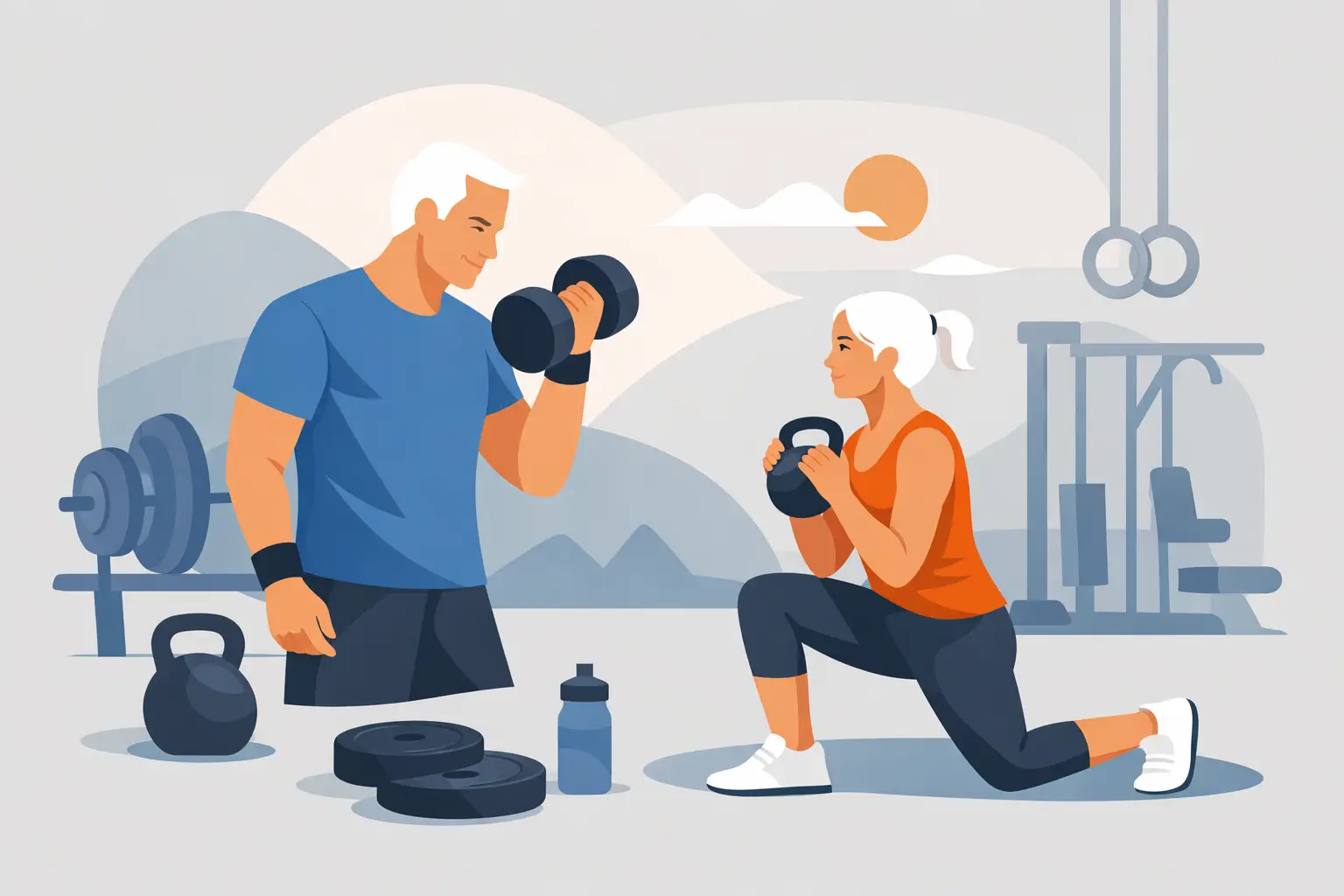
Turning 50 does not mean your training needs to become cautious, light, or limited to walking. It means fitness training for adults over 50 needs to become more precise. The goal is not simply to burn calories or survive a workout. It is to build the strength, mobility, balance, and confidence that let you keep golfing, playing tennis, traveling, lifting grandchildren, running, and handling everyday life on your terms.
The right program recognizes that your body has a history. Maybe a shoulder has bothered you since an old sports injury. Maybe your knees ache after pickleball, your back tightens after yard work, or you have lost confidence under a barbell after a period of pain. Those factors do not automatically take exercise off the table. They tell us where to start.
Why Training Changes After 50
Muscle mass, bone density, power, and balance can decline with age, especially when strength training is absent. The practical effects are easy to recognize: stairs feel harder, a round of golf creates more fatigue, and a minor tweak takes longer to settle down. Regular, well-designed resistance training directly addresses these changes.
But age alone is rarely the problem. The larger issue is often a mismatch between what the body can currently tolerate and what a person asks it to do. Someone may be active every day but still lack hip strength, ankle mobility, trunk control, or shoulder capacity for the activities they enjoy. Repeating the same workouts without addressing those gaps can keep the cycle going: exercise, flare-up, rest, restart, repeat.
A productive plan does not treat pain as a reason to stop moving forever. It identifies whether the limitation comes from mobility restrictions, poor load tolerance, movement strategy, recovery, or an injury that needs more focused care. Then it progresses training accordingly.
The Priorities of Fitness Training for Adults Over 50
The most effective programs are built around capacity, not random exercise variety. That begins with strength.
Strength protects independence
Strength training helps preserve the ability to rise from the floor, carry luggage, lift a bag of mulch, and maintain control when you trip or change direction. It also creates the physical reserve needed for recreational sports. A stronger set of legs and hips makes it easier to walk a hilly course, get lower into a tennis stance, or push through the final miles of a run.
Compound movements such as squats, hinges, rows, presses, carries, and step-ups are valuable because they train patterns people use in real life. The specific exercise matters less than the execution, loading, and progression. A goblet squat to a box may be the right starting point for one person, while another is ready for heavier front squats. Both can be training well.
Mobility should support the task
Mobility is not about becoming as flexible as possible. It is about having enough movement at the right joints to perform a task without forcing compensation somewhere else.
For example, limited ankle motion can change squat mechanics and add stress to the knees. Restricted thoracic spine movement can make overhead lifting or a golf swing feel awkward. Improving those limitations may reduce the need for the body to borrow motion from the low back, neck, or shoulders.
Stretching can help in certain cases, but mobility improves most reliably when it is paired with active control and strength. If you gain range but cannot control it under load, the change may not carry over to the activities that matter.
Balance and power deserve a place in the plan
Balance is not just standing on one foot near a countertop. It is the ability to control your body when conditions change. Single-leg strength, stepping drills, carries, direction changes, and uneven-surface demands all contribute to usable balance.
Power matters as well. Power is the ability to produce force quickly, which supports faster reactions, climbing stairs, catching yourself during a stumble, and athletic movements such as swinging a club or returning a serve. Power training does not have to mean high-impact jumping. It can begin with controlled sit-to-stands performed with intent, medicine ball throws, light kettlebell work, or low-level step movements. The right option depends on your joints, goals, and current capacity.
Start With an Assessment, Not a Generic Workout
A generic online plan cannot tell you why your knee hurts during a lunge, why your shoulder pinches overhead, or why your low back gets sore after deadlifts. It can offer exercises, but it cannot replace an evaluation of how you move.
A high-quality assessment looks beyond the painful area. If your hip hurts, the contributing factor may involve hip strength, but it may also involve foot control, trunk mechanics, training volume, or limited motion at the ankle. If your shoulder hurts, the answer is not always to stop pressing. It may be a matter of improving thoracic mobility, rotator cuff capacity, pressing technique, or the amount of load you are currently asking the shoulder to manage.
This root-cause approach is central to The Gray Method™ at Back In Motion. The process is designed to identify movement limitations, correct what is limiting performance, and build capacity through progressive training. That matters because a plan should not end when pain improves. It should continue until you can confidently return to the demands of your life and sport.
How Hard Should You Train?
Many adults over 50 are either undertraining because they are afraid of getting hurt or overtraining because they assume soreness is proof of progress. Neither approach is necessary.
Training should be challenging enough to create adaptation while remaining technically sound and recoverable. You should feel that you worked, but you should not consistently leave the gym depleted, unstable, or more painful for days. Mild muscle soreness can be normal, particularly when starting a new program. Sharp pain, worsening joint symptoms, swelling, numbness, or pain that changes how you move are different signals and deserve attention.
The best loading strategy depends on the person. Heavier resistance with fewer repetitions can build strength efficiently when technique and joint tolerance are solid. Moderate loads and higher repetitions may be more appropriate while learning a movement, rebuilding after injury, or managing irritated joints. There is no universal “safe” rep range for everyone over 50. The right dose is the one that matches your starting point and moves forward over time.
Progress can mean adding weight, performing another repetition, improving range of motion, moving with better control, or recovering more easily between sessions. These are measurable wins, even before the numbers on the dumbbells change.
Recovery Is Part of the Training Plan
Training creates the stimulus. Recovery is where your body adapts. Sleep, protein intake, daily movement, stress management, and sensible scheduling all influence results.
For many active adults, two or three focused strength sessions per week provide an excellent foundation. Walking, cycling, swimming, sport practice, and mobility work can fit around those sessions, but total volume still matters. A hard tennis match, a long bike ride, and a demanding lower-body workout may all challenge the same tissues in one week.
Rather than asking whether an activity is good or bad, ask whether your current body is prepared for its dose. That shift removes unnecessary fear while making overuse problems easier to prevent.
When Pain Is Already Limiting Your Workouts
Do not accept recurring pain as the price of staying active. If symptoms repeatedly stop you from training, playing your sport, or completing daily tasks, a more detailed evaluation can provide clarity.
The solution may include physical therapy, targeted mobility work, temporary exercise modifications, hands-on treatment, and a structured return to strength training. The key is that rehab and fitness should connect. Passive care alone may calm symptoms, but long-term confidence comes from restoring strength and tolerance for the movements that previously caused trouble.
For adults in Fort Myers who want to stay active for decades, the target is not a smaller version of their former life. Train for the life you want to keep living: strong enough for the unexpected, mobile enough for the activities you enjoy, and confident enough to keep saying yes when opportunity shows up.
About the Author: Dr. Scott Gray


Get Dr. Gray's Best-Selling Book, Free
Why pain keeps coming back, and how The Gray Method™ helps you fix it for good.
Send Me the Free BookOur Most-Read Articles
- 1Three Conditions That Mimic Sciatica PainBack
- 2The Great Plantar Fasciitis Debate: Why Boots & Cortisone Rarely Fix ItFoot
- 3Common Causes of Lower Back Pain: Herniated DiscBack
- 4The 3 Most Common Symptoms of Knee Meniscal TearsKnee
- 5What Is Hip Bursitis?Hip
- 6Pelvic Pain Explained: When It's Not a UTI but Feels Like OnePelvic
What Do You Need Help With?
- 🩺Back, neck & joint pain→
- 💪Fitness for adults 50+→
- 💙Pelvic health→
- ⚡Sports performance→
- ⛳Golf performance→
Talk to a Doctor of Physical Therapy
One-on-one care that finds the cause of your pain. Fort Myers, Cape Coral & Estero.
Inquire About an Appointment Or call (239) 223-0484
