
Does Active Rehab Versus Passive Treatment Work Better?
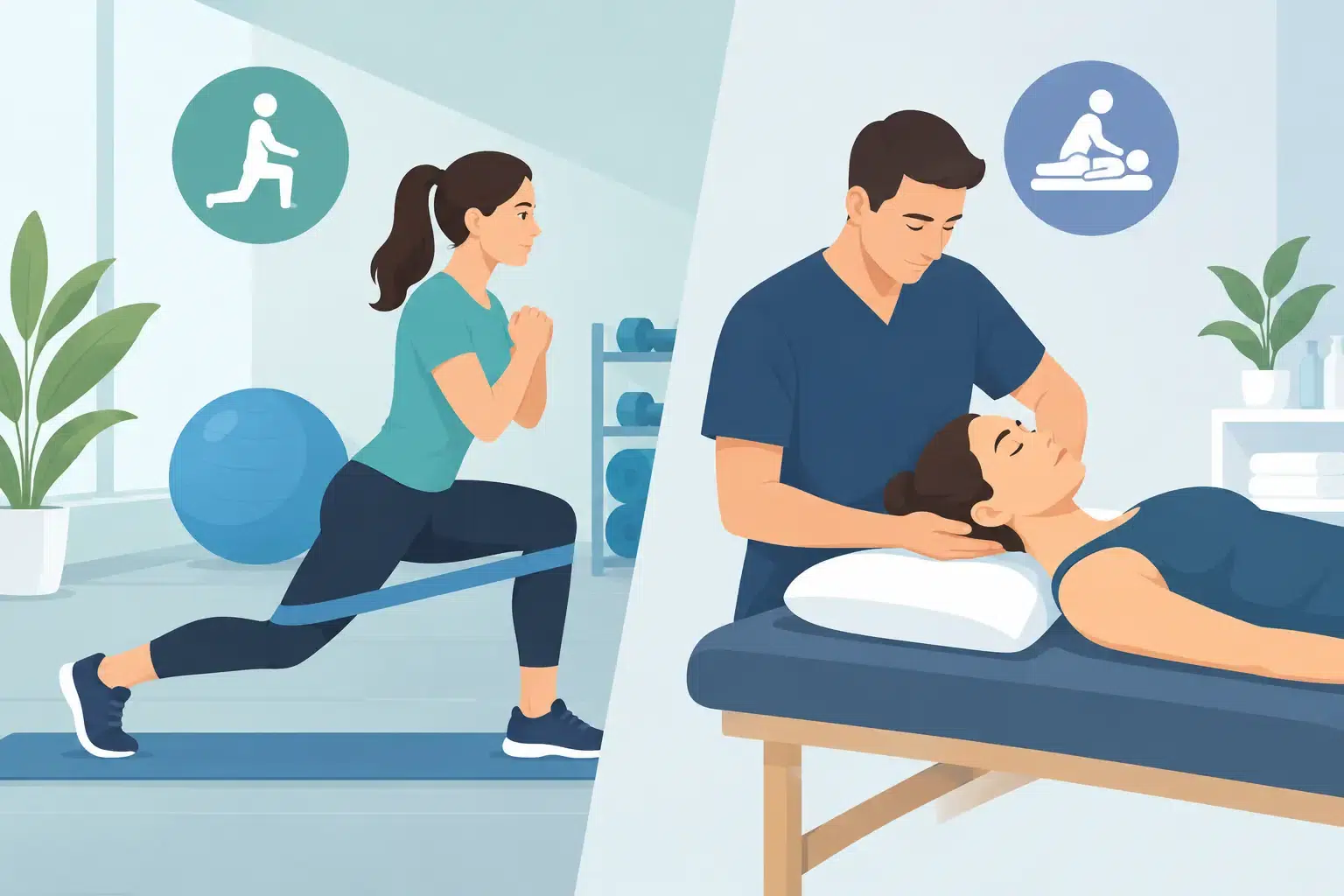
A runner with knee pain may feel better after massage, dry needling, or manual therapy. But if their hip control, training volume, ankle mobility, or running mechanics remain unchanged, that relief often fades at the next hard workout. That is the practical difference in active rehab versus passive treatment: one may calm symptoms, while the other builds the capacity to move, train, and live with greater confidence.
Passive care is not automatically bad, and exercise is not automatically the right answer on day one. The best plan depends on your diagnosis, irritability, goals, and current tolerance. The issue is relying on short-term symptom relief as the entire plan when your goal is to return to golf, lifting, tennis, running, work, or pain-free daily movement.
What Passive Treatment Can and Cannot Do
Passive treatment is care performed to you. It can include hands-on manual therapy, soft-tissue work, joint mobilization, dry needling, heat, ice, electrical stimulation, or traction. These interventions can reduce pain, improve comfort, and sometimes create enough mobility to begin moving better.
That matters. When pain is high, a shoulder is very stiff, or an acute injury has made normal movement difficult, a skilled clinician may use passive treatment to help settle the system and create a more comfortable starting point. For pelvic health concerns, for example, hands-on assessment and treatment may be appropriate when muscle guarding, sensitivity, or coordination problems are limiting function.
The limitation is that passive treatment does not automatically teach your body how to tolerate the demands that caused the problem. A massage cannot progressively strengthen your calf for running. An adjustment does not build single-leg control for cutting in soccer. Heat may ease low back stiffness, but it cannot prepare you to lift a child, carry groceries, or return to deadlifts.
Passive care is best viewed as a tool, not the finish line. If a treatment makes movement easier, that window should be used productively.
Active Rehab Versus Passive Treatment: The Core Difference
Active rehab asks you to participate in the solution. It uses purposeful movement, corrective exercise, strength training, balance work, mobility drills, motor-control training, and a gradual return to real-life or sport-specific demands. The goal is not simply to get you through today with less pain. The goal is to improve what your body can do tomorrow.
A quality active rehab plan starts with more than the painful area. Knee pain might involve limited ankle motion, weak or poorly timed hip muscles, reduced quad strength, a sudden jump in mileage, or poor tolerance to hills and speed work. Shoulder pain may be connected to thoracic mobility, scapular control, pressing volume, or weakness in specific positions. Low back pain may require a closer look at how you hinge, brace, rotate, recover, and load over time.
This is why generic exercise sheets often fall short. Two people can have the same diagnosis and need very different progressions. One person may need to restore range of motion before loading. Another may already have full mobility but lack strength and confidence under resistance. An athlete may need power, deceleration, and change-of-direction work before returning to competition. An active adult may simply need to squat, reach, walk, and sleep comfortably again.
At Back In Motion, this assessment-to-performance progression is central to The Gray Method™. The process identifies movement limitations, addresses the contributing factors, and then progresses treatment toward the activities that matter to you.
Why Strength and Exposure Matter for Lasting Results
The body adapts to the demands placed on it. When tissues have been irritated, deconditioned, or underprepared for a task, the answer is rarely permanent avoidance. It is usually a smart dose of the right stress.
That does not mean pushing through sharp pain or forcing a painful exercise because you were told to “tough it out.” It means finding an entry point you can tolerate, then progressing it with intention. A person recovering from Achilles pain may start with controlled calf raises, progress to heavier loading, then add hopping and running drills as symptoms and strength improve. Someone with a painful shoulder may begin with supported pressing variations, build capacity overhead, and eventually return to serving in tennis or lifting at the gym.
This process restores more than muscle strength. It improves coordination, confidence, tissue tolerance, and your ability to respond to unexpected demands. Those qualities matter when you step off a curb, swing a golf club late in a round, sprint after a ball, or spend a long day on your feet.
Progress should be measurable. Depending on the issue, that might mean greater range of motion, more repetitions at a given load, improved single-leg stability, better walking tolerance, fewer symptoms after activity, or a successful return to a specific drill. Clear markers replace guesswork and help determine when it is time to advance.
When Passive Care Has a Place
The choice is not always active or passive. In many cases, the strongest plan uses both, with active rehab doing the long-term work.
Passive treatment can be useful early in care when pain, swelling, stiffness, or muscle guarding make exercise difficult. It can also help after a flare-up, following an intense training block, or when a clinician needs to improve access to a movement pattern before loading it. The key question is simple: does this treatment help you move better and progress your plan?
If the answer is yes, it has value. If you feel temporary relief but return week after week without improved function, strength, mobility, or activity tolerance, the plan may be incomplete. You deserve an explanation of what is driving the problem and what will change beyond the treatment table.
There are also times when activity needs to be modified, not increased. A recent fracture, significant traumatic injury, post-operative restriction, neurological symptoms, unexplained swelling, fever, or worsening weakness requires appropriate medical evaluation and a carefully directed plan. Active rehab is not reckless exercise. It is informed, individualized progression.
What a Productive Rehab Plan Looks Like
A productive plan gives you clarity from the first visit. You should understand what movements or loads are currently limited, what the likely contributors are, and what the next phase of recovery requires. You should also know what is safe to keep doing. For many active people, maintaining some level of training is possible and beneficial when it is adjusted intelligently.
The exercises should have a reason. You may work on hip strength because it improves control during running, not because hip exercises are universally prescribed for knee pain. You may train trunk rotation because it supports your golf swing, or practice controlled landing because your child plays a jumping sport. The exercise selection should connect directly to your goals.
Your plan should evolve. Early rehab may focus on restoring motion and reducing sensitivity. The middle phase often emphasizes strength, control, and increased loading. Later stages should resemble the demands you are returning to: heavier lifting, longer runs, rotational power, faster change of direction, or repeated overhead activity. Stopping at basic band exercises is not enough for someone whose lifestyle requires much more.
Communication matters just as much. Symptoms can fluctuate during recovery, particularly when you increase activity. A knowledgeable physical therapist helps you distinguish between expected training discomfort and a sign that the dose is too high. That guidance prevents the two common mistakes: doing too little because you are afraid to move, or doing too much because you are eager to get back quickly.
Choose Care That Prepares You for Your Real Life
The right question is not whether manual therapy, dry needling, or exercise is “best” in every situation. Ask whether your care plan is moving you toward independence. Are you becoming stronger? Is your range of motion improving? Can you tolerate more of the activities you value? Do you know how to manage a flare-up without starting from zero?
For active adults and athletes in Fort Myers, the goal should be more than leaving an appointment temporarily looser or less sore. It should be returning to the gym, the court, the course, the trail, or your normal routine with a body that is better prepared than it was before.
Relief can be a useful first step. Lasting progress comes when that relief is paired with a precise plan, consistent movement, and the right amount of challenge. Your rehab should not make you dependent on treatment. It should teach you how to trust your body again.
About the Author: Dr. Scott Gray




 Call (239) 788-0838