Why Your X-Ray or MRI for Knee Pain Can Be Misleading
When people have knee pain, it’s common to hear phrases like “I have a torn meniscus” or “I’m bone-on-bone,” based on their X-ray or MRI. Many patients assume these findings mean they’re destined for surgery, or that their knee will only get worse without it. But relying only on your knee X-ray or MRI can be misleading, and it often leads to unnecessary surgery or over-treatment.
At Back In Motion Physical Therapy & Performance, we see a common pattern in knee pain patients: abnormal knee movement from hypermobility irritates the ligaments, meniscus and cartilage. If that movement problem isn’t addressed, it can progress into arthritis and chronic knee issues. Here’s why imaging doesn’t tell the whole story, what we commonly see in the clinic, and how fixing movement can resolve knee pain without surgery.
What We Commonly See: The Hypermobile Knee
Many of our knee pain patients show abnormal knee movement, which we call knee hypermobility. The knee moves too much relative to the hip and ankle, causing uneven stress on the ligaments, meniscus and cartilage. Here’s what happens:
- The knee compensates: the hip or ankle may be too stiff or weak, forcing the knee to move too much
- Tissues get irritated: that extra movement irritates the ligaments, meniscus and kneecap cartilage
- Wear builds up: over time, the abnormal pattern can lead to arthritic changes in the joint
Example: Hyperextension and Meniscus Stress
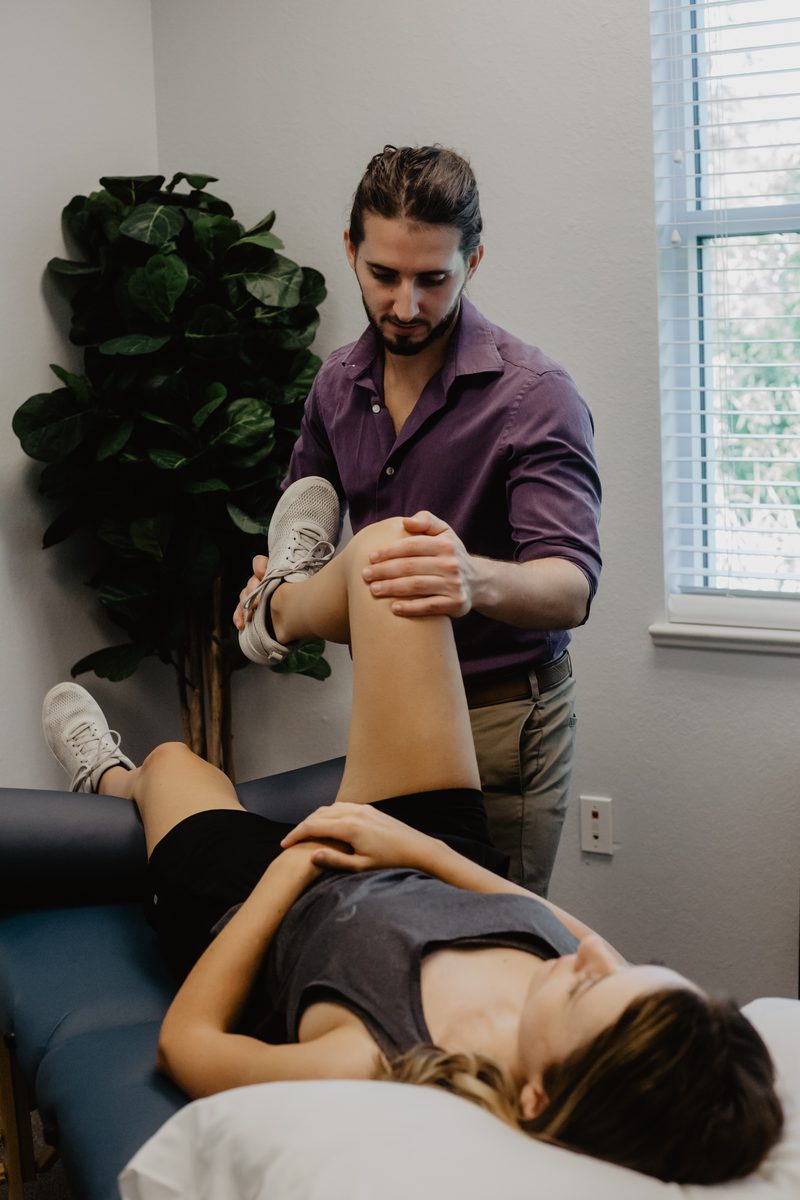
We often see patients with hip knee hyperextension syndrome (HKE), where the knee straightens too far before the hip does its job during walking or running. This puts excess stress on the meniscus and ligaments, which may show up on an MRI as a meniscus tear. But the tear may not be the main cause of the pain. The movement dysfunction is. We explain HKE and two other common patterns in the most common causes of knee pain.
Why Imaging Findings Don’t Always Match Your Pain
One of the biggest misconceptions is that what you see on an X-ray or MRI directly explains your pain. Research shows that many people with abnormal imaging findings have no pain at all.
What the science says: a large study of adults aged 50 to 90 published in the New England Journal of Medicine found that meniscus tears on MRI were common, and that many of the people who had them had no knee pain, aching or stiffness (Englund et al., 2008). Degenerative changes like arthritis are also often seen in people with no symptoms.
What this means: many patients who are told they have a meniscus tear or cartilage degeneration based on an MRI don’t need surgery. Instead, they need to fix the movement problem that is overloading the knee. If you’re worried about a tear, read about the three common symptoms of knee meniscal tears.
Why “Bone-on-Bone” Arthritis Is Often Misunderstood
Many patients are told they’re “bone-on-bone” because their X-ray shows joint space narrowing. That phrase is frightening, and it can make joint replacement feel inevitable. But research shows that joint space narrowing doesn’t always match pain or disability.
What the science says: a large U.S. population study found substantial mismatch between X-ray changes of knee osteoarthritis and knee pain: many people with arthritis on X-ray had no knee pain, and many people with knee pain had little on their X-ray (Hannan, Felson and Pincus, 2000).
What this means: even if your X-ray shows narrowing, it doesn’t mean you’ll be in constant pain or that surgery is necessary. Correcting muscle imbalances and movement impairments can often ease knee pain and improve how the joint works. Read more in why knee pain today doesn’t mean knee replacement tomorrow.
How Hypermobile Knees Lead to Pain (and Arthritis Over Time)
The knee joint is designed to be stable, with the hip and ankle providing most of the movement when you walk, run and play. When the knee becomes hypermobile, it starts moving in ways it shouldn’t, which wears on the ligaments, meniscus and cartilage. If this isn’t corrected, the extra movement can cause:
- Ligament irritation: leading to chronic knee instability
- Meniscus tears: from uneven stress
- Cartilage damage: leading to patellofemoral pain syndrome
- Arthritic changes: as the joint takes on long-term stress
When to Get Your Knee Checked Right Away
- A locked knee: the knee is stuck and won’t straighten
- Can’t bear weight: you can’t walk normally on the leg
- Rapid swelling: the knee swells quickly after an injury
- After a fall or hard twist: especially with a pop
- Fever or redness: a hot, red, swollen knee
Why You Should Focus on Movement, Not Just Imaging
At Back In Motion, we focus on fixing the cause of knee pain, not just treating what’s seen on an X-ray or MRI. Our assessments identify the abnormal movement patterns and muscle imbalances that make the knee move too much. We commonly see:
- Tibiofemoral rotation syndrome: the knee twists too much
- Hip knee hyperextension syndrome (HKE): the knee locks out too early
- Lack of inferior glide of the patella: the kneecap doesn’t glide properly as the knee bends
By correcting these dysfunctions, we can help reduce pain, improve joint stability and lower the risk of future arthritis and joint damage.
References
- Englund M, Guermazi A, Gale D, et al. Incidental meniscal findings on knee MRI in middle-aged and elderly persons. New England Journal of Medicine. 2008;359(11):1108-1115.
- Hannan MT, Felson DT, Pincus T. Analysis of the discordance between radiographic changes and knee pain in osteoarthritis of the knee. Journal of Rheumatology. 2000;27(6):1513-1517.
Imaging Alone Doesn’t Tell the Whole Story
X-rays and MRIs can provide useful information, but they don’t always explain your pain. Our knee pain treatment in Fort Myers uses The Gray Method™ to find and fix the movement problems behind it, one-on-one with a Doctor of Physical Therapy, at our clinics in Fort Myers, Cape Coral and Estero.
Start with our Fixing the Cause & Not Just the Symptoms Assessment, or Inquire About an Appointment →
Call our office at (239) 223-0484 to schedule your appointment.
About the Author: Dr. Scott Gray


Get Dr. Gray's Best-Selling Book, Free
Why pain keeps coming back, and how The Gray Method™ helps you fix it for good.
Send Me the Free BookOur Most-Read Articles
- 1Three Conditions That Mimic Sciatica PainBack
- 2The Great Plantar Fasciitis Debate: Why Boots & Cortisone Rarely Fix ItFoot
- 3Common Causes of Lower Back Pain: Herniated DiscBack
- 4The 3 Most Common Symptoms of Knee Meniscal TearsKnee
- 5What Is Hip Bursitis?Hip
- 6Pelvic Pain Explained: When It's Not a UTI but Feels Like OnePelvic
What Do You Need Help With?
- 🩺Back, neck & joint pain→
- 💪Fitness for adults 50+→
- 💙Pelvic health→
- ⚡Sports performance→
- ⛳Golf performance→
Talk to a Doctor of Physical Therapy
One-on-one care that finds the cause of your pain. Fort Myers, Cape Coral & Estero.
Inquire About an Appointment Or call (239) 223-0484