Patient Case Study: How Tom Put An End To His Lower Back Pain
If you live in Southwest Florida, you know how popular golf is here. From the youth athlete, to a group of businessmen closing a deal, to the retired couple picking up a new hobby together, golf is a game for everyone at every level.
It can help relieve stress (or cause it after a bad round), keep you active, and it’s a great way to socialize with your friends.
However, golf can be and often is a source of injury and pain. Many golfers have to take time off from playing or play less often than they would like because of pain. Some who love the game have had to avoid it altogether because of injury.
Have you ever heard someone you know say “If it hurts, just stop doing it?”
Well, if that something is golf or another activity that you really enjoy, I say “don’t stop; let’s find out why it hurts and fix it, or at least find a way around it, so you can keep doing what you love.”
Here is the story of how one of my clients, Tom, was able to put an end to his chronic lower back pain while golfing.
Tom Had Lower Back Pain Every Time He Played Golf
Tom is retired, a member of a local golf club here in Fort Myers, and an avid golfer. He plays in his men’s league and has a low handicap, which means he’s a very good golfer.
As with any sport, golf requires repetitive and efficient practice to maintain a good score. This requires a lot of muscle strength and endurance, as well as really good mobility of the joints in the hips and the vertebrae of the spine.
Since golfing can be an explosive and torque-producing activity, it puts a lot of stress on the spine, and injuries and joint pain are quite common among golfers.
In golf, the hips and thoracic spine can become extremely tight, forcing the lower back to compensate for this loss of motion and increased torque. This makes the golfer more susceptible to low back compression and torsion-related injuries.
Tom was one of those golfers. Tom would have lower right back pain every time he played.
The pain wasn’t terrible when he started the round, but by the time he was on the turn (after 9 holes), the pain would start causing him to change his swing, take a few shots off, or sometimes even force him to quit altogether.
Tom was not ready to give up golf because of his back pain. He tried physical therapy, chiropractic, and injections from MDs.
He said all of those options helped in the short term, but nothing solved his pain when he got back out onto the course.
Without specialized knowledge and experience, it can be difficult to pinpoint the exact cause of this type of condition and provide the right treatment for it. That’s what Back In Motion Physical Therapy & Performance was able to provide to Tom: specialized care, unlike the generalist approach other healthcare providers had offered him in the past.
Tom knew something had to be out there that could help him. He contacted Back In Motion, hoping it would be what he was looking for. He found out that he was in the right place at his very first appointment.
Tom’s Initial Evaluation
Back In Motion has its own diagnosis and treatment process called The Gray Method™, named after its founder, Dr. Scott Gray.
It starts with a general and then expands to a specialized evaluation, to provide an accurate diagnosis of the patient’s issue. This method does not stop with the diagnosis; it digs deeper to find the precise root cause for the condition.
The thing with muscle and joint injuries is that they can be caused by a lot of different incidents or physical conditions. A back problem can be caused by things like muscle strain, tendonitis, stenosis, discs, ligament strains, arthritis, and fractures.
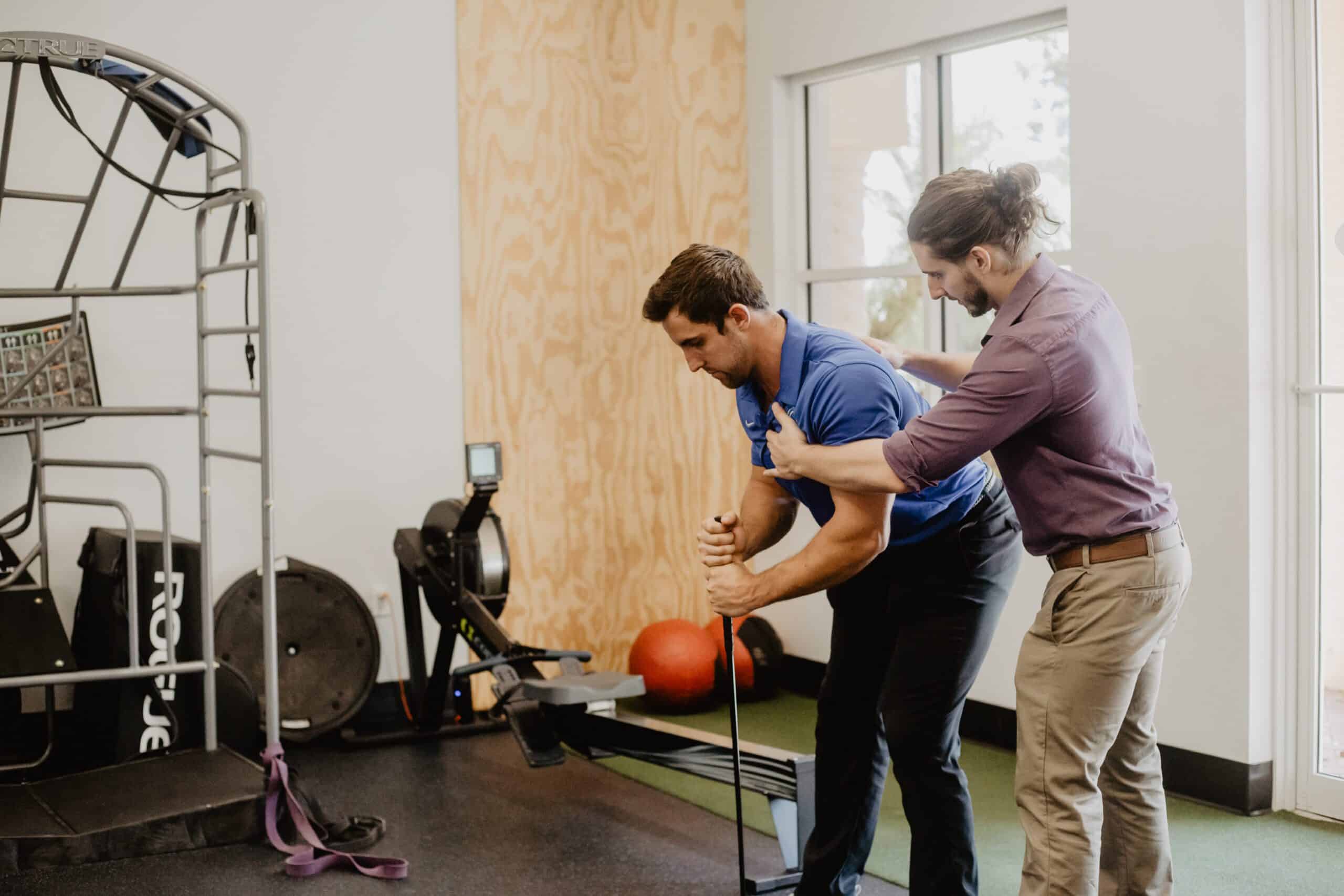
In Tom’s case, it was right-sided facet compression and arthritis.
Facet arthritis refers to the breakdown of the small joints in the spine that connect two vertebrae together. There is one facet joint on the left and right sides of each spinal segment.
Tom’s lateral facet joint was inflamed, and that was the reason he couldn’t golf as freely as he wanted to.
Fixing the Cause
After the extensive evaluation process, we found that Tom’s pain was due to increased compression and torsion of the right-side facet joints of the lower lumbar spine during the golf swing.
This was due to compensation in Tom’s swing that actually stems from immobile and weak hips.
Tom showed what in golf we call early extension and sway during his swing. These two swing faults cause a golfer to side bend and extend too much in the spine, creating a significant increase in compression.
With someone like Tom, who already has arthritis in his spine, this increase in compression can irritate the joint and create pain both during and after golf.
The treatment was therefore designed to help him strengthen his glute muscles and improve his hip rotation, allowing a more freely moving golf swing and some decompression of the spine, which allows the joint to heal properly.
Stretching exercises for the opposing muscles and exercises to strengthen the lateral hips were also prescribed.
Facet joint injuries can be tricky to deal with. They are usually caused by increased compression, lack of joint fluid movement, and inadequate mobility and stability of the spine. These joints depend on proper movement mechanics and stabilization from the surrounding muscles.
Resting the joint is only going to reduce the pain and heal the tissue until it is put into that provocative position again. Facet injuries usually need careful examination and continuous observation to keep the treatment consistent with the level of progress being made.
We designed specialized exercises focused on strengthening the hip muscles, increasing trunk stability, and building enough mobility to let golfers like Tom keep golfing.
We started with a logical sequence of low load and higher repetitions, then evolved the program to become more dynamic and explosive over time, to support Tom’s favorite sport: golf.
By identifying and dealing with the root cause of the problem, the hip muscle weakness, we were able to make sure the pain would not come back under the same circumstances.
How Is Tom Doing Now?
After about 8 weeks of thorough physical therapy and care, Tom is now back to golfing pain-free!
He now has the toolset to maintain his health, stay active, and remain competitive on the course.
If golf is where your back hurts, read 5 tips for a pain-free golf swing and how to fix lower back pain when squatting, which covers the same hip and spine mechanics. Our sports physical therapy for golfers and golf swing analysis look at the whole swing, not just the sore spot.
Get Back on the Course Without Back Pain
Are you suffering from a problem like this or something similar? Our back pain treatment in Fort Myers starts with The Gray Method™, one-on-one with a Doctor of Physical Therapy, at our clinics in Fort Myers, Cape Coral and Estero.
Start with our Fixing the Cause & Not Just the Symptoms Assessment, or Inquire About an Appointment →
Call our office at (239) 223-0484 to schedule your appointment.
About the Author: Dr. Scott Gray


Get Dr. Gray's Best-Selling Book, Free
Why pain keeps coming back, and how The Gray Method™ helps you fix it for good.
Send Me the Free BookOur Most-Read Articles
- 1Three Conditions That Mimic Sciatica PainBack
- 2The Great Plantar Fasciitis Debate: Why Boots & Cortisone Rarely Fix ItFoot
- 3Common Causes of Lower Back Pain: Herniated DiscBack
- 4The 3 Most Common Symptoms of Knee Meniscal TearsKnee
- 5What Is Hip Bursitis?Hip
- 6Pelvic Pain Explained: When It's Not a UTI but Feels Like OnePelvic
What Do You Need Help With?
- 🩺Back, neck & joint pain→
- 💪Fitness for adults 50+→
- 💙Pelvic health→
- ⚡Sports performance→
- ⛳Golf performance→
Talk to a Doctor of Physical Therapy
One-on-one care that finds the cause of your pain. Fort Myers, Cape Coral & Estero.
Inquire About an Appointment Or call (239) 223-0484