5 Myths About the Golf Swing
Every golfer has heard the advice: keep your head down, lock that left arm, slow it down. Most of it is passed along with good intentions. Some of it quietly hurts your game, and some of it hurts you.
Our team regularly sees Fort Myers golfers whose back, neck or shoulder pain started when they forced their body into a “correct” position it wasn’t built for. Here are 5 golf swing myths worth leaving behind, and what to focus on instead.
Myth #1: “The Bigger the Swing, the Better”
This myth sends plenty of golfers to our clinic. It’s easy to see why it sticks: tour pros make big, full swings on TV.
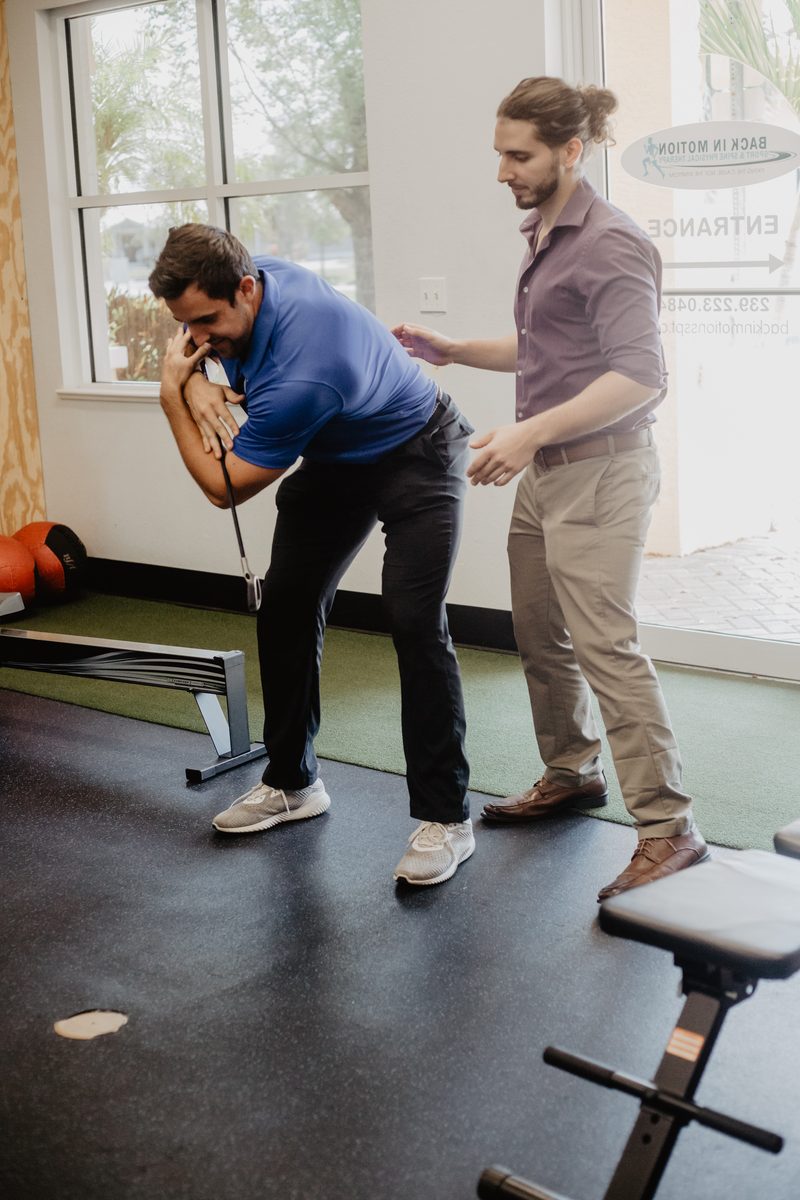
But if you aren’t well conditioned for golf, or you lack flexibility, chasing the biggest swing you can make throws off your coordination and posture and puts extra strain on your spine. Your lower back ends up making the turn your hips and upper back can’t.
Instead, swing from the ground up. Your lower body should start the forward swing while the club, hands and arms are still moving to the top. A swing that fits your current range will be more controlled, and usually longer, than one that overreaches. A golf swing assessment can measure how much hip and upper-back turn you really have.
Myth #2: “Slow Down!”
When your swing feels off, slowing down seems like the answer, so you can concentrate on getting it right. But a slow swing isn’t a better swing. It’s the same swing, just weaker.
Speed is what makes power. To swing fast with good technique:
- Warm up first: arm circles, trunk rotations and dynamic stretches prepare you for speed (try our golf warmup exercises)
- Train power: lunges and explosive lifts build speed, balance and coordination
- Build mobility: a body that can turn freely doesn’t need to slow down to stay in control
Myth #3: “Keep Your Head Still and Down”
Nearly every golfer has heard this one, and it’s a common thread among golfers who come to us with a sore neck.
Your head weighs roughly 8 to 12 pounds, and the swing happens fast. Lifting your head too early would take real effort, so it’s rarely the cause of a bad shot. Locking your head down, on the other hand, restricts the turn and the follow-through, limits your posture, and strains the neck.
Holding the head rigidly down is also one of the most common reasons for a bent lead arm at impact, which leads to the next myth.
Myth #4: “Lock That Left Arm!”
A fairly straight lead arm (the left arm for a right-handed golfer) usually makes more power than a collapsed one. A locked arm is another story. Forcing it straight creates tension in the shoulders and neck and a stiff, restricted swing.
Keep the lead arm relaxed, let your head move naturally, and turn as far as you can without losing posture. If the arm isn’t perfectly straight, that’s okay. Several successful tour players have played with a noticeably bent lead arm. Working with your own flexibility beats forcing a “rule”.
Myth #5: “Roll the Wrists Through Impact”
Impact lasts a tiny fraction of a second, so trying to roll your wrists through it is a sure way to overcomplicate the swing. You end up sacrificing the big pieces to chase a small one.
Squaring the club is mostly about how you hold it. Grip firmly but not too tightly, and your wrists will release naturally.
A Better Way to Play: Focus on the Big Picture
Once you drop these myths, focus on what actually drives a pain-free golf swing:
- Upper back rotation: so the lower back doesn’t do the work
- Hip turn: so you can load and clear the hips
- Balance: so you can finish every swing in control
- Core strength: to transfer force from the ground to the club
- Separation: the ability to move your trunk and pelvis independently
Our mobility exercises for golfers train exactly these qualities.
When to Get Your Swing Pain Checked
Playing through pain can turn a nagging ache into a real injury. See a professional before your next round if you notice:
- Pain that travels: into a leg or arm, or numbness, tingling or weakness
- Neck pain with headaches: or dizziness after you play
- Sharp pain with rotation: in the back, hip or shoulder
- Pain that lasts for days: or wakes you at night
Enjoy Pain-Free Golf
Pain and stiffness keep you from your best golf and can lead to bigger injuries. Our golf swing analysis looks at how your body moves through the swing, then we fix the cause with The Gray Method™, one-on-one with a Doctor of Physical Therapy at our clinics in Fort Myers, Cape Coral and Estero.
Start with our Fixing the Cause & Not Just the Symptoms Assessment, or Inquire About an Appointment →
Call our office at (239) 223-0484 to schedule your appointment.
About the Author: Dr. Scott Gray


Get Dr. Gray's Best-Selling Book, Free
Why pain keeps coming back, and how The Gray Method™ helps you fix it for good.
Send Me the Free BookOur Most-Read Articles
- 1Three Conditions That Mimic Sciatica PainBack
- 2The Great Plantar Fasciitis Debate: Why Boots & Cortisone Rarely Fix ItFoot
- 3Common Causes of Lower Back Pain: Herniated DiscBack
- 4The 3 Most Common Symptoms of Knee Meniscal TearsKnee
- 5What Is Hip Bursitis?Hip
- 6Pelvic Pain Explained: When It's Not a UTI but Feels Like OnePelvic
What Do You Need Help With?
- 🩺Back, neck & joint pain→
- 💪Fitness for adults 50+→
- 💙Pelvic health→
- ⚡Sports performance→
- ⛳Golf performance→
Talk to a Doctor of Physical Therapy
One-on-one care that finds the cause of your pain. Fort Myers, Cape Coral & Estero.
Inquire About an Appointment Or call (239) 223-0484